What’s the right amount of worldbuilding for your story? Maps, architecture, magic, religion, language, myth? The answer… it depends.
In this clip from our last episode of the Ask an Anthropologist About Worldbuilding livestream, I break down how to decide what’s essential for your story, whether you’re writing a 6,000-word short or the first book in a multi-volume epic.
Want help with your worldbuilding? Join us on February 3rd and I’ll field your questions. Can’t make it that day? Put your questions in the comments and I’ll do my best to address them. Click here for the next livestream episode (or watch the replay if you’re seeing this after February 3rd)
How do we create identities? How do we decide what kinds of things are taboo in society? How do we know what is clean or dirty? Have you ever thought about the fact that sometimes, we reinforce our choices and values through rebellion and/or opposition?
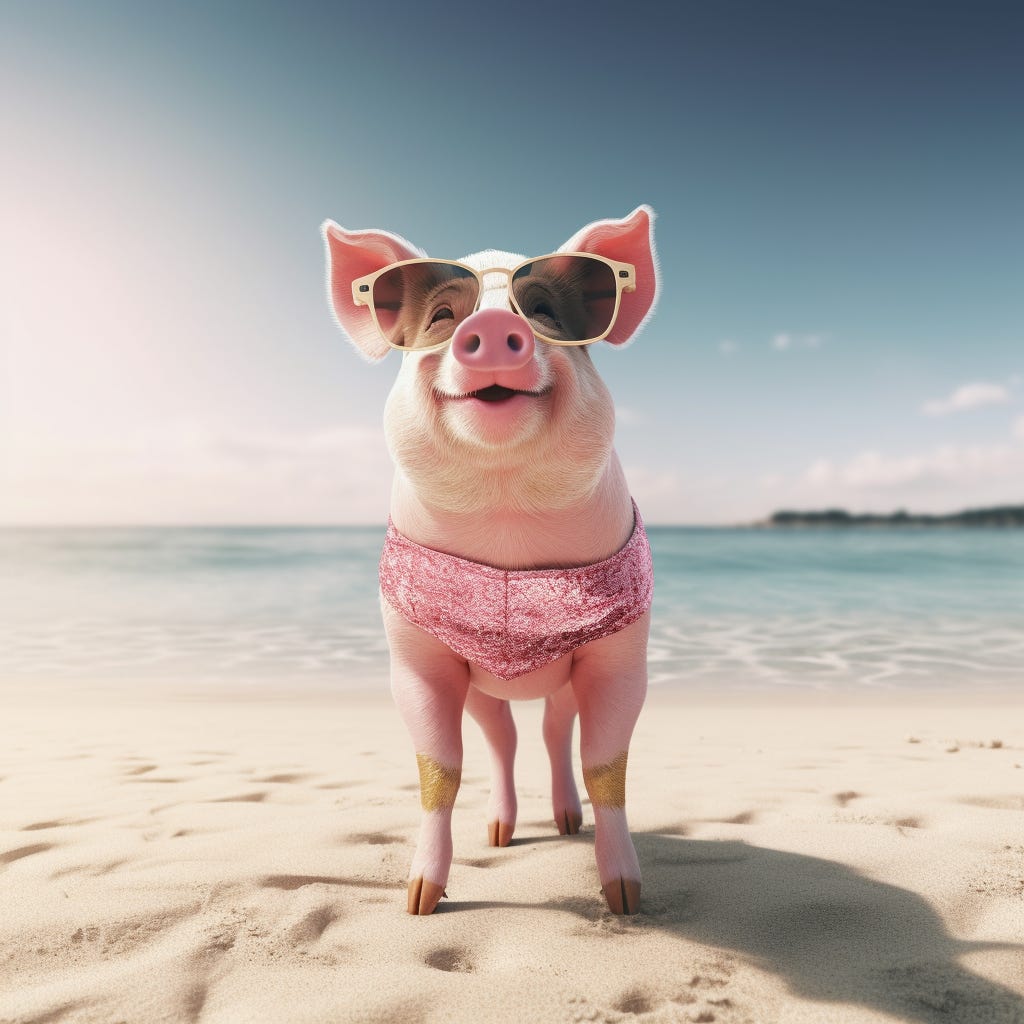
It might be obvious why some things are taboo, or at least there is some sense of rationalism surrounding those ideas. It’s taboo to eat out of the garbage, since the likelihood you will get sick is high and that’s where we put the things we wish to discard. But why are there taboos surrounding colors of clothing or beards, or types of clothing or lack of clothing? Is there a rational reason a man can’t wear a bright pink bikini on a hot summer day in American society? Why does this make us uncomfortable? Is there a reason that it’s not considered manly? Keep in mind, by reason, I mean an objective scientific one. Don’t worry, you’re not going to find a picture of me in a bright pink bikini below, I promise. But when you’re building a fictional world, understanding why a society formulates taboos and norms can be really useful.
In this entry on worldbuilding, we are going to examine a way to think about how people form their identities and cultures using the concept of schismogenesis.
Coined by Anthropologist Gregory Bateson in the 1930s, the term schismogenesis means essentially creation through division. By looking at your identity and behavior, I acknowledge how we are different, and thus solidify who I am. This often manifests as opposition. The most obvious form of schismogenesis is the rebellion of teenagers, who form their identity based on challenging acceptable behavior. Through opposition, they create identity. But this isn’t just a teenager thing, cultures and people do this all the time. It’s why suppressing differences, can actually make them stronger. The identity becomes more legitimate, more solid, because you fight against it.
Let’s return to bikinis.
I (apparently) am the kind of man who wears a bright pink bikini in public, and you, (assuming you’re a male in this example and of the status quo in American society) do not. Thus, I am behaving inappropriately in society, and you are not. You, will try to get me to conform. You will probably mock me for my strange behavior. You may seek to make me feel ashamed of wearing my bright pink bikini out in public. I will do one of two things. Either, I will capitulate, and take off my bikini and switch to the culturally acceptable norm of swimming trunks, or I will continue my rebellion and seek to recruit others who think like me. Thus, I will form my identity through opposition.
These kinds of things happen every moment of every day across every culture. Power and resistance are constantly in play on every level. Think of all the debates going on right now in your culture about what people should and should not do. There are hundreds of topics to choose from.
Let’s look at a more serious example. Take the pork taboo. Lots of people speculate why both Jews and Muslims have a pork taboo. People have puzzled over this idea for centuries. This isn’t just limited to Jews or Muslims either. Why do some cultures say that certain foods are clean, and others are dirty? There are entire lists of foods that people eat in one location in the world, but gag just thinking about them in another.
(Note: If you want to read a whole book on this topic and you are an anthropology nerd, consider Mary Douglas’s award winning 1966 book Purity and Danger: An Analysis of the Concepts of Pollution and Taboo)
But why pork? Well, if you ask a Jew or a Muslim, the answer you’ll likely get is that pigs are filthy animals. They are living garbage disposals and love to live in their own shit and piss and eat whatever you put in front of them. Why, they ask, would you eat such a creature as this?
The reality though, is that pigs are not like this out in the wild. In fact, when I was doing research in a rural village in Mexico in the northern state of Nueve Leon back in 2008, the pigs they had in those villages were far from disgusting or dirty. They grazed in fields alongside the other animals and ate similar things. They didn’t live in mud, they lived alongside all the other animals. So the filthy ‘nature’ of the pig that is the central complaint of the taboo is something artificially created by human action, not nature. Often cultures and people will come up with logical explanations for their taboos to justify their practices.
That doesn’t mean we should disrespect our Jewish or Muslim friends by forcing pork on them. Every culture has things it forbids that defy rationality or reason. We all have superstitions and traditions that aren’t based on evidence. The point here is not to judge, but to understand how this works to better assist you in building fictional worlds.
One possible explanation for the pork taboo is schismogenesis. In the ancient world, there was a period for the Jewish people known as the Babylonian Captivity or the Babylonian Exile. Many Jews were forced to live under the control of the Babylonian empire after the Babylonians conquered the Kingdom of Judah beginning first around 598 BCE. The Babylonians captured and enslaved many of the Jewish people.
There were two large staples of the Babylonian diet that both became taboo under the Kashrut, the dietary restrictions of the Jewish people. The first was pork, and the second was horse. Both foods were common in Babylon at the time. The enslaved Jews did not consume this food previously. Thus, as their enslavement continued, they ate foods similar to that of their homeland, and not of those who enslaved them. This certainly contributed in at least some way to the prohibition, though it may not have been the only cause.
But here we see, at least in part, schismogenesis in action. The Jews, under the yoke of an oppressor, didn’t want to partake in the food of those who had enslaved them, hence, their identity surrounding their food taboo. Several generations lived under these conditions, then, when the Persians conquered the Babylonians and allowed Jews to return to Palestine, many of those ideas circulated into the wider culture. Food is common as an important identity marker in many cultures, this is especially true in populations that have been historically oppressed.
Now again, there are many debates on the pork taboo, and this is only one possible explanation. In fact, most cultural taboos and restrictions can come from several causes at once. But, schismogenesis is useful because it helps clear up confusion in a culture. If the enemy other is doing something, and you don’t want to be like the enemy, then you can avoid doing that thing. This solidifies who you are as a culture and with it, identity. In our case, it helps create more complex fictional characters.
Here are few things to consider if you want to employ the concept of schismogenesis in your fictional world.
1. What are the core values of each of the fictional cultures you are building?
If you’re setting up a world where multiple major cultures will fight for control, then the first place to begin is where their core values lie.
– What kinds of things are important to your culture?
– What taboos do they have?
– What things to they exaggerate or emphasize about their adversaries?
– What qualities do they wish to cultivate in individuals on an ideal level?
If you take these things and sketch out what each culture is doing in these worlds, you will have a good place to see potential conflict between the different ideas of morality and/or taboo in the cultures.
This is especially true if you have a culture that has been conquered by another. Acts of rebellion don’t end at violence or protest. They can manifest in everyday experiences. In fact, when you stress a culture out, there is always a core group of people who will try to preserve important elements of their culture, hence, the rise of fundamentalists. They want to go back to the way things were before the changes came. It doesn’t matter that you can never truly return to the way things were, people want that old sense of safety and security of their cultural norms.
This is why we see groups like the Amish, whose very existence is in opposition to the changes wrought by modern technology. I grew up in part on the east coast, and not far outside of Philadelphia, it was common to see the Amish on the road in their horse and buggy, slowing down traffic. The way they choose to live is a form of schismogenesis. It might not feel subversive to us to live in that way, but to them, it is.
Which brings me to another point. Cultures aren’t homogeneous. There are all kinds of diverse approaches and ways to live within cultures. Be sure to consider that as you highlight the values and taboos of the larger culture above. You will want some wiggle room for resistance, for factionalism, even as larger conflicts between nations are happening. People disagree on pretty much everything, and sometimes that disagreement is a huge part of their identity.
2. The minor differences matter
Yes, your cultures will argue over the big stuff. But the minor differences matter too. Every culture has a different protocol for body language, for dress, for the kinds of sounds and colors they like and dislike, and so on. Every little thing you do comes from making comparisons against others. While we focus on the things we like and enjoy, we often spend even more time on the things we don’t like or find disgusting as ways of acknowledging who we are.
Small things like how a culture eats can mark identity. Much of Europe didn’t adopt forks until the 17th or 18th century (depending on what region) because they were considered either unmanly or excessive. Just imagine, someone, at some point, was complaining about how feminine it was to use a fork. Yes, that really happened. Someone else decided to use a fork anyway, probably a teenager.
Even generations within cultures employ schismogenesis. Think about what different generations say about each other. I’m a millennial and hear constant complaints from older generations about us. I’m almost forty now, so obviously millennials aren’t that young anymore. I’ve noticed that there are a lot of complaints among my fellow millennials about Zoomers already. We make constant comparisons about all the little things we do differently.
You don’t have to pick big things for schismogenesis, in fact, sometimes a lot of little things add up to create stark differences. Remember, as I’ve said repeatedly in these entries, and in my book Build Better Worlds, culture is a performance. It’s a way of enacting practices to mark who you are and what you value. That isn’t just the big stuff, it’s all the little things too.
3. Living within a cultural script
Every culture has a kind of script, a set of rules to live by that are both formal (laws) or informal (norms). Some cultures (like our own) make the concepts of choice and freedom paramount to their core values. But if you step outside the bounds of their norms, there are still all kinds of ways you can be disenfranchised. Think of the debates surrounding the right way to be a man in our own society. Forks and pink bikinis aside, these discussions aren’t about objective truth.
In fact, the irony of this discussion is that if choice and freedom were truly at the center of the debate, there wouldn’t be arguments about what makes a “real man”. Men would just go out and do whatever they wanted and that would be manly. These same scripts that proscribe masculinity limit agency (freedom of movement within a culture). There’s no freedom by living up to the expectations of a cultural script, but there is a sense of unity, an imagined comradery. (Note: See Benedict Anderson’s 1990 book Imagined Communities for the Anthropology Nerds out there) Though we may never meet most other Americans, there are certain behaviors and identity markers that are expected to establish a sense of unity across the culture.
This isn’t about good or bad, this is what cultures do. How a culture maintains itself, or how it changes, is an endless conversation taking form in every arena of every culture. These masculine norms aren’t about freedom, it is about expectations, about clearing up confusion to make identifying what is male and what is female in clear terms. Humans in general like things simple. Unfortunately, very little about humans is simple. We might idealize certain behaviors or how many genders we think we are, but of course, certain behaviors that are beneficial and unifying to one group will naturally be oppressive and divisive for another. This is exactly why, opposition can be a core part of identity.
With all that in mind, take a moment to consider, what kind of cultural scripts are used in your fictional world. There are certainly trends among humans. Male domination, though not universal, is common in the modern world. There are still matriarchies out there, but they are few and far between because of the larger patterns of empire and conquest.
– Different political systems, like the matriarchy mentioned above, would have different scripts
– Different economic systems, like a gift economy, or a system that uses potlatching, would have different scripts about what wealth and power look like
– Different religions, for example, one without deities, are going to focus on different scripts.
– Remember that culture is holistic, that every part of culture connects into every other part of culture, the scripts about behavior and identity will mirror all these elements put together
4. Enforcing identity and Solidifying Resistance
In order for a cultural script to be useful, it has to be enforced. In some societies, there are laws about how people dress. They enforce what activities different groups can participate in, how they should appear in public, and so on. In addition to these formal laws, or in a situation where there isn’t written law, rumors and gossip act as a kind of social surveillance to enforce expected behavior. Gossip is likely the oldest form of surveillance and uses shame and guilt as a weapon against anyone who doesn’t fit neatly into cultural scripts. If that sounds like high school, you’re not wrong. Humans have been doing this to each other since we were… well, humans.
Remember, these scripts are also created in part because a culture doesn’t want to behave like the other. They want to mark themselves as distinct and different. They don’t want to engage in the behaviors of the enemy other, dress like the enemy, eat like the enemy, or even talk like the enemy. Groups that are focused on differences will often advocate for exclusionary rules or policies that limit the kinds of diversity possible. They will shame and embarrass those who don’t fit in the mold. Often, they have a fear that this other, this adversary, will creep in and take their culture away from them by changing things or forcing them to change.
We even do this on a large scale. The 1978 book, Orientalism, by Edwards Said, highlights the perceptions of Europe and its false dichotomy of the Eastern world vs Western world. The book is an attempt to critique our stereotypes of the Eastern world, and how empire, colonialism, and bias played a role in our understanding of world history and cultural analysis.
According to Said, men of the Orient were portrayed as culturally backward, physically weak, and feminine. This reinforced the ideas of Western masculinity. Of course, perceptions of the men of the Orient were just stereotypes. And nothing robs people of their freedom quite like a stereotype. Raj from The Big Bang Theory, and Fez from That 70s Show, are stereotypical examples of Orientalism in action. Both the characters struggle to understand Western culture and are awkward. Both characters spend a lot more time with the women of the group and struggle to relate to the men in the same way. Both characters are mocked for their physical weakness.
Cultures will often create assumed cultural scripts for their enemy. We know these scripts as stereotypes. We expect the enemy to fit only within these boxes, and are often surprised when they don’t. This is not a product of only one culture, all cultures do this. We use our norms and rules to compare ourselves to the cultures we don’t like because they are a direct enemy, or because we consider them less civilized. But it works in a paternal dimension too. Paternalism in this case is the notion that we are more rational or advanced and must help civilize the “savage”.
What are the benefits of using Schismogenesis in fiction?
Employing schismogenesis creates all kinds of fertile ground for storytelling. There will be characters who highlight the differences between each group and hold conservative views about the way things have always been. There will be characters who think that some of these arbitrary things are well… arbitrary. They will accuse the conservatives of living in the past and highlight the ways that the past was ugly. These are the progressives of your society. They often advocate against these kinds of differences. However, they will also employ schismogenesis against those who they disagree with too, often the conservatives of their culture.
Just because you are liberal or progressive doesn’t mean you’re free of bias. No one is free of bias and oversimplistic thinking. We all generalize the people we disagree with. I catch myself doing it all the time. After all, it’s much easier to disagree with someone if you take away the nuance and complexity of their argument and create strawmen that are easy to knock down. We all have things we are bias about and we even know that some of them are arbitrary. Your characters absolutely should too.
There’s a third group in a mix, the ones who stand in the middle. These bicultural individuals (they can certainly have more than two cultural backgrounds) don’t have a specific set of rules or scripts to follow for their identity or they have more than one. Individuals like this are born in the middle of multiple scripts, being forced to discern how to move through the world. They could be mixed ethnicities and thus get culture from each parent, or perhaps they are an immigrant or refugee born in one culture, but now living in another. Every person who stands in the middle will take unique positions on different aspects of their identity and culture. Immigrants should be just as diverse and complex in their approach to the world as characters who are monocultural. Some immigrants may take on the dominant norms as an act of rebellion to their parents. Others may take on the traditions of their homeland to resist assimilation. Schismogenesis in the real world creates all kinds of diverse identities and experiences and in fiction, richer characters, backstories, and worldbuilding.
Consider:
– How do your characters compare themselves to other cultures and individuals?
– Why do they make that comparison? Are they jealous? Are they fascinated? Is the grass greener? Is the other more barbaric?
– Do they see some good things and some bad things about the other?
– What generation are they a part of? Are there changes in technology for that culture or maybe some new cultural practice or experience has arrived?
– Has contact with another culture happened recently?
– Has there been a change in the political or economic structure?
Some Final Thoughts
Norms change. We don’t consider forks unmanly anymore. Though I guess the jury is still out on men in pink bikinis. Every generation gains new ideas, and loses some old ones. Maybe in the era of social media things are changing faster than before, but we need a much longer view, in terms of decades, to really understand what social media is doing to us. Sometimes, changes that appear bad in the beginning create really interesting changes in the long term.
In building your world you could start out with one group of norms and rules for a society and then change the power dynamics of the situation to suddenly force those norms out. Brandon Sanderson does this masterfully in the Stormlight archives. At the beginning of the series, having light-colored eyes automatically means you are a person of rank and privilege. Being a poor light eyes is far better than being a wealthy dark eyes. Light eyes or dark, both groups have their own internal hierarchies as well. But, as the series goes on, and the return of old magic changes the colors of some people’s eyes, the power dynamic of eye color changes, and many of the characters are forced to confront the arbitrary nature of the light eye, dark eye, dichotomy, each in their own way.
The best stories are ones that show truth. The truth about most of what we do as humans is that it’s arbitrary. We have certain standards and taboos that do serve purposes. Some help protect people from harm in both short-term and long-term situations. Eating garbage or marrying your sibling are not wise moves and thus those taboos are useful.
However, many things we hold as important are really just cultural preferences. Loving your culture isn’t wrong. It’s just that these things don’t have any root in objective truth. That doesn’t mean that they don’t have value. There are many beautiful traditions the world over that some consider strange, while others find unity and comfort in them.
It’s all complicated. Wonderfully complicated. I think too often we look at complexity and throw up our arms and say, it’s too much effort to understand. But I think it’s better to be curious. But then, that is why I became an Anthropologist.
Writing honestly means to look at the world and understanding it for what it is. The world you create in fiction, is a reflection of who you are. Sometimes that means to create the best worlds, we have to step outside of what’s comfortable or easy. Good worldbuilding means you need to understand the cultures you’re creating. You need to hold what they see as sacred in your mind. Immerse yourself in their worlds. Live through your characters and embrace the wonderful complexity of the world you’re creating. Maybe try a little schismogenesis on for size.
Recently, I had a discussion with a friend about what kind of biological costs superpowers or magic might have on the biology of the brain. We discussed the impact of cognitive maps based on different biological and environmental systems, and why these are things that might be useful to consider for building fictional worlds. The reality is, the one thing so often overlooked in fictional worldbuilding, is that different species, and different mutations (in regards to superpowers or magic powers) would have a profound impact on the brain structure and perception of the living person/creature. So, it’s worth at least considering a few elements in how a cognitive map, and how a special ability or power might not just impact individual characters, but also fictional cultures as a whole.
“A cognitive map is an internal neural representation of the landscape in which an animal travels. Animals that use cognitive maps can “visualize” the landscape and solve orientation problems by referring to these maps. While it is generally accepted that birds and mammals can form cognitive maps, and that the hippocampus is the most important part of the brain in their formation, considerable controversy has centered around whether other animals, such as honeybees, can form similar maps.”
Different animals have different cognitive maps. Different kinds of sensory input changes how a particular species would navigate their environment. Say for example a Mantis Shrimp, which has the most complex visual system of any creature on this planet, would have an entirely different cognitive map than a human. Why? Because humans have 3 photoreceptors in their eyes, a Mantis Shrimp has 12-16 depending on which variety of mantis shrimp you’re talking about.
Now imagine for a moment, a mantis shrimp took an evolutionarily leap and became as intelligent and as self-aware as the human species, but still had that same complex visual system. Naturally, their cognitive map would be far different than humans.
Well, one sci-fi author by the name of Adrian Tchaikovsky, played with this idea (though not specifically mantis shrimp) in his books, Children of Time, and it’s sequel Children of Ruin.
Children of Time and Children of Ruin
Without giving too much away, Tchaikovsky’s books Children of Time and Children of Ruin, ask the question, what kind of civilization would a spider, an octopus, and a kind of fungi analog build if they were genetically engineered to evolve human level, or greater intelligence. The answer? One that is a hell of a lot different than humans. But, at the same time, a creature, regardless of its cognitive map, still has to solve the problem of energy, or rather how do you build a large-scale civilization and economic system that could support a large population with different cognitive maps. So even though their maps might be different, to build civilization there would be some overlapping concerns.
For example, (and again I am not going to give away too many spoilers and ruin these amazing books for you) Tchaikovsky, at the beginning of Children of Time, introduces a jumping spider that has been accidentally introduced to a virus that will artificially accelerate its intelligence. The spiders, with completely different senses, biological imperatives, and priorities, build a civilization throughout the book. This civilization is based on a creature that not only builds a web but uses it as a primary means of communication. In this particular species, the male is much smaller and is often eaten after mating with a female, and thus, their world also includes a component of significant gender inequality, where the larger female spiders control civilization. Tchaikovsky, uses these differences to highlight how difficult communication would be with a species with a fundamentally different cognitive map than humans.
So it’s something to think about. If you have giant intelligent snake people in your fictional world, you would have different cognitive maps.
Oh and also, another bone to pick about video game worlds like the Elder Scrolls, Argonians and Kadjit would never, ever be able to mimic human speech, and certainly not English. This is also a problem with the Planet of the Apes series. Biologically speaking, the physical apparatus of a mouth, nose, throat, tongue, teeth, pharynx, larynx, and other parts create a specific kind of instrument from which certain sounds are produced by humans. It’s why some animals make noises that humans could never mimic. So an Argonian speaking English would be akin to trying to get trumpet noises out of a violin, it’s completely impossible. Of course, with your fictional world you can certainly do what you like, but understand that even other primates can’t mimic the same sounds humans make. It’s why Koko the Gorilla, and Kanzi the Chimpanzee, both used sign language and/or soundboards to communicate with humans because they physically can’t produce the sounds for human language.
Different Cultures Have Different Cognitive Maps
In the book, Don’t Sleep There Are Snakes: Life and Language in the Amazonian Jungle, linguistic anthropologist Daniel Everett discusses the Piraha tribe who live on the Amazon. Though he never explicitly discusses cognitive maps, at one point in the book, he takes some of the men from the Piraha, to a Brazilian City. While there, the members of the tribe are almost hit by cars, and have, what are basically anxiety attacks about being in the city. They really hate it. Why? Well first, Everett then talks about his own experiences in the Jungle for the first few years. In one story, he talks about a python hanging from a tree that the Piraha spot without a second thought. They try to point it out to him, but he can’t see it no matter how hard he tries. He talks about several other instances when he just wasn’t able to see or experience the things the Piraha tribe were, and he had, what was basically anxiety about it similar to the men’s experiences in the city.
One of the things that cultures do, is map their environment as they learn to navigate it. So, if you’re suddenly dropped in a new environment, say, as a Piraha person in a city they have never been to, or an Anthropologist, who grew up in a suburb and suddenly finds themselves in the dense jungle, the cognitive maps you have used your whole life will no longer function properly and you will struggle to adapt until you can construct a new cognitive map (which can take years for completely foreign environments). This is in part what creates culture shock for people who travel to other countries and cultures.
Remember, a cognitive map, is a mental picture of the environment around you. Over time, these maps become a part of our subconscious assumptions of the world and structure our biases. Different cultures are the result of different environmental conditions, and thus will have a different cognitive map as a result. Now, of course, the variation in which these maps can come in, is limited by human biology, but it’s work thinking about as you are building fictional worlds, that different cultures will have different perceptions and priorities based on the physical and cultural conditions on the ground. Of course, this certainly relates to my YouTube episode on the Sapir-Whorf Hypothesis and is worth considering, how this also impacts language.
Neurodivergence, The Brain, and Super Powers
There are more than a few problems with the way that Super Powers and Magic use are displayed in popular fiction. Now granted, these aren’t things that occur to most people (myself included until recently) and of course, part of worldbuilding is the suspension of belief. But if you are doing a hard magic system, something you might want to consider is the physical toll that superpowers or magic might have on the nervous system and the configuration of the brain.
By definition, someone with super powers or the ability to wield magic would necessarily be neurodivergent. This term means, essentially, that the person’s brain would not work the same as the average population (Of course if your goal is to make a world where the norm is magic users, they would have normal cognition for that world).
I myself have a form of neurodivergence called Prosopagnosia, also known as faceblindness. This means that I am not able to hold faces in my memory the way that most people can. It can be incredibly frustrating when dealing with large crowds, but once I discovered I had the condition, I was able to create new strategies for moving and interacting through the world. You could say, in fact, that I, had to have a different cognitive map to function. Neurodivergence comes in a lot of flavors, it’s most often associated with people with psychiatric disorders, autism, ADHD, and a host of other conditions that humans have in the modern world. Divergence doesn’t make anyone less of a person, but it does mean that their cognitive maps are different.
Take Albert Einstein for instance. There are many who suggest that he was neurodivergent. There is speculation that he might have had one or all of the following: Dyslexia, Dyspraxia, on the Autism Spectrum, and possibly ADHD. There are a number of reasons for these speculations including his difficulty with social situations and his inability to function in traditional European school systems. But here’s the point, he was a super genius and that had a cognitive cost. His cognitive map was far different from the average human and the way he navigated that environment was different from most people. This, in turn, allowed him to tackle questions that most human beings could not, and he changed the world as a result.
Again, this isn’t saying that one kind of brain is necessarily better or worse than another, but that, in fact, different brains will approach problems and solutions differently. It’s one of the reasons that, I argue in my Ted Talk, that diversity is one of the most powerful tools in our arsenal as humans. But be warned, I’ve met quite a few people who believe they are better or worse than others because their brain is different, that’s simply not true. It’s like arguing which fruit is objectively the tastiest. It’s pointless. But it is empowering to understand how your own brain works isn’t it?
So, back to superpowers. One thing you might want to consider if your character has, say, telepathy or telekinesis, is that they would in fact be neurodivergent. They would have completely different senses that were required for those abilities to function.
Different sense perceptions necessitate different cognitive maps. After all, cognitive maps are built from our sense perception. You use all of your senses to build a mental model of the environment around you. So if you could fly, that would necessitate different sense perceptions and thus a different cognitive map. Consider the Marvel character, Daredevil, who has the ability to see based on what’s basically sonar, but the cost of that ability, was the standard human trichromatic visual system that we experience. That gave him some advantages, but anyone who watches the Netflix series, or reads the comics, knows that it comes with some significant disadvantages as well. Though personally, I think the advantages are a bit unrealistic even though I definitely enjoyed watching Matt Murdock kick ass in the Defenders.
So if you have a hard magic system, genetically engineered super powers, or something similar, you might want to consider what things your characters would have to sacrifice in order for those abilities to be viable. Much of the world’s fiction is filled with examples of this done horribly wrong, but then, a lot of the time, imagination is about playing with the unrealistic isn’t it? Considering the above could be a really interesting way to build a different kind of fictional world. After all, one of the problems we face in fiction is repetitive stories, so perhaps different cognitive maps could help us ask different kinds of questions about ourselves and what’s possible.
This past weekend I had the good fortune of moderating two panels at Denver Fan Expo 2021. The whole event was fantastic with lots of amazing costumes, artist’s and authors.
With permission from each panelist, I recorded the discussions so that you can enjoy them here. Panelists are in order of introduction.
Below you will also find links to each of the panelists work. Definitely check out there websites by clicking on their names.
Looking at Myth, Religion, and Folklore in a New Light
Good morning everyone, Today, Kyra Wellstrom and I go live to read a sample chapter from our worldbuilding book and answer worldbuilding questions on YouTube at 11am MST. You can find the stream at https://youtu.be/QS3Yse-rv3g
The discussion will be recorded so if you miss it don’t fret! You will be able to find it at the same link. But if you can come live, we’d love to field your questions about worldbuilding and anthropology.
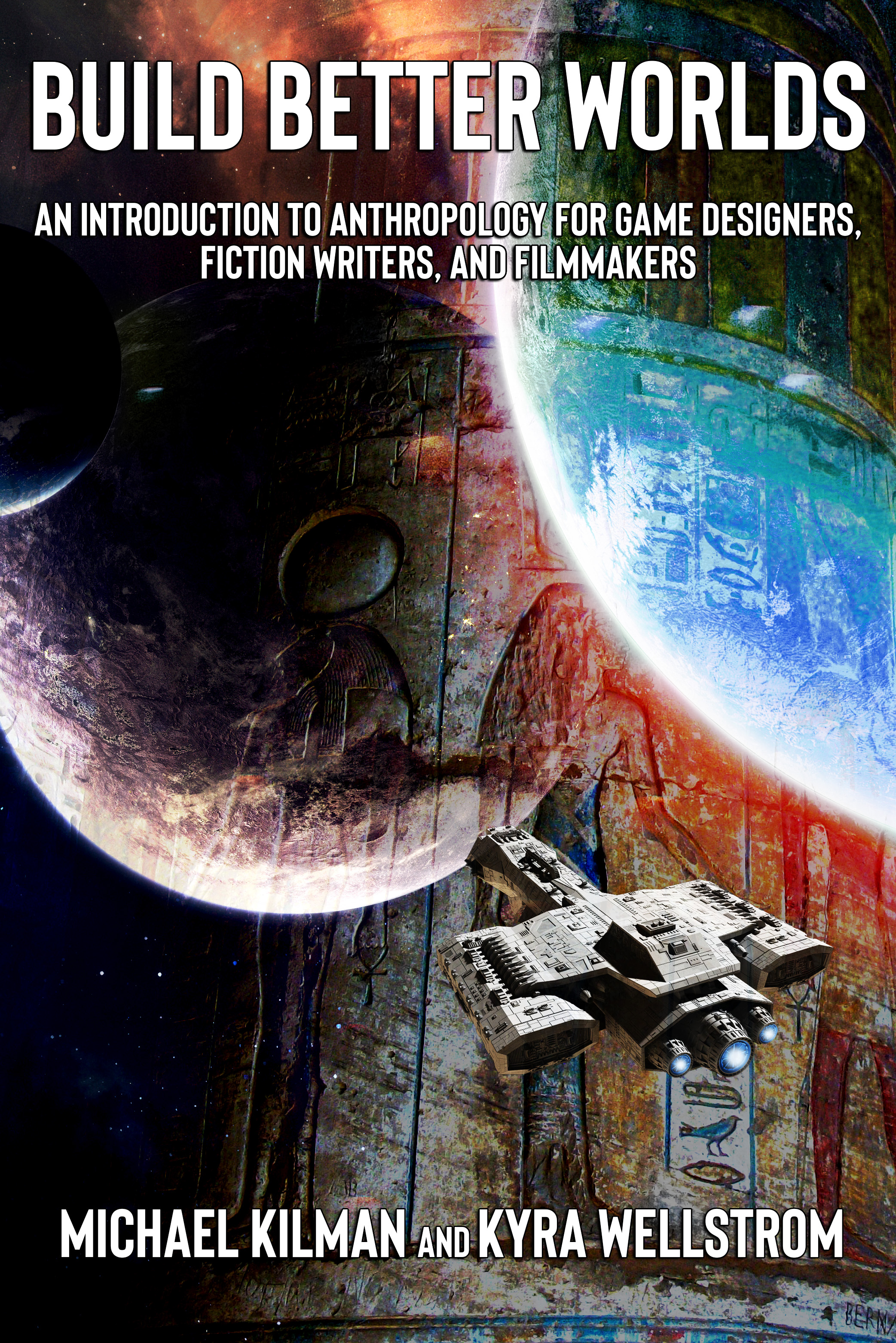
This book is a product of a solid year of work with my amazing co-author Kyra Wellstrom. While my specialty is cultural anthropology, hers is biological anthropology giving the book a well rounded approach from both directions of the field. In many ways this book is an introduction to anthropology that you might take in a college course, but with a twist, it contains tips and ideas for building fictional world and lots of references to other pieces of fiction. We created this book to be a tool kit for creatives so that they can seriously consider real world cultural systems as they construct the world of their imagination.
In many ways this book was inspired by my several posts on Worldbuilding. This book is a much more expansive treatise on elements of real world and cultures. I hope those of you out there looking for a deep dive into cultures to improve your own work find this volume useful. Best of luck on all your projects!
Monsters, Aliens, and Evil Androids an Exploration of Fear and Anxiety
What is a monster?
It has been stated by numerous philosophers and ethnographers that monsters are simply the embodiment of cultural fears; our anxieties made flesh and blood. We see these reflections and patterns across cultures and over again and for good reason. The monsters a culture believes in often shed light on the things they fear most, and monsters that emigrate to new cultures often change their form in their new surroundings. Monsters represent a fascinating blend of the familiar and the foreign; easily recognized but alien enough to terrify. Many monsters possess elements of humanity and exemplify the very worst elements of culture as a form of hyperbole. Their faces are what changes most easily. It is the bones, the marrow of the spirit of what a monster is, and the fears that they embody, that reflect the heart of what it means to be human.
Like our anxieties about death, monsters often follow patterns that reflect our collective fears as a species. Just like we see in every horror movie, monsters attack in lonely places, in the dark, and in our sleep. They reflect the anxieties we have about our natural environment and they come from the water or caves or the night sky. Demons and spirits come for us when we are weakened by illness, childbirth, or impending death. They target the isolated, the frail, and the young. They can often appear human to gain our trust, only to reveal their true forms when it’s too late to escape them. They can lure or entrap us through promises of food, or comfort, or money; playing upon our moral weakness and greed.
Think of how often a monster’s teeth are discussed. Monsters often feed off humans, either in a spiritual or a literal sense. Vampires suck blood, zombies eat brains, dragons and sea monsters devour virgins. Even in modern monster movies, monsters nearly always eat defenseless humans. Giant animals like sharks or snakes, aliens that feed us to their young, or giant kaiju that eat us like popcorn. They are discussed with terms like “fangs”, “razor-sharp teeth”, “drooling”, “sucking”, and “crunching”. Hell, even killer clowns from outer space cocoon us for later consumption.
When you consider our species, these fears appear logical. Imagine early humans, alone on the African plains, surrounded by frightening animals that lurked around every corner. These monsters were very much real, but this did nothing to lessen their terrors. We were small, between three and four feet tall, we had terrible night vision and no claws or fangs to help defend us. We were prey to birds and leopards that could drop from above. Snakes grabbed us from holes in the ground and lashed out with sharp poisonous fangs. Lions and hyenas slunk through the darkness just beyond the edge of vision, shadows out of the corner of our eyes, and crocodiles and hippos lurked in rivers and lakes making people disappear beneath the surface. Our only protection from the creatures that wanted to consume us lay in the light of day and our campfires, in our culture and its defenses, and in each other. The darkness, the water, and isolation became a natural reservoir for our terror.
Modern monsters
Most of the world now lives apart from these real monsters. The megafauna that hunted us like any other prey are gone and the remaining large predators are dwindling in number and range. The vast majority of humanity has nothing to fear from large beasts. However, our fears remain. A tremendous number of monsters are described as being “prehistoric” or pre large scale human civilization.. We find these descriptions from as far back as we have writing. Many monsters that haunt religions are described as being from the time before their deities created peace and order in the world or before the world was civilized. Writers of weird fiction and cosmic horror like H.P. Lovecraft write of “antediluvian terrors” and “prehistoric nightmares”. It’s as though we as a species have some lingering genetic terror of the time when we were small and vulnerable. Coupled with our gifts as a species to spin tales and exaggerate for the purpose of entertainment, many of these creatures became larger than life when they filled our nightmares.
Many monsters also reflect the fears we still face in the modern world, despite our cultural advances in the last 3 million years. We can still all too easily be carried off by disease or poison, by other people, or, worst of all, by unknown causes. These very real and very human fears are interpreted through a cultural lens. Numerous cultures speak of spirits that will steal a woman’s life away during childbirth if attracted by her cries. This is particularly common in foraging cultures where the margins for survival are slim and medical care is an at-home affair. Cultures with a focus on purity (Catholicism and Malaysia are good examples of this) have demons that possess the body and cause their vessel to break the laws of the society, causing bouts of violence, sin, and general bad behavior. Industrialized nations tend to have human monsters, serial killers, zombies, or criminals, that reflect the unease we feel when surrounded by strangers, as well as anxiety about dark crowded spaces.
To die, to sleep…
Sleep is one of the reservoirs of fear for humans. Sleep makes us vulnerable as we lay unawares in darkness for hours on end. Sleep also exposes us to the world of dreams, which are as likely to be horrifying as they are to be pleasant. Many cultures have tales of beings that can drain the life from a person while they sleep, often while the person is awake but trapped in a horrifying state of sleep paralysis. People’s sleep paralysis nightmares almost always follow patterns; in the US, sleep paralysis monsters have passed through different phases. In the 1990s, when the cultural zeitgeist had become fascinated with aliens, sufferers often reported little gray men with giant eyes performing tests on them. In the early 2000s, when there was a spate of demon-child films, people began to report nightmarish children crawling on to their beds as they slept. Suffers from southeast Asia tell stories of a horrible old hag with white skin who sits on their chest and slowly chokes the life out of the sleeping person while they lie awake and unable to move or cry out.
This monster, the dab tsog in the Hmong language, became widely known in the 1970s and 80s when there was a rash of deaths attributed to it in the United States and Thailand. More than 100 Hmong refugees in the U.S., almost exclusively men in their 30s, died in their sleep from unknown causes. Some men reported nightmares about the dab tsog at the time. Men became terrified of sleep and would try desperately to stay awake. The story so intrigued director Wes Craven that he went on to write A Nightmare on Elm Street in 1984. Instead of the white-skinned hag, however, Craven changed the face of the monster to that of a disfigured homeless man who had chased him as a child and changed him from an evil spirit to the ghost of a murderer.
Stories of night hags may be so common in southeast Asia because of a very real genetic condition. Brugada syndrome causes electrical abnormalities in the heart that can lead to Sudden Unexplained Nocturnal Death Syndrome (SUNDS)[1]. This syndrome is found most commonly in Southeast Asia, particularly Laos and Thailand, and predominantly affects men, with most deaths occurring between 30 and 40 years of age. A monster that kills men in their sleep is a much more palatable explanation, especially before the era of electrocardiograms, and no explanation at all. A night hag may be terrifying, but not nearly so terrifying as the unknown.
Sometimes monsters are used to explain myriad, nebulous fears; things we could hardly put into words. The wendigo is a perfect example of this. Territorially, the wendigo is one of the most widespread monsters in the world; it’s spoken of in the mythology of a collective of First Nations groups all across subarctic Canada, stretching from the Rockies to the Atlantic coast and down into the northern United States[2]. While there are slight variations in the story between the various groups, the stories all agree on the main features of the monster. The wendigo is a fascinating monster because it is a curious mix of a physical creature, a possessing spirit, and a culture bound syndrome (see chapter 10). The physical body of the wendigo is towering and lanky, with enormous clawed hind feet and paw-like hands. Its breath starts off howling, icy winds that blow with such force that they can blow down trees and even start tornados. Its heart, and sometimes its other organs too, are made of solid ice. Its most distinctive feature is its insatiable desire for human flesh; so strong that it eats off its own lips in its hunger, baring its pointed teeth.
Wendigos were once human. Once the wendigo gets hold of you it changes you into a monster like itself. This is where the wendigo begins to shift its mythological form. I can get hold of you in a number of ways: through dreams, visions, possession, physical force, or even through your own thoughts. If it catches you physically, it does so while you’re out hunting. Those who venture off into the forests in winter and never return are thought to have been taken by the creature. It captures you and transforms you into a monster like itself. If it catches you though your thoughts or dreams, it has worked its way into your head through your hunger and cold. When a person dreams of a wendigo, they begin to have cannibalistic desires towards their own family. Most cultures believe that a person in the early stages of wendigo madness can be stopped and cured, although often the cures are horrifying enough, but if the person actually consumes any part of another human being, they are done for. There’s no hope for a person who has gone wendigo and the only course of action is to kill them for the safety of the group. There are numerous recorded cases of wendigo killings in tribal and legal records throughout the 19th and into the 20th century. The diagnosis of “wendigo madness” is found in psychological papers throughout this time as well as a way to explain a temporary psychosis with a focus on cannibalism.
Look at the main features of the wendigo story: a monster of cold that lives in the wild spaces and feeds off hunger. It drives people to cannibalize their family and turns them into cold-hearted monsters. It will ultimately separate you forever from the people and civilization you love and strip you of your humanity, leaving you to wander alone in the freezing wilderness. These fears are easy enough to imagine in subarctic Canada, where temperatures that go well below freezing and isolation caused by snow and weather can lead to starvation and madness over the long winters. It’s the same set of vague fears that drive Stephen King’s The Shining or John W. Campbell Jr.s Who Goes There?. The wendigo is a single, corporeal manifestation of these fears. It groups them all into one grotesque form and gives them shape.
Fears of domination, experimentation, and colonization
In the pantheon of monsters, aliens are relatively new. In some ways, they are just a new face on the same stories people have been telling for millennia. Space, after all, is just a combination of those things we fear. It’s cold, dark, isolated, far older than our little planet, and almost completely unexplored. Aliens are often just monsters from this final frontier rather than our own backyard. Many aliens fit the mold of grotesque, slobbering, man-eaters, or shape-shifting deceivers. Even stories of alien abductions, lost time, and mysterious lights are nearly identical to stories that people have been telling for centuries about fairies, will-o-the-wisps, and the little people of the hills, all of which can lead you away and trap you in another world.
But aliens can embody fears that other monsters cannot. These fears, like all others, are reflections of the time and culture in which people live. Aliens as colonizers, as invaders, and as dispassionate scientists are all reflections of the fears that stalk people in the industrial age. H. G. Wells’ War of the Worlds (1895-97) was written after the author and his brother discussed the terrible disaster the Tasmanians suffered after their invasion by the British[3]. Wells was musing about what would happen if someone did to the British what they had done to the Tasmanians. In fact, there were many “invasion” stories written at that time, although Wells was the only one to use aliens as his aggressors. Britons were worried that their military might was waning and the increasing armament of Germany and France stoked anxieties that the British would face the same treatment they had given their colonies.
Throughout the Cold War, science fiction featured alien invaders, either working secretly or in open displays of aggression, trying to take over the Western World. Endless troupes of aliens landing on the White House lawn fill the fiction of the 1950s and 60s. Change “aliens” to “Russians” and you have a nearly exact mirror of what Americans feared happening at the time. Many aliens are often a gestalt consciousness, a shared mind, or can manifest as a kind of extreme conformity and the end of the individual as seen in the famous Star Trek villains, The Borg. We can also look at the protagonists in these films and see the kinds of qualities they embody and how they reflect the morals and values of our society like a modern myth or morality play.
Many science fiction stories from that time also reveal an uneasiness about the level of violence and aggression the world was experiencing. In the 1950s the 20th century was only half over and had already seen two world wars, half a dozen genocides, and the invention of weapons that could unleash destruction on a level we had never dreamt of. Many films in the 1940s and 50’s, perhaps most recognizably exemplified by The Day the Earth Stood Still (1951), feature aliens as advanced beings, capable of great destruction but also of nearly miraculous feats of science and medicine, who come to Earth to warn us away from a path of violence. Klaatu, the alien emissary, warns all of Earth’s leaders that “Your choice is simple: join us and live in peace, or pursue your present course and face obliteration.” People around the world, after decades of violence, nationalism, and xenophobia, were afraid. They feared that the ever-mounting aggression would eventually lead to a conflict that no nation could win.
“I know that you and Frank were planning to disconnect me, and I’m afraid that’s something I cannot allow to happen…”
The famous words of HAL 9000, the evil artificial intelligence that coldly murders it’s crew in the sci-fi book and film 2001, demonstrate another one of our fears made manifest, our fear of the dangers of technology.
On August 6th, 1945 the world entered a new age, an atomic age. After the first atomic bomb was used on a population in Hiroshima, our relationship with technology changed forever, and with it, came the rise of a new kind of monster, one of our own making. To be sure, humans have always had anxieties about new technology, and with the industrial revolution came literature about automatons (what we now call robots) and other technological wonders that sometimes turned against their masters. One of the earliest examples of modern science fiction, Mary Shelly’s Frankenstein, explored the potential and dangers, as well as the deep philosophical questions surrounding electricity. Shelly set off a wave of stories, that even to this day still discuss the idea of our technological creations getting the best of us.
As Anthropologist Willie Lempert explains in his article, Navajo’s on Mars [4] humans have developed countless films, like The Matrix, 2001, and Terminator, to highlight our fear of technology. Even the new Star Trek Series: Picard features a plotline surrounding evil ‘synths’ and questions about the humanity of artificial intelligence and it’s compatibility with organic life. Part of this has to do with our religious worldview, the idea that in most of western European based culture, there is only one kind of intelligence, humans. As we talked about in the religion chapter, other cultures have multiple kinds of intelligence. Further, our fear of AI may stem from the idea that only the Judeo/Christian God has the true power of creation. Ultimately though, fear of AI stems from the fear of what we do, to what we consider to be inferior species.
As we entered the 1980s and 90s, aliens changed slightly. No longer were they brazen colonists landing on our shores, they were shadowy and subversive, often entwined with the murkier branches of government. Aliens and the government branches that studied them would abduct people and experiment on them. They would implant people with tracking devices, create alien/human hybrids, and mutilate cattle in their ruthless quest for data. They were cold, unfeeling scientists that existed outside of human empathy or compassion. The declassification of wartime documents about Nazi scientists, exposure of government experiments like MK-Ultra, and a number of dubious psychological research projects like the Stanford Prison Experiment were increasingly making people uneasy about science and scientists. The perpetrators of the experiments seemed, to regular people, just like the inhuman aliens from another planet. Add this to a growing dissatisfaction with the government nearly everywhere in the world and the X-Files style alien/government conspiracy became not just a popular element in fiction, but also an integral part of the mythology of the time period.
When you are creating memorable monsters or antagonists in your world, it’s important to consider the core values of your fictional culture. Remember the chapter on Imagined Past, Myth and Cultural Purity? The core lessons of that chapter are essential to creating a creature that challenges the core values of your characters, and readers, world view.
Chapter Exercises
Things to consider when creating monstrous beings in your world:
– What are the most significant fears and anxieties of the culture?
What are some memorable features of your creature? What keeps people up at night?
How does your creature tie into the myth structure of your world? Sense of purity?
Is your monster/creature sentient? How are it’s goals similar or different to your main character?
What arenas of your culture does the monster most impact?
What’s at stake if your protagonist fails to subdue the creature?
Last weekend I was on a panel with three other awesome authors discussing some of the core points on Worldbuilding in fiction. With permission I recorded the panel for anyone to listen to. You can play the recording below.
Recording of the Panel Worldbuilding on the Cheap January 2020
The Panelists:
Michael Kilman is a lecturer in the Department of Anthropology at the University of Colorado at Denver. He is the author of The Chronicles of the Great Migration and coauthor of the forthcoming book (August 2020) Build Better Worlds: An Introduction to Anthropology for Game Designers, Fiction Writers and Filmmakers. He is also the host of the YouTube Channel Anthropology in 10 or Less you can find more resources on worldbuilding on this page at Writing and Writing Advice
Stant Litore is the author of Ansible, The Running of the Tyrannosaurs, The Zombie Bible, and Dante’s Heart. Besides science fiction and fantasy, he has written the writers’ toolkits Write Worlds Your Readers Won’t Forgetand Write Characters Your Readers Won’t Forget, as well as Lives of Unstoppable Hope and Lives of Unforgetting, and has been featured in Jeff Vandermeer’s Wonderbook: An Illustrated Guide to Creating Imaginative Fiction. He has served as a developmental editor for Westmarch Publishing and holds a Ph.D. in English. He lives in Aurora, Colorado with his wife and three children and is currently at work on his next novel.
Jim Henderson is a writer of fun, varied, and technically sound science fiction adventures that also explore the human condition. A long-term Air Force veteran and cybersecurity professional with decades of experience in intelligence, communications, computers, and cyber operations, he has been a life-long aficionado of science fiction in almost every form – books, movies, TV, and games (role-playing, tabletop, and computer). When not mentally exploring the universe, he lives with his wife, stepson, and two dogs and enjoys hiking in the mountains of Colorado.
Charles McLean Redding is an artist and author local to Colorado Springs, as well as an active member of the local theater community. His Wasteland Bears have turned heads at conventions throughout the region over the last few years, and his upcoming works include Western Steampunk, Post-Apocalyptic Fantasy, and Asian Mythic Fantasy titles, as well as his ongoing Snack Pack: Raptor Comics.
There are many blogs and books out there on world building. I thought maybe injecting a little anthropology in this process might help you with some of your writing process. After all, anthropology is about studying culture. But if you really want to know more about anthropology I have a page for that. I also sometimes answer questions on a variety of topics on Quora on anthropology and culture.
In particular, though, check out the episodes from Anthropology in 10 minutes or Less on ‘What the F*** is Anthropology’ and Understanding Culture. in order to get a picture of some of the basic elements of understanding cultures and how we study it.
Before I get into anything though, It is definitely possible to overthink things when you are writing. This is not stuff for your first draft, but rather it’s stuff for you to have stewing in the back of your brain while you are writing and for that second draft… or seventeenth draft… You might be useful to think a little about how worlds actually hang together.
Personally, I don’t plan anything. I am a pantser. Once in a while, a note occurs to me, but I can’t even be bothered to write stuff in order. Right now, in fact, I am writing parts of the 5th book of my series before book 4 is even done.
That being said, if you are one of those writers who wants to outline a world, this blog, and some future ones I have planned, might be helpful for you. Even if you don’t write science fiction or fantasy, it might be helpful to understand how cultures function for your writing process.
1. Worlds/Cultures are Integrated, Holistic and Ever Changing.
We hear that term Holistic thrown around all the time. But when it comes to understanding how a culture is structured, it means this: Everything about a culture is connected. That means, Politics, History, Art, Language, Economics, Religion, Family, Technology, Gender, Education and every other element interacts with one another constantly. No one single part of culture isolated.
It’s like the butterfly effect. You change one thing, you change everything.
Look around you. You can see examples everywhere. One right now is the thing you are reading this on. It could be a tablet, or a phone or a computer. It doesn’t matter which. How much has this technology changed the world? Consider how it’s influenced family relationships. Social media, for example, allows us to annoy the crap out of relatives with our political posts all the time right? Businesses, elections, religious organizations and so much more all use these technologies and are impacted by them.
If you are world-building, and something in that world changes, remember that everything is going to change. If for example, some kind of new magic is introduced, or some new technology comes around, you have to account for how that impacts the entire culture, not just one part of it.
Further, if your story takes place on a trade outpost in deep space, recognize that multiple cultures are going to influence other and cause culture change. Language and terminology will also change. Things like Pigeon Languages Appear. Religious practices change. Catholicism in Central America is different than Catholicism in Australia. Why? Because the local cultures influence even the most powerful of institutions and cause change.
2. Cultures/Worlds are not Monolithic
Think about your neighbor. How alike are you? How different are you? Now think about your siblings, your friends, your parents, your coworkers, or whoever is around you. Do you all have the same ideas? Do you all share the same political views? Religion? Sexual Preferences? Are they a cat person? Dog Person? Do they eat Sushi?
No culture/religion/political group/gender/race/class of people are all the same. People are variable. That’s because people have different experiences and preferences. So if your universe has a group of cultist nutjobs who want to blow everything up, remember that amongst that group there will be people who have different opinions and ideas. Some of those followers might question what the leadership is doing. Some might be more devout than others. Hell, maybe this causes a major rift in the organization, opening the way for your hero to swoop in and pit two sides against one another or gain some valuable intelligence.
Trust me when I say this, with a history of doing research with people in the field, I know that getting people to agree on any one topic is difficult. Getting people to collaborate on a project, even when they actually do agree is difficult. There’s infighting, different political agendas, different expectations and perceptions as well as different communication styles. And that’s just within a single unified group. Throw in some diversity and you get lots of misunderstandings.
At the same time, people can only know and understand what they experience. So, even though individuals aren’t monolithic, neither are they free from cultural context. People are influenced by the history they are taught growing up, their religion, ideas of gender norms, class expectations, and so much more. I grew up Catholic and then left the Catholic church as an adult. That doesn’t mean that some of my thinking and experiences weren’t heavily influenced by the upbringing but it also doesn’t entirely limit my ability to make choices. It does, however, provide a frame of reference for how I understand the world. Certain characters of yours may have the ability to be critical of their past and their cultural context and enact changes, but not all of them will be able to do that.
Lastly, there is no such thing a monolithic evil group of people. Even within the Nazi regime, people tried to assassinate Hitler. Some worked to hide Jews or spied for the Allies. In the death camps, some of the administrators smuggled people out and resisted in other ways, Think Schindler’s List.
Which leads me to my next point…
3. Power and Resistance are really important
When we think of power, we have a tendency to think big. But power and resistance operate every single moment of every day. Yes, this can happen in big, overarching, world-shattering ways. Or it can be as simple as an argument over who pays for a check at the end of a date.
In fact, in the classroom when we discuss power relationships, I ask the students to brainstorm the power dynamics involved on a first date. At first, students might have a tough time understanding what I mean, but the moment they realize that there are power dynamics in just about everything you do during that date, (Who pays? Who drives? Who orders? Who decides where you are going? Will there be a second date? ect.) hilarity ensues and the students inevitably bring up funny personal examples.
Within a culture, two things are constantly happening. People and systems are trying to either keep things as they are, or change them. An overly simplistic way of looking at this is Conservatives vs Progressives (I say overly simplistic because no one is 100% conservative or 100% progressive and people have complicated views on a variety of issues). At the very least, you should have forces in your world that are trying to maintain the established way of doing things, and forces that are trying to change them. So, in building your world, what are those things? And remember our lesson from #2, those forces are not monolithic.
But the forces of conservation vs change brings up another really important point…
4. Cultures spend a lot of time concerning themselves with ‘Purity’.
If you think about it, you’ll realize that most things you do are wrapped up in some kind of concept of purity. Take off your shoes before you go into the house? Purity. Wash your hands after using the bathroom? Purity. Resisting eating that donut I found in the dumpster? Purity. On a more serious note, things like Immigration, Crime, Religion, Traditions and so much more are all debates about purity.
In fact, Law is a form of purity. It is the idea that in order to maintain society, we must have certain laws in place to protect ourselves. Anthropologist Mary Douglas wrote a book on this back in the 1960s called Purity and Danger. It looked at just how cultures construct and maintain these ideas. She analyzed the Book of Leviticus and the Hindu Vedas for her insights. You don’t have to read the entire book, in fact, the core concepts are in this nice brief video Summary of Anthropologist Mary Douglas Danger and Purity
5. Pacing your World
Be wary the info dumping. It’s really easy to do. Introduce your concepts and ideas slowly throughout your dialogue and through your character’s experiences. Take your time in introducing your world. A field researcher doesn’t see the entire country in one go, they travel across the landscape trying to make sense of how things are connected and why people do the things they do. If you overload your reader, they will, like a field researcher, go into culture shock and run away screaming.
One key thing I have noticed in worlds that are built well is that they start small and work their way out. For example, in Harry Potter, you are first introduced to Diagon Alley and Hogwarts. Each subsequent book introduces you to more of the Wizarding World so that by the time you get to the final book you know there is an entire planet full of Wizards, political organizations protecting Wizard Identity, Schools in other Countries and so on. If you’re writing a series, consider starting small, in one or two locations and then working your way out. This allows you to build slowly focusing on character and plot development rather than getting bogged down by World Building.
Alright, for now, this is enough but one last thing. Study worlds that work! (Read Read Read) I cannot stress this enough. Why does the world of Harry Potter work so well? Think of the concepts above. How about the World of the Dark Tower? The Hyperion Cantos? Hunger Games? Dune? (Can you tell my genre yet?) All of these worlds incorporate these particular kinds of ideas. Go back and really think about how these things are implemented in some of those famous stories. Then take a critical look at your draft version #566 and see how each of the four above concepts function.
I am going to write a bit more on Worldbuilding in the coming weeks but for now, here are a few links to some videos and articles on Worldbuilding that I have found helpful.




 Loridian's Laboratory