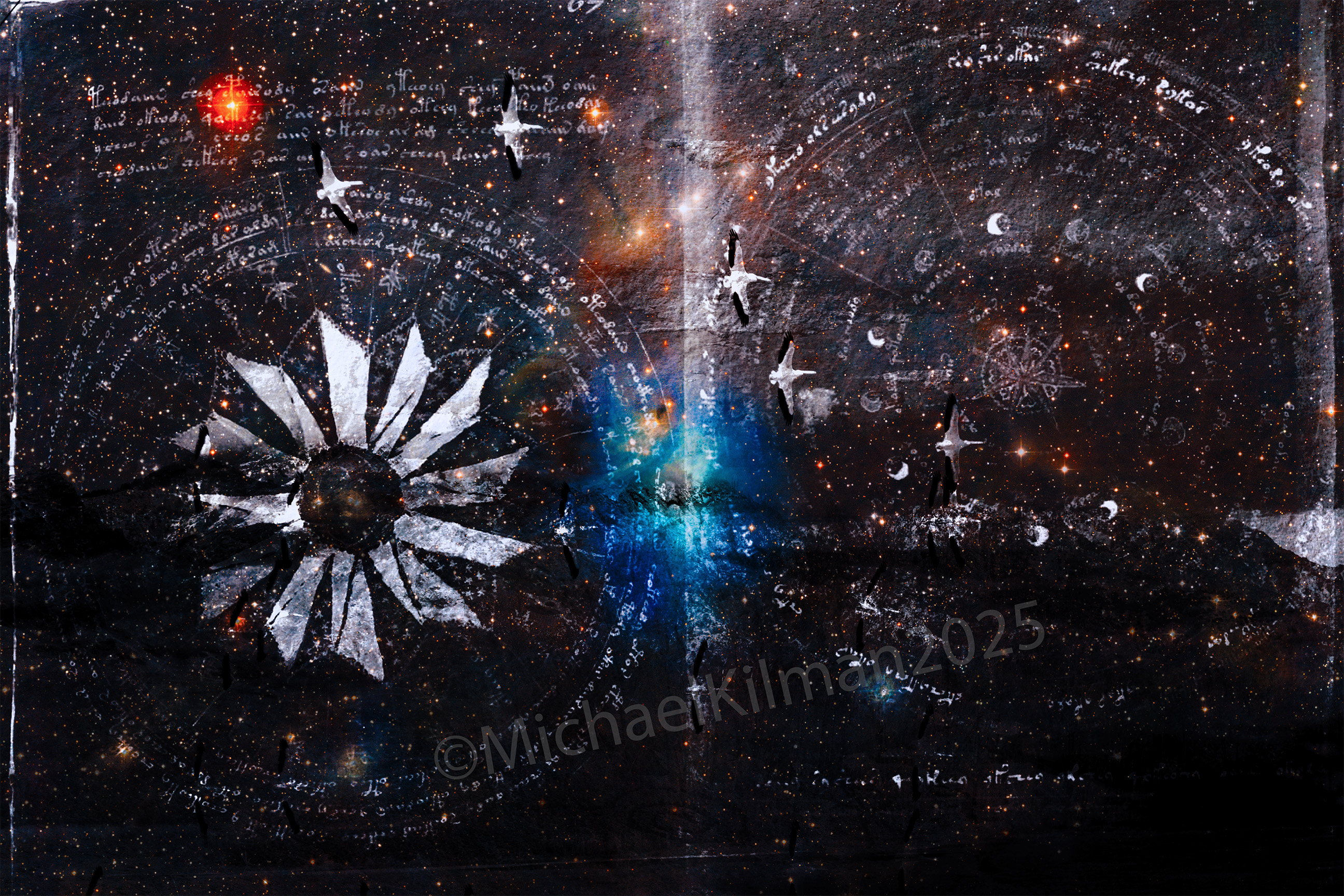
Original Digital Art: Inner Sanctum of the Celestial
Endings and beginnings have a way of forcing honesty.
For me, 2025 did that on every level. Personally, physically, and politically. Like many people in the United States, I could not ignore what was happening around me. That reckoning is what led to the creation of the Resistance Reads podcast. Then, in September, a cycling accident during the Denver Century resulted in reconstructive surgery on my left thumb and months of recovery. An interruption like that has a way of clarifying what truly matters.
What I returned to was simple.
My deepest commitment is to writing books, telling meaningful stories, and using anthropology to help people better understand themselves and the societies they live in.
A Refocused Direction
As a result, my work is more intentionally focused moving into 2026. This is not a dramatic change so much as a narrowing of attention toward what I do best and care about most. I want to be clear about that direction so readers know what to expect.
This site and my Substack will center on storytelling, culture, power, resistance, and transformation, especially through speculative fiction and anthropological insight.
What’s Coming This Year
Books
I will be publishing at least one book this year, possibly two. I plan to share transparent updates on drafting, revision, and release as those projects move forward. At least one audiobook will also be released. I have a big announcement about a stand alone book coming very soon, but I’m also working on Through and Endless Darkness Gleaming (Shades and Shapes in the Dark #2) and The Children of AEIS (Chronicles of the Great Migration #5).
Short Fiction
I’m currently revising several short stories. Some will be submitted to magazines and journals. Others will be shared directly with readers, with select pieces available to paid subscribers.
Paid Subscriber Content
Paid subscribers to my substack receive early access to novels, behind-the-scenes reflections on the writing process, and deeper explorations of anthropology and worldbuilding. That said, there will always be substantial free content available. I am aware of subscription fatigue (I certainly feel it myself) and want this work to remain accessible. If I could do this all for free, I would, but the more support I have, the more content I’m able to make.
This year I am launching live YouTube Q and A sessions focused on anthropology and storytelling. The first session, Ask an Anthropologist About Worldbuilding, takes place on January 13, with additional topics to follow. Future sessions will be shaped by reader and viewer interest.
Looking Ahead
If these themes resonate with you, I am glad you are here. If not, that is okay too. My goal this year is focused, meaningful creation, grounded in curiosity and care for how stories shape the world we live in.
If you are following along, I would genuinely love to know what you are most interested in exploring this year: books, anthropology, or the intersection of politics and fiction.
With curiosity, Michael Kilman
Progress updates on upcoming books will be posted on the homepage of LoridiansLaboratory.com every few months for readers who enjoy following projects as they take shape.
Monsters, Aliens, and Evil Androids an Exploration of Fear and Anxiety
What is a monster?
It has been stated by numerous philosophers and ethnographers that monsters are simply the embodiment of cultural fears; our anxieties made flesh and blood. We see these reflections and patterns across cultures and over again and for good reason. The monsters a culture believes in often shed light on the things they fear most, and monsters that emigrate to new cultures often change their form in their new surroundings. Monsters represent a fascinating blend of the familiar and the foreign; easily recognized but alien enough to terrify. Many monsters possess elements of humanity and exemplify the very worst elements of culture as a form of hyperbole. Their faces are what changes most easily. It is the bones, the marrow of the spirit of what a monster is, and the fears that they embody, that reflect the heart of what it means to be human.
Like our anxieties about death, monsters often follow patterns that reflect our collective fears as a species. Just like we see in every horror movie, monsters attack in lonely places, in the dark, and in our sleep. They reflect the anxieties we have about our natural environment and they come from the water or caves or the night sky. Demons and spirits come for us when we are weakened by illness, childbirth, or impending death. They target the isolated, the frail, and the young. They can often appear human to gain our trust, only to reveal their true forms when it’s too late to escape them. They can lure or entrap us through promises of food, or comfort, or money; playing upon our moral weakness and greed.
Think of how often a monster’s teeth are discussed. Monsters often feed off humans, either in a spiritual or a literal sense. Vampires suck blood, zombies eat brains, dragons and sea monsters devour virgins. Even in modern monster movies, monsters nearly always eat defenseless humans. Giant animals like sharks or snakes, aliens that feed us to their young, or giant kaiju that eat us like popcorn. They are discussed with terms like “fangs”, “razor-sharp teeth”, “drooling”, “sucking”, and “crunching”. Hell, even killer clowns from outer space cocoon us for later consumption.
When you consider our species, these fears appear logical. Imagine early humans, alone on the African plains, surrounded by frightening animals that lurked around every corner. These monsters were very much real, but this did nothing to lessen their terrors. We were small, between three and four feet tall, we had terrible night vision and no claws or fangs to help defend us. We were prey to birds and leopards that could drop from above. Snakes grabbed us from holes in the ground and lashed out with sharp poisonous fangs. Lions and hyenas slunk through the darkness just beyond the edge of vision, shadows out of the corner of our eyes, and crocodiles and hippos lurked in rivers and lakes making people disappear beneath the surface. Our only protection from the creatures that wanted to consume us lay in the light of day and our campfires, in our culture and its defenses, and in each other. The darkness, the water, and isolation became a natural reservoir for our terror.
Modern monsters
Most of the world now lives apart from these real monsters. The megafauna that hunted us like any other prey are gone and the remaining large predators are dwindling in number and range. The vast majority of humanity has nothing to fear from large beasts. However, our fears remain. A tremendous number of monsters are described as being “prehistoric” or pre large scale human civilization.. We find these descriptions from as far back as we have writing. Many monsters that haunt religions are described as being from the time before their deities created peace and order in the world or before the world was civilized. Writers of weird fiction and cosmic horror like H.P. Lovecraft write of “antediluvian terrors” and “prehistoric nightmares”. It’s as though we as a species have some lingering genetic terror of the time when we were small and vulnerable. Coupled with our gifts as a species to spin tales and exaggerate for the purpose of entertainment, many of these creatures became larger than life when they filled our nightmares.
Many monsters also reflect the fears we still face in the modern world, despite our cultural advances in the last 3 million years. We can still all too easily be carried off by disease or poison, by other people, or, worst of all, by unknown causes. These very real and very human fears are interpreted through a cultural lens. Numerous cultures speak of spirits that will steal a woman’s life away during childbirth if attracted by her cries. This is particularly common in foraging cultures where the margins for survival are slim and medical care is an at-home affair. Cultures with a focus on purity (Catholicism and Malaysia are good examples of this) have demons that possess the body and cause their vessel to break the laws of the society, causing bouts of violence, sin, and general bad behavior. Industrialized nations tend to have human monsters, serial killers, zombies, or criminals, that reflect the unease we feel when surrounded by strangers, as well as anxiety about dark crowded spaces.
To die, to sleep…
Sleep is one of the reservoirs of fear for humans. Sleep makes us vulnerable as we lay unawares in darkness for hours on end. Sleep also exposes us to the world of dreams, which are as likely to be horrifying as they are to be pleasant. Many cultures have tales of beings that can drain the life from a person while they sleep, often while the person is awake but trapped in a horrifying state of sleep paralysis. People’s sleep paralysis nightmares almost always follow patterns; in the US, sleep paralysis monsters have passed through different phases. In the 1990s, when the cultural zeitgeist had become fascinated with aliens, sufferers often reported little gray men with giant eyes performing tests on them. In the early 2000s, when there was a spate of demon-child films, people began to report nightmarish children crawling on to their beds as they slept. Suffers from southeast Asia tell stories of a horrible old hag with white skin who sits on their chest and slowly chokes the life out of the sleeping person while they lie awake and unable to move or cry out.
This monster, the dab tsog in the Hmong language, became widely known in the 1970s and 80s when there was a rash of deaths attributed to it in the United States and Thailand. More than 100 Hmong refugees in the U.S., almost exclusively men in their 30s, died in their sleep from unknown causes. Some men reported nightmares about the dab tsog at the time. Men became terrified of sleep and would try desperately to stay awake. The story so intrigued director Wes Craven that he went on to write A Nightmare on Elm Street in 1984. Instead of the white-skinned hag, however, Craven changed the face of the monster to that of a disfigured homeless man who had chased him as a child and changed him from an evil spirit to the ghost of a murderer.
Stories of night hags may be so common in southeast Asia because of a very real genetic condition. Brugada syndrome causes electrical abnormalities in the heart that can lead to Sudden Unexplained Nocturnal Death Syndrome (SUNDS)[1]. This syndrome is found most commonly in Southeast Asia, particularly Laos and Thailand, and predominantly affects men, with most deaths occurring between 30 and 40 years of age. A monster that kills men in their sleep is a much more palatable explanation, especially before the era of electrocardiograms, and no explanation at all. A night hag may be terrifying, but not nearly so terrifying as the unknown.
Sometimes monsters are used to explain myriad, nebulous fears; things we could hardly put into words. The wendigo is a perfect example of this. Territorially, the wendigo is one of the most widespread monsters in the world; it’s spoken of in the mythology of a collective of First Nations groups all across subarctic Canada, stretching from the Rockies to the Atlantic coast and down into the northern United States[2]. While there are slight variations in the story between the various groups, the stories all agree on the main features of the monster. The wendigo is a fascinating monster because it is a curious mix of a physical creature, a possessing spirit, and a culture bound syndrome (see chapter 10). The physical body of the wendigo is towering and lanky, with enormous clawed hind feet and paw-like hands. Its breath starts off howling, icy winds that blow with such force that they can blow down trees and even start tornados. Its heart, and sometimes its other organs too, are made of solid ice. Its most distinctive feature is its insatiable desire for human flesh; so strong that it eats off its own lips in its hunger, baring its pointed teeth.
Wendigos were once human. Once the wendigo gets hold of you it changes you into a monster like itself. This is where the wendigo begins to shift its mythological form. I can get hold of you in a number of ways: through dreams, visions, possession, physical force, or even through your own thoughts. If it catches you physically, it does so while you’re out hunting. Those who venture off into the forests in winter and never return are thought to have been taken by the creature. It captures you and transforms you into a monster like itself. If it catches you though your thoughts or dreams, it has worked its way into your head through your hunger and cold. When a person dreams of a wendigo, they begin to have cannibalistic desires towards their own family. Most cultures believe that a person in the early stages of wendigo madness can be stopped and cured, although often the cures are horrifying enough, but if the person actually consumes any part of another human being, they are done for. There’s no hope for a person who has gone wendigo and the only course of action is to kill them for the safety of the group. There are numerous recorded cases of wendigo killings in tribal and legal records throughout the 19th and into the 20th century. The diagnosis of “wendigo madness” is found in psychological papers throughout this time as well as a way to explain a temporary psychosis with a focus on cannibalism.
Look at the main features of the wendigo story: a monster of cold that lives in the wild spaces and feeds off hunger. It drives people to cannibalize their family and turns them into cold-hearted monsters. It will ultimately separate you forever from the people and civilization you love and strip you of your humanity, leaving you to wander alone in the freezing wilderness. These fears are easy enough to imagine in subarctic Canada, where temperatures that go well below freezing and isolation caused by snow and weather can lead to starvation and madness over the long winters. It’s the same set of vague fears that drive Stephen King’s The Shining or John W. Campbell Jr.s Who Goes There?. The wendigo is a single, corporeal manifestation of these fears. It groups them all into one grotesque form and gives them shape.
Fears of domination, experimentation, and colonization
In the pantheon of monsters, aliens are relatively new. In some ways, they are just a new face on the same stories people have been telling for millennia. Space, after all, is just a combination of those things we fear. It’s cold, dark, isolated, far older than our little planet, and almost completely unexplored. Aliens are often just monsters from this final frontier rather than our own backyard. Many aliens fit the mold of grotesque, slobbering, man-eaters, or shape-shifting deceivers. Even stories of alien abductions, lost time, and mysterious lights are nearly identical to stories that people have been telling for centuries about fairies, will-o-the-wisps, and the little people of the hills, all of which can lead you away and trap you in another world.
But aliens can embody fears that other monsters cannot. These fears, like all others, are reflections of the time and culture in which people live. Aliens as colonizers, as invaders, and as dispassionate scientists are all reflections of the fears that stalk people in the industrial age. H. G. Wells’ War of the Worlds (1895-97) was written after the author and his brother discussed the terrible disaster the Tasmanians suffered after their invasion by the British[3]. Wells was musing about what would happen if someone did to the British what they had done to the Tasmanians. In fact, there were many “invasion” stories written at that time, although Wells was the only one to use aliens as his aggressors. Britons were worried that their military might was waning and the increasing armament of Germany and France stoked anxieties that the British would face the same treatment they had given their colonies.
Throughout the Cold War, science fiction featured alien invaders, either working secretly or in open displays of aggression, trying to take over the Western World. Endless troupes of aliens landing on the White House lawn fill the fiction of the 1950s and 60s. Change “aliens” to “Russians” and you have a nearly exact mirror of what Americans feared happening at the time. Many aliens are often a gestalt consciousness, a shared mind, or can manifest as a kind of extreme conformity and the end of the individual as seen in the famous Star Trek villains, The Borg. We can also look at the protagonists in these films and see the kinds of qualities they embody and how they reflect the morals and values of our society like a modern myth or morality play.
Many science fiction stories from that time also reveal an uneasiness about the level of violence and aggression the world was experiencing. In the 1950s the 20th century was only half over and had already seen two world wars, half a dozen genocides, and the invention of weapons that could unleash destruction on a level we had never dreamt of. Many films in the 1940s and 50’s, perhaps most recognizably exemplified by The Day the Earth Stood Still (1951), feature aliens as advanced beings, capable of great destruction but also of nearly miraculous feats of science and medicine, who come to Earth to warn us away from a path of violence. Klaatu, the alien emissary, warns all of Earth’s leaders that “Your choice is simple: join us and live in peace, or pursue your present course and face obliteration.” People around the world, after decades of violence, nationalism, and xenophobia, were afraid. They feared that the ever-mounting aggression would eventually lead to a conflict that no nation could win.
“I know that you and Frank were planning to disconnect me, and I’m afraid that’s something I cannot allow to happen…”
The famous words of HAL 9000, the evil artificial intelligence that coldly murders it’s crew in the sci-fi book and film 2001, demonstrate another one of our fears made manifest, our fear of the dangers of technology.
On August 6th, 1945 the world entered a new age, an atomic age. After the first atomic bomb was used on a population in Hiroshima, our relationship with technology changed forever, and with it, came the rise of a new kind of monster, one of our own making. To be sure, humans have always had anxieties about new technology, and with the industrial revolution came literature about automatons (what we now call robots) and other technological wonders that sometimes turned against their masters. One of the earliest examples of modern science fiction, Mary Shelly’s Frankenstein, explored the potential and dangers, as well as the deep philosophical questions surrounding electricity. Shelly set off a wave of stories, that even to this day still discuss the idea of our technological creations getting the best of us.
As Anthropologist Willie Lempert explains in his article, Navajo’s on Mars [4] humans have developed countless films, like The Matrix, 2001, and Terminator, to highlight our fear of technology. Even the new Star Trek Series: Picard features a plotline surrounding evil ‘synths’ and questions about the humanity of artificial intelligence and it’s compatibility with organic life. Part of this has to do with our religious worldview, the idea that in most of western European based culture, there is only one kind of intelligence, humans. As we talked about in the religion chapter, other cultures have multiple kinds of intelligence. Further, our fear of AI may stem from the idea that only the Judeo/Christian God has the true power of creation. Ultimately though, fear of AI stems from the fear of what we do, to what we consider to be inferior species.
As we entered the 1980s and 90s, aliens changed slightly. No longer were they brazen colonists landing on our shores, they were shadowy and subversive, often entwined with the murkier branches of government. Aliens and the government branches that studied them would abduct people and experiment on them. They would implant people with tracking devices, create alien/human hybrids, and mutilate cattle in their ruthless quest for data. They were cold, unfeeling scientists that existed outside of human empathy or compassion. The declassification of wartime documents about Nazi scientists, exposure of government experiments like MK-Ultra, and a number of dubious psychological research projects like the Stanford Prison Experiment were increasingly making people uneasy about science and scientists. The perpetrators of the experiments seemed, to regular people, just like the inhuman aliens from another planet. Add this to a growing dissatisfaction with the government nearly everywhere in the world and the X-Files style alien/government conspiracy became not just a popular element in fiction, but also an integral part of the mythology of the time period.
When you are creating memorable monsters or antagonists in your world, it’s important to consider the core values of your fictional culture. Remember the chapter on Imagined Past, Myth and Cultural Purity? The core lessons of that chapter are essential to creating a creature that challenges the core values of your characters, and readers, world view.
Chapter Exercises
Things to consider when creating monstrous beings in your world:
– What are the most significant fears and anxieties of the culture?
What are some memorable features of your creature? What keeps people up at night?
How does your creature tie into the myth structure of your world? Sense of purity?
Is your monster/creature sentient? How are it’s goals similar or different to your main character?
What arenas of your culture does the monster most impact?
What’s at stake if your protagonist fails to subdue the creature?
Myths are fascinating and interesting arenas within cultures. Every culture has some kind of myth story (but not all cultures have creation myths i.e. the Piraha) that helps us to understand what in the world we are supposed to be doing as human beings.
But here’s the thing. There are a lot of video games and fiction out there that just throw in cute myth story for no apparent reason. The myth is fascinating but doesn’t have any weight in the character’s lives. The culture gives it a nod here and there and it holds no real consequences in the society. This is a major problem. This is where many fictional worlds go wrong. So here is a list of things about myths that you should consider in order to create better cultures and better worlds.
1. Myths aren’t just about religion. They aren’t all false. They are repositories of knowledgea culture uses to interpret reality.
Every country has a myth about it’s creation. In the United States we tell a story of the Founding Fathers, a group of men who fought for liberty against the tyranny of the King of England and ultimately won out. Upon the granting of our independence, a sacred document was penned to replace the faulty Articles of Confederation that tenuously held the colonies together. This document is called the Constitution.
Every American grows up hearing this. We interpret these stories and this document over and over when new ideas, technologies, court battles, as they come into our culture. That document and it’s amendments structure the values of our society and so, there are endless debates and interpretations of what those men wrote. This is a very active and powerful myth structure.
When you create your myth structure, be it religious or secular in nature, what impact does it have in society? How do people debate the meaning of those myths? Are their other myth structures at odds with the dominant one? For example, how do the Christian myth structures support or conflict with that of the Founding Fathers and the formation of our country? We see constant debates on laws and rights based on these two competing (and sometimes overlapping) myths. This is an arena in fiction that is rife with making authentic and interesting conversations that your characters and cultures have.
2. Myths structure our idea of purity
Mythology also tells us what good and bad things are in society. Not all myths are concerned with simple binaries (regardless of what structuralists might think). But many of them identify what things are good and bad to have in a culture or give prescriptions for the kind of mind, body, or spirit to cultivate.
Returning to the American example, the political myth of our country includes a number of concepts about what kinds of governments are good and bad. Who should have the right to vote (which has changed over time) and with the Bill of Rights, attempts to map out the rights of citizens that are required to keep maintain a working political system.
Myths may or may not include the following
What things are we supposed to eat/avoid
What are good/bad/ideal sexual relationships or practices
Marriage patterns
Clean and dirty parts of the body and when or why you should wash
Important dates
Important people
How we mark or think about time
What kinds of intelligences are there (does nature have a will of it’s own? Is there an all-knowing being in the sky? Does a fox have human intelligence? ect.)
What about disease? Is there germ theory? Is, like in the middle ages in Europe, smell associated with disease?
How about the question of suffering? Is there a being that makes suffering? Is suffering from ignorance? Is suffering a thing at all?
Is there free will?
How many lives do we have?
What words are sacred/dangerous?
Is there a certain style of dress or attire or tattoo or body modification that is considered sacred or taboo?
What is reality? Are we living in a giant theater performance? Do we live in a simulation like in the Matrix? Is there a better place to go when we die? A worse one? How do physics/magic/will structure reality?
You don’t have to include all of the above but you should at least consider them and their ramifications. Lots of tension and conflict in fiction can, like in the real world, arise for competing myth structures or provide interesting limitations that characters have to work with.
3. Myth legitimizes the present social order and system of power
Myth often offers an explanation for why people have the life conditions they do. In Hinduism for example, the Hindu caste system, and the breakdown of wealth and poverty is addressed in numerous Hindu texts. People are born into certain conditions because of consequences of their past lives. In Christian Europe it became popular for Kings to claim that they had a Divine right to be in their throne. In China, an emperor was thought to have a “Mandate of Heaven.” These are a mix of religious and political myth structures that allow those in power to continue to consolidate their power and claim a legitimate right to their station. Similarly in the United States we have the bootstraps myth, the idea that with hard work, you too can one day be wealthy and that often, the poor are lazy and unworthy of success. This myth goes back to Benjamin Franklin. (Check out this podcast “Poverty Myths Busted” on why it’s more complicated than the bootstraps myth suggests and also as an interesting study in myth-making and consequences.)
Your fictional world should include myths that have consequences related to power. Manifest Destiny was the myth structure that justified the Europeans conquerors actions during the 15th – 19th century. It claimed that God wanted Europeans to civilize the world and spend Christianity far and wide. That had some really deep and pretty awful consequences for non-Christians and non-Europeans. Empires always spread their myths. Even the Mongol empire which had freedom of religion and a secular state, still spread it’s myth about the mighty Genghis Khan and the legitimacy of their power.
4. Myths Explain The Nature of Reality
Myths can sometimes act as a kind of proto-science, that provides explanations for the state of reality. In the absence of scientific investigation (and even with it) Myths can provide us with the story of where we came from, why we are here, and where we are going. They can explain why man has two legs, why some creatures have different kinds of tales, what are good morals and values to have and provide limitations on what can/can’t do or can/can’t know. Myths can be flexible and empirical, based on the observation of individuals and experience, but they can also be fanciful and strange or even non-nonsensical to outsiders.
In writing your fiction, remember that even in a secular state, there are many competing myths. We still have creationists in the United States who argue the world is only 6,000 years old, along side scientific evidence that the world is 4.5 billion years old. Which leads me to…
5. Myths mark In Groups vs Out Groups and for the In Group bring Unity
Myths not only structure the way that people see the world and the elements above, but they also make clear cultural distinctions about who is a part of a group and who isn’t. Sometimes this can be as simple as, hey, I subscribe to that belief so I am part of the group. Sometimes, it can something like, in my mythology this particular group of people has different color skin because they are punished by god(s) (yes that’s a real myth story and has some obvious and very dangerous consequences). Myths can tell us, who is allowed to join in the community and who is a pollutant (back to that purity stuff) and a danger to the society. Thus, in your fiction, it can be a source of conflict. Perhaps the origin story of one group states that another group was created by an evil being hell bent on taking over the world. Enter your main character who suddenly finds themselves working with a person who they thought were inherently evil their whole life because of the myth structure they were raised on. Again, myths are a lens from which people see the world and how they order society.
And one final thing…
6. Myths are not monolithic
If you write a world where you have hundreds of thousands or millions of elves and they only have one myth story… you’ve got a serious problem. If you write an alien planet that has only one religion/language/myth/culture… you’ve also got a serious problem. Look around at all the myths in your own culture. How many religions are in the world? How many flavors of each of those religions that use different myth stories to justify their existence? If your cultures only have one myth and everyone agrees on it… that’s lazy and bad writing… unless you do it on purpose. If you do this, you will have to justify why you did it. Maybe there was some event in the past that forced everyone to agree on the same thing? But that has to be one hell of a justification. There are currently 42,000 denominations of Christianity in the world and some of them are very different from the days following the death of Jesus. Over the course of time, myth and politics and religions change. If you are doing one myth as social commentary, or a purposeful reason, make sure you have a good reason for doing it, otherwise it will just come of as lazy and/or bad writing.
If you are going to spend a lot of time creating a myth for your fictional world, make sure it has consequences. Nothing shows poor writing more then an amazingly well built myth structure that doesn’t impact your characters lives or adventures. Myths have weight. They are another arena to build good tension. Use them wisely.
Alright, so after reading my first two blog posts on world building you have some semblance of the kinds of dynamics that go on in crafting a cultural environment right?
So here’s the key question, how does your world impact your characters? This really is the biggest and most important piece of your world building and the easiest place to lose consistency. If you mess this up, your story could suck or at least have readers rolling their eyes. At the end of the day, it’s compelling characters that we care about. Also, don’t forget to listen to your characters. They have hopes and dreams too.
I touched on this a little bit last time, but this time we’re diving deep into a little social science of identity construction.
1. Nature vs Nurture
Since good old Descartes (but really all the way back to the ancient Greeks) wrote on Dualism in the 1600’s there has been a question of what influences us most, Nature or Nurture.
Most of you probably know this already but the answer is both.
Humans are not a tabula rasa (a blank slate). On a very physical level we have certain tendencies that have been fostered by natural selection. For example, human’s don’t have wings (of course if they do in your story you might need to consider various elements of winged culture) they walk on two legs (known as bipedalism) and they speak.
A terrible example of world-building done wrong because of the physical limitations is the Planet of the Apes series. Now, I enjoy those movies but what kills me is this. In order to have human speech, your mouth, throat, and tongue must have a certain shape to produce human noises. Apes do not have the physical apparatus for speech and even the shape of their face and neck would have to change significantly before they were capable of human-like speech. Still, they are fun films and I do enjoy them, but I can be heard grumbling like a disgruntled Star Wars fan after I watch them.
So that’s an example of nature, there are certain things in our neurology and physical makeup that put limitations on us as well as certain instinctual things that pop up.
There’s now also some science to suggest that your experiences and traumas may pass themselves on to the next generation. This surrounds epigenetics, and I am not going to get into this here (as I am definitely no expert in this area) and admittedly there is still a lot of unknowns about the science behind this, but if true, it certainly complicates things doesn’t it?
What about nurture? Well, there certainly isn’t something inherent or genetic in religion. If there was, we would have people who have never had any contact to Christianity spontaneously becoming Christian in remote areas (we don’t). We are enculturated (basically taught our culture) as we grow up. Our family brings us to church or perhaps we are raised Atheist or Buddhist or Pagan and learn the values and ideals of those practices (remember that purity stuff back in part 1). A huge portion of your personality comes down to nurture.
Speaking of which…
Personality is one of those that is a hard mix of both. If any of you out there reading this have more than one child, you know that they are born with a tendency towards a certain personality. Some children are more cautious, some are absolutely fearless (I’ve got both types and it’s fascinating to see the difference). Some have short tempers and are emotional while others are calm in almost any circumstance. Add environmental factors and it shapes and reshapes their personality. People always have tendencies but the wonderful thing about human beings is that we are capable of changing the way we experience the world, it’s just that a lot of us don’t because it’s a lot of work. As some of you frequent readers know, I have spent a great deal of time working on meditation and have seen changes in my own thinking and experiences, but damn is it hard!
So how does this relate to your character? Well, what elements of nature and nurture come into play? If you have a genetically engineered winged population that’s going to change the experience of your character. Are there benevolent vampires? Well, they gotta eat, right? Perhaps your humans have undergone gene editing to live on Mars but suddenly find themselves back on Earth? Robert Heinlein’s famous sci-fi book Stranger in a Strange Land posits the question of a human who is raised by Martians returning to earth and how he struggles to understand what it means to be human with some fascinating cultural results. So, just in the nature/nuture part, there’s a lot to consider.
2. Imagined Past
So, before I get into this, when I use the phrase ‘Imagined Past’ I don’t mean that something is made up. What it means is that our upbringing and cultural perspective foster history in such a way that we imagine that one event is important and another isn’t. Of course, there are objectively more and less important events in history, but how we imagine those events unfolding is based on things like culture and ideology.
The reality is, history is always messy as hell. I don’t care what event you are talking about. Nothing is ever straightforward and simple. Remember our discussion in part one of world-building on Power and Resistance? That’s why.
The Imagined past is your perspective and your wider culture’s perspective on history and events. They are an interpretation of what happened and why they happened that way.
Let’s take an example that is debated every October, Columbus Day.
If you are of indigenous heritage though or perhaps you’ve read some pretty terrible (and true things) about Columbus… you might be a bit more critical of this point. For that perspective check out this article.
But where you sit on the side of Columbus isn’t the point here. The point is, both sides IMAGINE THE PAST and take a certain perspective on what happened and if the events were good and we should honor Columbus, or they were bad and we should ax the holiday. I am, admittedly very critical of Columbus day, but it is impossible to argue that 1492 wasn’t a very important year in world history. After Europeans realized there was a huge chunk of populated territory waiting to be exploited, the world changed significantly. The event happened but how we interpret it changes in our imagination and our perspective. That is imagined past.
So why should you think about imagined past in your worldbuilding? Well, if you have a story where two sides are at war, you might consider having characters from both sides of the conflict. For example, In Avatar the Last Airbender, where four different nations rule the world (one for each of the four elements) the Fire Nation, the conquerors have a very different imagined past as the Earth Kingdom, whom the Fire Nation are trying to subjugate. The amazing thing about that world is that you have characters from all four nations (I really recommend that series if you aren’t familiar), and you get an amazing backstory and shift in perspectives of characters from different nations and even variety within each of the nations (Remember in Part 1 we talked about how every population is variable?) So consider that in your world-building, how do your characters imagine the past? How can this create conflict? Could the sharing of a perspective of the various perspectives on a historical event change the character interactions? Could it further entrench them? Perhaps part of the past was hidden and is now revealed and changes how charters see things? Think of how your favorite stories do this well.
3. Intersectionality
Red alert Red alert! If you have heard this term before and don’t understand it, you might cringe at its use. I promise I don’t have some crazy agenda here so just hear me out.
It’s actually really quite simple.
Intersectionality = Identity is complex and variable
Intersectionality is really about considering the various components of identity. Identity is really complex.
I will use myself as an example to begin with. A White, Middle Class, Straight, Male, Raise Catholic (and now Buddhist), with a Graduate Degree in Anthropology and raised on the East Coast is going to have certain kinds of expectations, perspectives, and thoughts that will impact his perspective. All of those components, plus my personal experiences went into making me the person typing this blog right now.
Now, imagine an African American, Woman, Wealthy, Gay, raised Atheist, with a degree in Engineering, and Raised on the West Coast. She’s going to have very different experiences, expectations and perspectives then I do right?
Intersectionality shows us that Identity is Conditional.It is based on the various ingredients of your life and your experiences and fosters different identities.
But it’s still not even that simple! Because imagine you took another copy of me and raised me five blocks away in near identical upbringing both of us are still going to end up different, aren’t we? We may have a lot in common but maybe my clone loves Nickleback (which means we couldn’t be friends) and thus we may end up going to different concerts and meeting and encountering different people and thus changing our experiences and perspectives.
Let’s talk about freewill really briefly here too. Though, if you want a prolonged philosophical discussion on this check out my blog on Freewill. When studying a culture Anthropologists often look at something we call ‘agency’. Agency means basically, your ability to act based on the rules (formal and informal) of the society. Agents are individuals within a society that have to function based on cultural norms, laws, and expectations. So yes, we do have free will, but our culture puts rules around what that means. For more on this check out a YouTube Video on ‘Field Theory’ Also if this or anything is confusing to you, feel free to comment and I will do my best to clarify.
There is nothing wrong with difference, but if we want to understand someone else’s perspective and why they might think or act in a certain way, then intersectionality, understanding the conditional nature of identity is a good tool to consider.
What about intersectionality in your characters? Well, intersectionality can help you to avoid those annoying stereotypes and tropes, such as strong women come from tragic backgrounds. Maybe, for example, the woman in question was raised as a blacksmiths daughter and had to work with her father and deal with difficult customers on a daily basis. Or perhaps you have a character that comes from a race of elves that are savage and violent, yet the character has adopted a pacifistic religion after a personal revelation? The point is you can look at the conditions of your characters lives and upbringing. Some people make character profiles in this regard where you can plot different parts of your character identities. I don’t do this unless I run into a roadblock, but some of you may find it useful to do so. Really, there is no wrong answer for method in writing.
Oh, one more thing, your identity changes every day little by little (or a lot if your world comes crashing down) based on your experiences and daily interactions. You are never the same person from day to day. Consider this also in your characters.
4. Personal Bias and Blind Spots in knowledge
All of the above contributes to this section. Everyone has blind spots in knowledge. Everyone has bias and limitations as to what they can see and understand. If you put me in front of a motorcycle and tell me to fix it I will blink at you until my eyelashes fall off. If you tell me to understand the experience of a Muslim woman growing up in Sri Lanka, I probably can’t help you there either. There is nothing wrong with having blind spots, the problem is, when we assume that blind spots equal weakness and we make arrogant statements to cover it up (I can’t tell you how many times I myself have done this only to realize what I was doing later).
So back to me and my conditional identity. I grew up on the East Coast. On the East Coast there is often a kind of linguistic style in play where it’s actually weird and awkward not to interrupt people. We are very often active communicators cutting each other off mid-sentence and it’s not considered rude. Also, I come from a huge family. Now you might think your family with 3 kids is big, but my Dad had 14 brothers and sisters and I have 3 brothers, with some of my aunts and uncles, who were my age raised almost like siblings. So, on top of this east coast conversational style (Here’s a wonderful YouTube on that for you who really want to understand the linguistics of it) and my huge family upbringing, I can be a loud, arrogant, interrupting son of a bitch. Now living in Denver Colorado, it took me a long time to understand that people don’t always appreciate the way I communicate because this region in the Rocky Mountains has a very different conversational style. So there is a huge blind spot for me. Understanding that blind spot was really powerful and helped me to see the way I bulldoze people in conversation sometimes.
So what are your character blind spots? Is your character a Buddhist monk and barely knows anything of Christianity? Is your character a male who suddenly finds himself in a female-dominated society? Hell, look at Star Trek TNG, is your character a Klingon growing up in a human world and trying to bridge both cultures? What kinds of things wouldn’t your character easily understand because of their training or knowledge? A pacifist priest isn’t usually going to understand combat. A warlord may not understand diplomacy. Good characters have flaws and weakness and blindspots.No one likes a perfect character. They are boring. My character Mimi, in Mimi of the Nowhere, doesn’t trust easily. She struggles with sharing intimate parts of herself after a long life living on the streets. Blindspots can also be where your characters grow and change. The world you built could suddenly come crashing in and force them to change and alter their identity.


 Loridian's Laboratory