Mishmash (A Free Comedic Short Story)

Image via Pixabay user azmeyart-design

Last week I entered a contest over at Reedsy for a short story. The prompt I chose was, choose a perspective from a Zombie, Mutant, or Infected Creature. The result? A comedic piece about a Zombie suddenly remembering himself.

It appears that my entry didn’t win, but I had so much fun writing it I thought I would share it with all of you. If you like my other comedic sci-fi stories than this one is right up your alley. Enjoy!

Mishmash

Stumbling forward and dragging one dislocated leg behind him, the creature woke from its viral-infused fugue. Its first thoughts upon waking were, where… how… what… and also, where’s dinner?

It looked around. Gray concrete lined every surface. In front of it, a gray wall rose far above. The creature’s eyes traced the wall up twenty feet or so, and saw dozens of people standing there behind a black railing under an awning. Then, it looked down and saw a moat between them and it. It tried hard to think of where it had seen something like that before, until finally, the image of a zoo popped into its head. He, and yes, it now remembered it was a he, couldn’t fathom why he would be in a zoo. Especially since he seemed to be inside of a pen.

He leaned down and dunked his hand in the water, testing the temperature, but felt no change. It occurred to him; that he felt nothing at all. Looking up, he opened his mouth to ask the people above where he was, but all that came out was a long low moan of “Misssssshhhhhhmassshhh.”

“Wow! It talks, Daddy?” asked a little girl in the pink dress with twin pigtails standing above Mishmash with the crowd.

“Well, zombies can’t talk. Not anymore. They’re too stupid. All they want to do is eat,” said the man, whose long beard hung over his bib overalls.

“Oh.” she paused for a moment and then said, “But it said Mishmash. Isn’t that a word?” asked the daughter. “It sounds like a word.”

“Well, maybe that’s its name. Maybe that’s all it remembers of being human,” replied the father.

“But if it remembers its name, then doesn’t that mean it’s not stupid?”

Changing the subject, the father said, “I don’t know. Do you want to feed it, princess?” 

“Yeah!” shouted the little girl.

Mishmash searched the crowd above for the father and the little girl. As he did, he saw motion above him. Something was falling from the sky. He tried to focus his eyes, but they didn’t work quite the way they used to. Then he saw it, a severed arm twirling through the air, and the moment he identified it, the arm smacked him right in the center of his face before it fell limp to the ground before him. He stumbled backward, his dislocated leg twisting, and he fell on his ass.

The girl squealed with laughter. “Bullseye Daddy!”

The man chuckled and pulled up on the straps of his overalls. “You sure got him good, princess.”

She clapped her hands. “Oh, I can’t wait to watch him eat it! It’s so gross when they eat. I love it!”

Her father laughed again. “Well, remember, if you’re too grossed out, we can leave. You don’t have to watch.”  

“Don’t worry, I won’t be! I told you I watched the zoo livestream feeding the zombies on YouTube all the time!” She giggled and continued, “I like it when they eat heads. It’s so weird to watch them try to bite it like an apple.” The little girl sighed and then pouted. “I wish I could get two hundred million views on my YouTube videos.”

“Me too, princess, me too. Too bad they won’t let us have our phones here or we could have recorded your bullseye. I bet a lot of people would have laughed at that.”

Confused and listening, Mishmash looked down at the arm. Then he looked up at the little girl who had thrown it. She stood at the top of a rail, a good twenty feet above, standing in the middle of the crowd. Her pink dress flapped in the gentle breeze. He scanned the crowd looking past the father in overalls and at the other spectators. Other people in the crowd wore everything from yoga pants to their Sunday best. It was a whole general mishmash of people from all walks of life.

Mishmash picked himself up, stumbling to his feet. Angry, he shook his fist and shouted at the little girl and said, “Mishhhhhhmassshhhh” He thought to himself that people really let their kids get away with anything these days. He wasn’t wrong. Imagine, reader, how you would feel in Mishmash’s situation.  

Many members of the crowd standing behind the railing above held severed limbs and assorted body parts of their own. Mishmash thought he saw one young boy holding what had to be a coiled ball of intestines. Before Mishmash could say or do anything, a shower of body parts rained down around him. He dove to the ground, covering his head as organs and limbs made squishing and splatting noises on the concrete of the enclosure.

Puzzled at the assault, Mishmash stood up again and dusted himself off. He turned and saw that, to his surprise, zombies were all around him. Terrified, he stepped back to the edge of the moat, feeling his panic rise. They ignored him.

Each creature headed toward the closest body part. He looked back down at the arm lying there in front of him. Then he looked back up at the crowd, and then, back at the Zombies. They didn’t seem very interested in him, and certainly, if they were zombies, wouldn’t they want to eat him?

With a sinking feeling, Mishmash looked down at his hands. He turned them over back and forth. They were a strange grayish color, though there were splotches of normal skin here and there. He thought, Oh no. Oh no no no no no. How had this happened? He couldn’t be a Zombie, could he? Zombies weren’t supposed to think. Something was wrong here, but he couldn’t quite remember what.

Hunger pain rose in his belly and his eyes drew to the severed arm sitting there just before him. Without thinking, he kneeled on the ground with his good leg, picked up the arm, and drew it toward his mouth. It was cold as if recently stored in a meat locker or a morgue. But that didn’t matter. He was so hungry he could barely stand it.

Mishmash opened his jaw wide so that he could bite off the biggest chunk possible, then stopped. He remembered himself, paused, and dropped the arm. It occurred to him that he really shouldn’t be doing this. It was a human arm, and he was… what? Well, obviously, not exactly human. Were zombies human? What did it mean to be human?

For a moment, dear reader, he felt tempted to go down a philosophical rabbit hole about that question, but opted instead, to examine his circumstances. He was after all a scientist. That’s right! He remembered now, he, Mishmash, was a scientist, at least in the before times.

He abandoned the arm, walking around the pen and observing the others eating their fill. Despite his desperate hunger, he felt a wave of revulsion. It was a noisy business, their hungry mouths munching and tearing at flesh and tendon. Nor did it smell much better. Zombies, he decided, smelled terrible. He sniffed himself and wondered if the moat was available for bathing. Did they provide zombies with soap here? He doubted it.  

Mishmash looked back down at his hands again and something, some fragment of memory, stirred in him. He remembered the bite. He looked down at his right hand and noticed, under the graying skin, teeth marks.  

Stumbling, he fell and remembered his dislocated leg. There was no pain. He looked down at his knee, bent at an odd angle, reached down, and straightened it with a pop. Apparently, the only discomfort he could feel was hunger. He stood, with his leg adjusted, but far from perfect, he walked back to the moat where the abandoned limb lay. It was then more memories flooded back.

“What’s it doing? What didn’t it eat the arm?” said the little girl.  

“I don’t know. Maybe it’s full?” said the father.

Another person, who Mishmash couldn’t see, said, “Zombies don’t get full, you idiot. They eat and eat and eat.”

The father said, “Then you explain what it’s doing.”

Mishmash lost the tenor of the conversation to his own thoughts.

Everything was so clear now. His name wasn’t Mishmash, it was Dr.… Dr.… well, he couldn’t remember his name, but he remembered the viral outbreak. Because the virus took a long time to transform you, the military contained the disease in a few cities. With the worst possible outcome avoided, Mishmash and his lab assistant had begun research on a vaccine to prevent future outbreaks.

He looked around again, and his heart sank. This was the pen he used to conduct his research. This was where they kept the handful of Zombies they hadn’t torched. He was in the Bronx Zoo. The body parts were from cadavers because it turned out that Zombies were picky eaters. They only liked human flesh, and you couldn’t very well have your test subjects starve to death. Funny enough, they had discovered Zombies could starve to death. However, the only other way they could die was by destroying the brain. Somehow the virus kept the rest of the flesh up and running regardless of its condition.

The virus had something to do with… immortality research? Yes, that was it. Well, here it was, basic immortality, as long as you ate people and gave up your mind. But then, why did he have a mind? There was a reason, but he couldn’t quite remember. But first things first, Mishmash had to get out of here. He clearly didn’t belong anymore.

He prepared a plea, a cry for help. And reader, I promise you he was trying his absolute best. It was just that, well, his mouth didn’t quite work the same anymore. He moaned, “Miiissssshhhhhhmassssshhhh.”

Someone above said, “Is it trying to talk to us?”

Hope filled Mishmash. They were listening. He was so damn hungry… but someone was listening! He could get out of here. Maybe they would let him go back into his lab and find a full cure. Then he could eat. Perhaps they could provide him with a snack on the way?

Something else flashed in his memory… the exposure… it wasn’t an accident. Someone had undone the restraints on the Zombies bed, just as he was injecting it with the test vaccine. He had been so close. There was something about… the zoo… ticket prices… money? The memory was incomplete. But he remembered that just before the disease spread to his brain, he had given himself a dose of the vaccine. Apparently, it hadn’t entirely worked, but now, here he was, and he was back… well, his mind anyway.  

He tried to think of anything else but the arm and ignore the ravenous hunger, and yes, his eyes kept drawing back to that arm. He didn’t want to eat it, but also, he really did. Could anyone blame him? The cadavers came from bodies donated to science. So it wasn’t like anyone was getting hurt. Dr. Mishmash, as he now thought of himself, had a disease, a virus that made you ravenous. He must have eaten human flesh before or else he wouldn’t have survived this long. He licked his lips and reached for the arm.

He stopped. No, there was no time for eating now. Mishmash focused and knew what he needed to do. He needed to escape. In order to do that, he needed to be as eloquent as possible. Yes, if he could only express himself properly, then he could escape and perhaps continue his research… and eat. He would definitely eat.

Mishmash raised one finger as if to make a pronouncement and win his freedom from the enclosure. He would tell them that his body had fought off the disease, and that he could think clearly again. He would say that, now that I’ve been through the gauntlet and out the other side, a cure was inevitable. They must trust the science.

He opened his mouth and said. “Missssssssssshhhmash. Mishmash. Mish. Mish. Mash. MMMMMMMish. Mish mash mash mash mash mish. MISH MASH!

Then he sat, exhausted. Hopefully, they understood. There were a lot of mishes and mashes there, but he was certain that he had belabored the point.

He looked up, expectant of his liberty. Knowing that any minute now, surely someone would come down and get him out of here. It would be tricky, because the other zombies were around and he certainly wouldn’t anyone to get… bitten…. He licked his lips. Unless… well, maybe he could have just a nibble. That man in the overalls was plump. Perhaps, just a taste?

No one moved. Nothing happened except for silence. Well, okay, it wasn’t silent, because behind him, he could hear his fellows munching away at their… lunch? Dinner? Did it really matter? It wasn’t like you decided, oh, arms are for breakfast and legs are for dinner. Either would be fine for any meal. His eyes drew back to that arm, still sitting there where he’d left it.

He made himself focus. It was just a matter of time till someone rescued him. Mishmash waited. His stomach rumbled. He waited some more.

Then he stood back up and tried to say something again.

“Miiiiissshh mash mash mash mish.”

Still no response. He knew it was difficult to understand his decaying vocal cords, but his tongue was working just fine. Surely they had understood some of the words he had said?

Another zombie walked up next to him. It was a woman. He looked at her lovely face and recognized his lab assistant, though he couldn’t seem to recall her name. She turned her face toward him, and he saw, with only, light horror, considering what he now understood about himself, that the cheek on her right side was entirely missing. He could see her teeth through her face.

She grabbed him by the hand, and all at once, he realized she, too, had woken from the long slumber of the zombie fugue. The test subject bit them both at the same time and Mishmash had injected her with the vaccine as well, in hopes they would both avoid the exact fate they were currently experiencing. So here it was the proof that his vaccine worked, sort of. With a little refinement, Mishmash was confident they would both find a cure and win a Nobel prize for their efforts. Also, she looked really cute standing there, with part of her face missing. Good enough to eat almost.

She said, “Maaaaagooooorrrr Magor magor…”

He nodded in agreement. The humans above didn’t seem to understand but somehow he did. Were they psychically linked somehow? Another interesting element to research. He asked her, in what he was increasingly certain was their own distinct zombie language, how long she had been… awake.

She replied, a few days, and that another, the one who had bitten them after they had given it the vaccine, had woken up as well. Unfortunately, after an attempt at a hunger strike to try to get the attention of someone, anyone, that she was no longer mindless, Magor had gone mad with hunger and eaten the only other zombie who woke from the fugue.

In Zombie, Mishmash said, “Well, at least there are still two of us, and were cured!”  

In the zombie language, which outwardly sounded like Magor Gor Mag Magggggooorr Magor magor, she said, “Well, I wouldn’t say we’re cured just yet would you Dr.? I can’t stop craving human flesh.”

“No, Dr. Magor,” replied Mishmash, “I don’t suppose we are. We will need to get back to the lab and further refine our treatment. But I’m confident we can find the cure.”

From above, the little girl said, “What are they doing, Daddy?”

“I don’t know, princess. Maybe they’re talking to one another.”

The third person, who was still not visible to either Mishmash or Magor, said, “Zombies don’t talk stupid. They just eat. Maybe they’re about to eat each other!”

“Oooo,” said the little girl. “Do they do that, Daddy?”

“I don’t know princess, they might if they’re hungry enough.”

Magor picked up the severed arm that had hit Mishmash in the face and said, “Are you gonna eat this?”

“Yes.” Said Mishmash, “I suppose I should. I must keep my mind clear.”

She handed over the arm. She was only a little hungry since she had just eaten.

Mishmash gave into his hunger.

Don’t be grossed out, reader. You would do the same thing in his situation. Just let Mishmash eat in peace. Then, maybe, he can find a way out of this.

Maybe.
Lizard Boobs (A Comedic Short Story)

This short story is another example of comedic sci-fi that I’ve been working on for some time and will ultimately appear with stories like Simulacra and The Great Magnetic Sock Migration of 2077. So if comedic sci-fi is your thing, Lizard Boobs will be up your alley.

Synopsis: Jerry may have injected Melissa’s laboratory lizards with a gene editing serum that gives them boobs. Will Melissa murder him this time or find some other use for two lizards with very large breasts?

Excerpt: (Become a paid subscriber on my substack to read the rest)


“What in the hell did you do?”

Jerry shrugged in the flickering fluorescent laboratory light. “I guess I just thought that the world would be better with more boobs?”

“So you put them there? On a lizard? What good are boobs that aren’t on a mammal.”

There they were, two oversized iguanas, with large green mammaries protruding down between their forelegs. Both creatures were struggling to move since their breasts dragged as they walked. One of the creatures had taken to rolling around at the bottom of the tank, exposing two round and erect nipples with strange green coloration stabbing at the sky.

Melissa leaned forward on the stainless steel table she stood behind. Jerry was purposely keeping that table and the specimen’s tank between them. He knew they were her prized lizards but even the lizards in the tank looked nervous.

The Great Magnetic Sock Migration of 2077 (Short Story)

Hey readers,

As most of you know, I write a lot of serious things. So sometimes it feels good to write something absurd and fun. This story will ultimately be part of an anthology I’ve been working on for a while but don’t expect the full release anytime soon. The anthology will be called ‘A Comedy of Mechanical Errors’ and it currently has 10 complete similar stories written in it. It’s a sort of a side project for me but I love each and every one of these stories.

Below is a free preview of the story I published for paid subscribers on substack. If you want to read the rest you can visit the link here and subscribe.

The Great Magnetic Sock Migration of 2077

By Michael Kilman

“Socks… socks Luke. Who would have thunk it?”

As the pair drove west on the highway in the old green Land Rover, Luke rolled his eyes.

He sighed. “How many are on the move now, Roger?” 

“One second, let me look.”

Roger opened up his phone and scrolled as Luke drove on. They passed scores of abandoned vehicles on the shoulder. The highway, once 4 lanes, only had enough for two cars to pass abreast, and no one was headed east anymore.

“Wow! 2,938,532,971.”

“How the hell could that be an odd number? Wasn’t that the entire point of those damn socks?”

Luke dodged a few flipped-over cars in the road. One car had a few dozen socks inching over the derelict vehicle.

“I don’t know. It’s just what the tracker says. Maybe a bird ate one of them or something.”

“What the hell would a bird eat a sock for?”

“I don’t know. There’s gotta be a reason though, right? I mean, look at those things. Hey! Maybe one of them fell into a volcano!”

Luke rolled his eyes. “They aren’t the one ring, Roger, they’re socks.”

“They ain’t just any old socks. They’re Super Socks! You know what everyone is calling this whole thing on social media?”

“Do I really want to know?”

“The… ASOCKalypse.” He paused. “Get it? Get it?”

“Is anyone actually calling it that or are you just trying to promote hashtags again?”

“Nope, not me this time. There are like a million memes about it and some of them have us and the other teams in it. Do you want to see it?”

“I’m driving. So… no thanks.”

“Asockalypse ha! I wish I’d thought of it first.”

“Millions of people are already following us and the other teams. What more do you want?”

“I don’t know… money? Fame? Memes?”

“T.S. Elliot was right.”

“What? Who?”

“The Poet. T.S. Elliot.”

Roger just blinked and stared at Luke.

Luke sighed again. “He said that the world won’t end with a bang, but a whimper. And our world is ending with socks and memes. That feels like a whimper.”

“Well there’s gonna be a pretty big bang isn’t there? I mean if we don’t stop this.”

“Okay, so a bang after the whimper.”

“The world’s gotta end somehow right?”

“With socks?”

“No, the Asockalypse!” Roger had a massive grin on his face. 

Want to read the rest? Become a paid subscriber of my substack and get a free short story or exclusive content every month.

Snakeskin (A Sci-Fi Short Story)

I’m happy to announce the release of another short story of mine. This is a dark sci-fi horror story. It just officially went up for preorder and will be available October 17th at all your favorite digital stores.

A dark sci-fi/horror short story

In the near future, it is possible to shed your skin for a better body. The procedure is brutal, but many believe it is worth the cost. There are rumors that the procedure does something else too… something sinister. Kelly, who never really wanted the procedure in the first place, is about to discover the truth one way or another.

You can find it here

Happy 4th Birthday Mimi of the Nowhere! An Announcement, Why My Series Isn’t Dystopian, And Why Book 5 Has Been Slow Coming

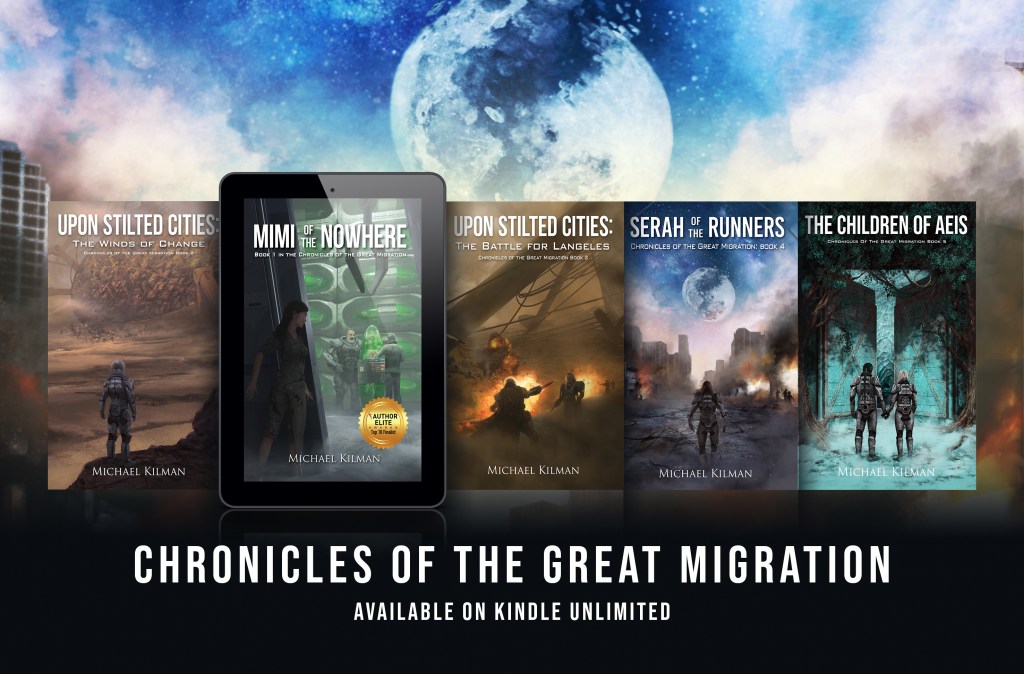
Today is the 4th anniversary of my first novel, Mimi of the Nowhere going live on Amazon, Kobo, and Barnes and Noble. In the last 4 years, there have been four books published in the series since that date, with more on the way. I am approaching the end of the first draft of book 5, The Children of AEIS and expect it to be out late summer.

For those who of you who have been following the series, you may have noticed it’s been two years between book 4 and book 5. Why is this? Well, as I am sure so many of you have experienced, the Covid-19 pandemic made life a bit more complicated for a while. But in addition to that, in June of 2020 I suffered a major head injury during a cycling accident. I struggled to read or write anything for almost 6 months. I would have occasional little bursts of creativity during that time, but I wrote and read very little. I was diagnosed with post concussion syndrome and I can say now, that after almost 2 years, I finally have a great deal of normality with only occasional concussion related issues.

This spring and summer I am back in the full swing of writing. And so there is another announcement. The Children of AEIS became rather lengthy, well over 1000 pages. If you’ve been following the series, you might no why… the world went from one walking city, to multiple, and then in book 4… the whole solar system began to open up. Because of it’s length, I have decided to split it into two books. Which will release within six months of each other. The new entry to the series, means the series will now be seven books in length. Book six is titled, “A War For The Heavens.” While book 5 focuses on the survivors of the aftermath of the Battle for Langeles, book 6 will return back to Manhatsten with their new allies the Lunites, and a conflict that is growing with ROAM. Book 7, A Hand to the Stars, will focus on the final battles for the fate of all remaining walking cities and the solar system itself.

You know, another thing I have been thinking about… my series never really fit quite right into the dystopian literature. Things are hard yes, but not hopeless. There is a lot of oppression, a lot of social control, but there are good things as well. It’s much more complex than the label of dystopian. My project here isn’t to talk about how awful society can be and the fear around the slide downhill… instead, this series is something different. I recently discovered an article on polytopias, about stories where the fundamental driving force of the story is that of change and diversity itself. I realized that the heart of everything happening my fictional universe fits this approach so much better. Definitely give that article a read if you want more info about polytopias. The author correctly points out Kim Stanley Robinson’s Mars trilogy and the Expanse as important examples of polytopias, and stories about change and diversity are definitely my approach.

Thank you to all of you who continue to follow my work. I appreciate every single one of you. I don’t have many fans, but the ones I do are the absolute best.

Why Your Narrative Design Team Needs An Anthropologist or at Least Some Anthropology

Why Your Narrative Design Team Needs an Anthropologist

By Michael Kilman, M.S. Applied Anthropology


I’m an avid gamer and science fiction author. I’m also an anthropologist with over a decade of teaching, fieldwork, and consulting experience. So for me, worldbuilding is everything. A bad worldbuild kills my immersion immediately. And as audiences grow more sophisticated, I hear this more and more from gamers, readers, and filmmakers too.

Which raises a question: why do so many fictional worlds still feel hollow?

Part of the answer is that most narrative design teams are missing a specific skill set, someone trained to see culture as a living, integrated system. Characters across games aren’t just copies of western identity, there are distinct ways of knowing the world that don’t always translate easily across culture. That’s missing skill set is anthropology.

Below are six reasons why bringing anthropological thinking into your narrative design process can transform the worlds you build.


1. Holism: Everything Is Connected

One of anthropology’s foundational concepts is holism. It’s the idea that culture is an integrated system. If you change one facet of culture, you change everything. Think of chaos theory’s butterfly effect: small shifts ripple outward in unexpected ways.

Applied to worldbuilding, this means your fictional economic system, your family structures, your political arrangements, your religion, your ethnic identities, your people’s relationship to death, their biology, their environment, all of these are deeply interrelated. They shape systems of power, freedom, and oppression. When you’re building a fictional world, a holistic framework helps you understand how those relationships create meaning, consequence, and true complexity.

Anthropologists are trained to hold this complexity. We work at the intersection of biology, environment, social structure, language, and culture. This big-picture thinking is exactly what most narrative design processes are missing.


2. More Immersive and Realistic Cause-and-Effect

Creating a believable fictional world means thinking carefully about the causes and consequences of every major action. This isn’t just true for individual characters, but the culture as a whole. The most compelling games and narratives are often the ones that let player choices ripple outward in culturally coherent ways.

Imagine if your protagonist made an alliance early in a game with a faction. This alliance created real, culture-wide changes throughout the narrative.  This isn’t just a change in character relationships, I’m talking about changing the religion, economics, political system, or maybe even language of your world later in the game. That’s where anthropology comes in. Anthropologists have more than a century of research on how cultural change actually works and how it manifests across cultures and generations.

When I’ve consulted on these kinds of questions, including with a major tech firm on post-pandemic cultural shifts, we’ve drawn on real historical examples. The 1918 flu pandemic, for instance, fundamentally shifted American standards of beauty. It made sunbathing fashionable, and altered building architecture toward open spaces and natural light. That’s the kind of layered, counterintuitive thinking that makes fictional worlds feel real.


3. Anthropologists Are Intercultural Communicators

Our job isn’t just to study cultures, it’s to help different cultures and subcultures understand one another. We are a kind of intercultural mediator. That’s why tech companies hire UX and Design Anthropologists, and why I’ve worked with clients ranging from Native American tribal governments to Samsung UK on cross-cultural research questions.

Intercultural communication is a fundamental part of narrative design. If your world has diverse factions, ethnic groups, or political coalitions, an anthropologist can help you think through how those groups would actually perceive and misread each other. In fieldwork you learn quickly that even the most positive, and well intentioned changes you might make to a community meets resistance. That’s because, no matter how benevolent the change, someone will always lose and in ways you may never expect. Building that friction into your narrative design is what makes a world feel inhabited rather than constructed.


4. Diversity Is a Craft Skill, Not Just a Political Position

There’s a lot of conversation right now about representation and diversity in games and media. Culture wars are near constant in the social media sphere. But here’s the thing, lack of diversity isn’t just ethically problematic, it’s bad storytelling. The world is complex. Fictional worlds that flatten that complexity feel wooden and vacant.

The challenge is that writing cultures unfamiliar to you requires more than good intentions. True inclusion requires research, consultation, and ideally collaboration. Anthropologists can help mediate that process. We’re trained to identify the blind spots in our own cultural assumptions.

Have you ever considered what you think of specific accents? Why do you think that? Where do your opinions on different kinds of accents come from? These biases don’t just come from personal experiences, they’re formed over time, and through history and conflict. 

Anthropologists have also spent decades thinking about analogs and representations. If your fictional culture is standing in for a real one, you need to know what you’re doing. An anthropologist who has worked directly with those communities are ideal, they can help you navigate your own assumptions and open up your fictional world in a way you never considered before, a way that makes your story vastly more interesting and immersive.


5. The World Is Full of Untapped Source Material

Every culture is a dreamscape, a world made through symbols and imagination. One of the biggest missed opportunities in speculative fiction is that it only draws on a tiny sliver of possibility. The same alien invasion stories, the same European medieval settings, the same recycled mythologies, and gods, and political archetypes, and economic systems appear over and over. To be fair, it’s not that these traditions aren’t rich and wonderful on their own, it’s just that they’ve become predictable and stale, a singular worldview that no longer makes us question our own thinking with wonder. They just don’t stand out anymore.  

The world contains thousands of distinct cultural traditions, belief systems, governance structures, and cosmologies that most Western narrative designers have never even thought about. I made this exact argument in my TEDx talk, because, what we imagine matters.

Consider the game Never Alone (Kisima Inŋitchuŋa), made by and for Iñupiaq people, featuring the indigenous language and unlockable interviews with Iñupiaq elders. That game didn’t just tell a unique story, it expanded the possibilities of what games can do. It’s beautiful, and complex, and driven by the culture it comes from. There’s nothing else out there quite like it. It stands out because it offers another way of knowing/being in the world.


6. Anthropology Is a Toolkit, Not Just a Perspective

Everything I’ve described above isn’t abstract, it’s practical and in the era of AI, more necessary than ever. AI is capable of generating an incredible amount of mediocre and predicable media. Anthropology is an edge in worldbuilding and storytelling. It gives you concrete tools: frameworks for analyzing kinship and power, models for understanding how religion and economics interact, methods for identifying the cultural logic behind social norms that seem arbitrary.

My colleague Kyra Wellstrom and I built some of those tools into a book titled: Build Better Worlds: An Introduction to Anthropology for Game Designers, Fiction Writers, and Filmmakers. It distills over a century of anthropological research into an accessible guide that doesn’t require wading through academic textbooks.

On my YouTube channel I also host live Worldbuilding Q&As every month called, “Ask an Anthropologist.” I also bring on special guests. There you can also find my social science explainer series, Anthropology in 10 or Less, and soon my new series launching this spring, Anthropology Through Science Fiction. I’ve been translating these same ideas into free, accessible content for creators. And in my worldbuilding consulting practice, I bring this toolkit directly to projects.


Ready to Build a Better World?

I’ve spent 11 years teaching anthropology at the university level, published research on how worldbuilding works as a pedagogical tool, and consulted for clients ranging from indie fiction writers to major tech firms. My fiction, including the dystopian sci-fi Chronicles of the Great Migration series and my dark fantasy novel Shades & Shapes in the Dark are built on the same anthropological foundations I’m describing here.

If you or your team is serious about creating fictional cultures that feel authentic and immersive, I’d love to talk.

Book a free 10-minute consulting call →

Or explore free worldbuilding resources, essays, and video content at loridianslaboratory.com.


Michael Kilman holds an M.S. in Applied Anthropology (focus: Media) from Portland State University. He is the author of the Chronicles of the Great Migration series, Shades & Shapes in the Dark, and Build Better Worlds. He is also known for his TEDx talk “Anthropology, Our Imagination, and How to Understand Difference.”

My First Three Novels are Free till March 25th!


If you’ve read my posts and enjoy my work and haven’t checked out my book series, The Chronicles of the Great Migration, now is your chance to get the first 3 books in the series totally free until Friday March 25th. My books are leaving KU permanently and to celebrate, I thought I would run a free promotion for the series.

Mimi of the Nowhere, Upon Stilted Cities: The Winds of Change, and Upon Stilted Cities: The Battle for Langeles are totally free until this coming Friday.

Feel free to share the link to as many people as you like. And, if you do read the books, all I ask is you leave a honest review.

Terminal Decay: A Short Story in the Chronicles of the Great Migration

Recently I have decided to take some of my unpublished short stories in my sci-fi series, The Chronicles of the Great Migration and begin recording them and uploading them to YouTube. This will be an ongoing series with occasional releases that add to the world in which my story takes place.

The first entry in this series is titled Terminal Decay. In it:

A sentient satellite falls to earth and reflects on it’s life and the state of humanity, who is now relegated to living inside giant walking cities.

I hope you enjoy it!

Cover Reveal for The Children of AEIS!!!

The Children of AEIS, the fifth book in my sci-fi series The Chronicles of the Great Migration, now has a cover! I am so incredibly happy with this cover. The artwork for this cover was created by the very talented Jon Stubbington. Definitely check out his amazing work.

Though I don’t have a firm date for release for the book yet, it will certainly be out before the end of spring of 2022. The Children of AEIS is the penultimate entry into this series, followed finally by A Hand to the Stars.

From the back of the book:

In the penultimate entry of the Chronicles of The Great Migration, Alexa Turon, Runner 17, Major Daniels, and their allies must learn the secrets of the mysterious AEIS and the underground city of Lastion if they hope to discover the key to defeat Miranda once and for all. Above, those aboard Manhatsten scrambles to deal with a new crisis from ROAM.

But from the ashes of the Battle for Langeles and the conflict with the Children of Gaia, a new power rises, one unlike any the world has ever known. It has only one goal, to consume.