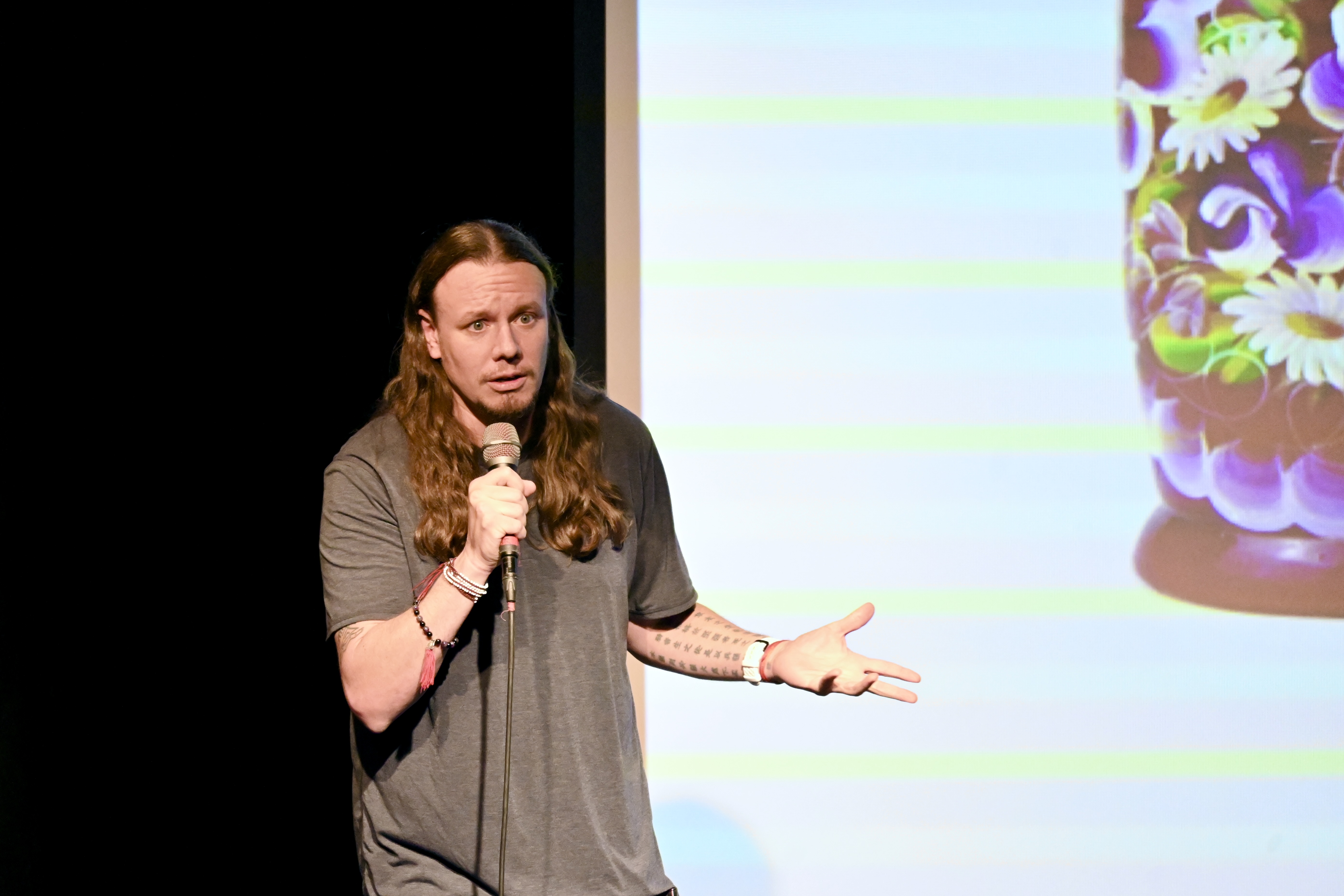
Wednesday Night October 9th I had the good fortune to share some of my ideas at the live event, Ignite Denver #41. My topic? Stories Will Save the World.
You may have heard the phrase uttered by Neil Degrasse Tyson and others, “We Are Made of Star Stuff”. It’s true, we’re made of the things born at the beginning of the universe. But my talk was about something else. We’re Also Made of Story Stuff. But we’re not just our story. We’re characters in countless stories, those of your parents, your friends, your family, passing acquaintances, that jerk who cut you off on the highway, and yes, you are the villain in someone else’s story.
We Are Made of Story Stuff and that’s why, It will be stories that save the world.
A few weeks ago I went on the UK based Open Minded Podcast to talk about Anthropology. On Episode 36 titled “What It Means to Be an Individual” We covered a variety of concepts and it was fun and very organic conversation. You can find it below.
I just turned 40 this month. And I saw someone the other day ask on Facebook, what’s one piece of advice you would give your younger self? And I thought, my younger self was a stubborn ass and had to learn everything the hard way. But then after a conversation with one of my children, I got to thinking, would there be anything I could tell that might help younger me?
So this is it. This short essay is the answer, but really it all comes down to one line:
It is dangerous to believe everything you think.
No matter what you think of yourself, every person you meet thinks you are a different person than you do. Even the casual or passive encounter, has a model of you in their head, a projection of what they think about you and what your reality means to them. They may love you or curse you, or simply want to get around you in the grocery aisle. But no matter what you think of yourself, every person you meet thinks you are a different person than you do.
This is why it is dangerous to believe everything you think.
We are wrong all the time. Our brains see patterns in things that aren’t there. We see the closet monster or the coat hanging on the chair in the dead of night and feel dread and fear. We see a text message and assume it means one thing when it means another. We will take insult when none was offered. We are wrong all the time.
This is why it is dangerous to believe everything you think.
We are myth-making machines. We make myths of the day ins and days out of our lives. We talk about how wonderful or terrible it was that something happened to us. Is happening to us. Will happen to us. We will be epic heroes cheered by crowds and perhaps an attractive mate, or victims of grave injustice, but always the starring role of any scene. Because in myth it’s often a lone hero saving the day. We are myth-making machines.
This is why it is dangerous to believe everything you think.
Stories are symbols of the real. No story you tell is ever real, it is only your model, your projection of the real from your perspective. But your perspective has been shaped from the moment you drew breath. Every experience, every bit of culture taught to you, has shaped the way you approach a topic, a moment, or even an emotion. Stories are symbols of the real.
This is why it is dangerous to believe everything you think.
Our emotions possess us sometimes. They take away our sense of proportion. They make you eat more, or eat less. Sometimes we welcome that possession in some dark corner of our mind, addicted to our outrage, or fear, or sadness. Or emotions can be like a stranger, climbing inside of you and taking the reins until they are burned out, and then we are left standing with the mess they have made. In one moment, we can undo years of work, trust, or effort or even destroy lives. Our emotions possess us sometimes.
This is why it is dangerous to believe everything you think.
We are all traumatized, at least a little. Some of us carry around gaping holes in our stomachs from the emotional damage that life thrust upon us. Others carry a hundred smaller wounds, that while not deep, still leave scar tissue. And so, we see through the lens of our pain and misfortune. Our brain prefers a negative bias, because, after all, it kept us alive in ancient times, to assume the worst of everything. So we are stuck with a brain wired to fixate on our suffering and sometimes seek our own dissatisfaction. We are all traumatized, at least a little.
This is why it is dangerous to believe everything you think.
This last fall I was a guest on three podcasts. Two of those podcasts have gone live already. The final one just came out yesterday and is live on YouTube. I had a lot of fun on this episode. We talked about a whole host of different topics on life, culture, anthropology, art, AI, change, and the future. Check out our conversation at the link below
Do you feel stressed just thinking about a few of your relatives who will create contentious conversations? Who are difficult to deal with? Are you ready for the holidays to be over before they begin?
The best advice is usually to avoid those thorny conversations, to find common ground, and focus on stuff you agree on. It’s good advice. But that’s not always possible. Sometimes you can’t avoid the tough conversations. So why not find ways to make them easier over time?
Ram Dass famously said, “If you think you are so enlightened, spend a week with your family.” And it’s true. Our families can be the most challenging group for us to deal with. There is so much history there that they can struggle to see the person you are now, as opposed to the person you used to be. It’s easy to forget that people change when you’ve known them for decades, especially from childhood.
I’ve been teaching Anthropology, Cross-Cultural Communication, and Diversity for almost ten years. So, I thought maybe I would offer up a few tips to help you navigate the holidays and how we can start healing the division we’re all experiencing.
Before I dive in, I want to ask you to read the whole thing. Quite frankly, when I am out in the world discussing this stuff, people will often interrupt and dismiss some of these tools for a variety of reasons. I will address most of this below, so even if you don’t agree with something I write, I encourage you to keep reading till the end because your question might be answered.
1. Listen to Understand, Not To Be Right
When I teach classes on diversity or communication, students are assigned reading reflections. In the first portion of these assignments, they must fully summarize an article with the core ideas, and the evidence the author is using to make their claims. They are not allowed to inject their opinion in the summary section. Why? Because before you can critique an argument, you have to fully understand it. So, before they are allowed to share their opinion, in the following section, they must first demonstrate they can summarize someone else’s argument.
This is an important life skill.
When someone has contrasting beliefs with our own, we tend to shut down and stop thinking critically. The walls go up. Then we accuse the other person of a lack of critical thinking or ignorance or dismiss them in some way. Who is right and who is wrong isn’t really the core issue here. Neither side is hearing the other and so no one will see a way across the divide.
Don’t listen to someone to prove something. Don’t listen to someone to be right. That is just an emotional reaction. You have allowed your emotions to take possession of you. This means the other person will also react emotionally and the conflict will escalate, and both parties will walk away miserable.
What to do instead?
Take a breath and listen. Don’t just listen to what they are saying, but try to understand where their concern comes from. What’s at the root of their fear and anxiety? It’s often different than you might think. What are their desires? Their hopes? What does a good future look like to them?
This leads to the next point…
2. Ditch the Devil’s Advocate
After nearly a decade of teaching, I’ve come to believe that the Devil’s Advocate approach is well, a devil. Meaning that it’s rarely a useful approach. The position of the Devil’s advocate masks itself as sincere critique, but most of the time, it ignores the concerns of the other person and seeks only to undercut someone else’s argument. It’s often dishonest, and disingenuous.
There are spaces where it’s possible to use the devil’s advocate well. If you’re in the midst of a debate in some kind of performative setting, where there is a moderator or someone able to continually keep both people in bounds, it can work. But the Devil’s Advocate isn’t a tool to persuade someone to your side, it’s to persuade an audience to your position. That’s a completely different tool. You’re not going to connect with the person you’re arguing with by using the Devil’s advocate approach, at least not usually. Yes, there are some people who can get something from this approach, but again, in my years of teaching on these topics, I’ve found nine times out of ten, it causes more problems than it solves.
What to do instead?
Use a kind of soft Socratic approach. You have to be gentle with this approach because remember, Socrates pissed enough people off that they made him drink poison. The goal is not to make the other party feel stupid or ignorant (which is what got Socrates killed) but to open the door for them to think about their viewpoint. Ask questions motivated to understand what the other person is saying. These questions should be rooted in an earnest curiosity to investigate their true thoughts and desires.
You’d be surprised how many people build a wall with their beliefs to try and prevent themselves from feeling overwhelmed by information. Soft Socrates can help them recognize that wall, to see that they’ve created a blockage between themselves and others.
How do you do this?
Don’t try to argue your beliefs. Don’t try to make appeals that work on you. Everyone has empathy, it’s a matter of who they have empathy for, and what they feel personally connected too. If someone doesn’t like immigrants, talking about women and children suffering, isn’t going to work in a direct approach.
Ask questions that show them you are empathetic to them, that you’re willing to listen and want to understand them. This builds rapport and creates space for them to share their deeper feelings and thoughts over time, and allows you to speak to them in a way they may understand in the future.
Again, you don’t have to agree with their beliefs or ideas (you can disagree with them intensely), but being able to summarize someone else’s argument effectively, is a really powerful tool for a number of reasons. Remember, this is just a conversation. Nothing is lost if they don’t ultimately agree with you, because, well, they already don’t. So ask lots of clarifying questions. If you can understand their point of view, you can learn to speak their language.
Ask questions like:
You keep bringing this up. Why is this issue more important to you the others?
Can you help me understand how and why you came to that conclusion?
If they got their ideas from a media personality consider: Where do you think that this person got their ideas and information? Have you seen this personally?
Was there something that you experienced that made you feel this way?
How might someone else interpret that experience?
It sounds like you’ve spent a lot of time thinking about this. I have too. But do you think you can explain the beliefs of people who disagree with you? Do they all think that way?
How do you think the other side came to their beliefs?
Why do you think their conclusions are as important to them, as your conclusions are important to you?
What do you think is important for other people to know about this topic? Why is that?
Is there another way of thinking about that issue that you can at least partially agree with?
What do you have in common with the people you disagree with?
Wow, it sounds like you care a lot about this issue. How can we solve this issue in a way that benefits everyone involved?
The point with this approach is to establish common ground and to get them thinking that there are other ways of interpreting the same information. You’d be surprised how often someone who believes the opposite things as you, wants very similar things.
In general, people want to know that their basic needs are going to be met. They want to have the peace and freedom to pursue their interests and desires, and that people will care about them when something happens. Yes, even bigots want these things.
Context – The cultural system into which someone was born. This includes all the available cultural knowledge they grew up with, the time in history, and important historical events that will have shaped their thinking. This is the entire system into which they were born, not their personal experience.
Conditions – These are the personal experiences that someone has had in their life. What kind of exposure to different ideas have they had? What challenges have they faced? What are their religious beliefs, language, gender, class identity, and so on. How do these compare to the norms of the culture (does that create conflict or perceived conflict for them?) These are their experiences within the system they were born.
Choices – Once you have taken the time to understand a person’s cultural background and personal life experiences, you can begin to understand many of their choices, their political opinions, their religious beliefs, and so on. This doesn’t mean you agree with them, but this exercise is to help you recognize them not as that ranting irrational person you can barely stand to be around, but as a complex person who has different thoughts, desires, emotions, and needs.
Humanizing someone is important. Dehumanizing someone is the first step to violence. That doesn’t mean you like what they believe (especially if their beliefs are dehumanizing), it doesn’t mean you agree with what they are saying, but understanding is the starting point to a more cohesive coexistence and to find ways to solve problems.
People do not usually change their minds because someone screams facts at them. They have to connect emotionally with the facts. If you connect with them, and you build trust, they are far more likely to listen to you and given enough time, change their mind.
There are no quick fixes here. People don’t come to hate something in a singular moment. It takes time. Either they are born into a way of thinking and they are raised with it, or something happened to them to put them in a vulnerable position where the seeds of hatred could grow. Hate usually grows from outrage, and these days, all of us, across the political spectrum, consume media that purposely makes us feel outraged. That’s how these companies make their money.
That’s actually optimistic because we’ve created these problems. That means we can uncreate many of them.
4. This won’t work every time, and it takes lots of practice
As someone who has not only taught diversity for a decade but has lived and worked among other cultures, I’ve heard every argument for why we should or shouldn’t appeal to the humanity of someone who disagrees with us.
Things like:
“You can’t be tolerant of someone who wants to end your existence.”
“Some people just thrive on chaos.”
“They are a narcissist (or some other reason they will never listen).”
“They are willfully ignorant and will never change their mind.”
“I know better because I’m older and more experienced.”
“They are too old to change their mind.”
“They could never understand what I’ve been through.”
“Their generation has xyz issues.”
Maybe these are true. Maybe you’re right and that person will never listen. Have you tried the above approaches? Have you put down your weapons and tried to talk about these things, not to win, not to be right, but to understand? Maybe you have. Maybe my advice doesn’t work for the person or people you’re thinking about.
But it will for someone. And in a world where so many of us feel the rising conflict, every person who listens counts. Every courageous conversation counts. It’s often the little acts that change the world, that bring communities together.
People doubt their beliefs, especially when there are obvious holes in what they think. People are aware at some level, of their own cognitive dissonance. It’s why they get so angry when presented with a sincere challenge to their worldview. When you attack them, it gives them a reason to put aside their doubt, and build a higher wall.
But if you approach things from a different direction, if you meet their walls with an olive branch, sometimes they will open the gate. Given enough time, they might start to take bricks off that wall, enough that they can start to see over to the other side. Even if they never fully change their mind, softening their view can deescalate potential violence and conflict. Even if becomes, well, we know we can’t approach that topic but we still love and care for each other, that’s a victory. If you have even 10% more peace during your holiday. That’s a victory.
No this won’t work every time. It might not work the first time, or the tenth, but if we care about this person, or ever cared about this person, we must remember their humanity.
I am definitely not perfect. I screw this up all the time. Ten years of teaching, and I can’t always make it work. There are some people, and some things that just get under my skin and I have a hard time seeing past that. But over time, that’s less true. Over time, I can talk about complex issues such as race, gender, or oppression in ways that are more accessible and thought-provoking, less attacking, and more about developing connections.
I’ve been the angry activist on the street, screaming and shouting for tyranny to end. I’ve written no end of essays and articles about injustice. I conducted graduate research on media and representation and saw all the terrible ways our system treats differences. I’ve struggled with elements of my own identity for most of my life. I grew up in a deeply segregated community on the East Coast and didn’t understand anything about diversity. But I learned. I changed. I continue to make mistakes and reflect so that I continue to grow.
It’s know it’s hard to be the bigger person, really hard. But I promise you, the payoff is worth it. We just have to try. Sometimes we will make a connection and change things for the better. Sometimes we won’t. But you never know for sure until you try.
I hope you all have a wonderful holiday and some of this is useful.
Our goal in this world should not be to dominate and control, but rather, to empower and encourage the unique qualities of every living being. We should seek to allow the best versions of ourselves to develop and thrive and encourage those around us to do the same. I’ve said it before, our diversity in thinking, experience, ways of knowing, and qualities are the greatest tools human beings have. After all, if we try to tackle the same problem with the same approach time and again, all we do is make ourselves miserable and the problem still won’t be solved. Throughout history, the greatest achievements have always come from collaboration across diverse viewpoints. The greatest works of art, the greatest developments in science and technology, and the answers to our most difficult problems were all solved by applying diverse thinking and skills and collaborating with others.
So why do we fight so hard against diversity and difference? Why do we so often seek uniformity?
The answer is simple, fear and cowardice.
The concepts of strength and courage have, for too long, been equated with the ability to dominate, to control, to create order and hierarchy. But neither strength nor courage is really about these things. These notions are falsehoods perpetuated by longstanding narratives and myths that reinforce existing structures of domination and control. Essentially, the reason we’ve come to feel that strength and courage are about these things is that those in power have used that narrative to legitimize their abusive system.
What do I mean by an abusive system?
Regardless of which political or economic system you employ, it becomes abusive the moment that it creates a situation that takes away people’s agency. This isn’t an argument for libertarianism though. This isn’t an attempt to say we should undo government regulation. There are many ways you can take away people’s access to society, and deregulation of the private sector and creating a situation where those with money and power have no accountability to the people they impact with their choices can be just as destructive as systems with governments that have too much power and too much invasion of your privacy.
An abusive system is one where a large portion of the population struggles to meet their basic needs and are chasing after safety, security, health, and must suppress their skills and talents to survive.
Any system that causes suppression of our creativity, our dignity, and eats up most of our free time, is an abusive system.
An authoritarian government is an abusive system.
A system where a small minority of people control the majority of resources is an abusive system.
A system where you are discriminated against because of either outward features or inward abilities, is an abusive system.
A system where there is only one right way of thinking and there is no opportunity to play with ideas is an abusive system.
Anything that stifles agency and creativity is abusive. Nor can we forget that freedom must be partnered with accountability. For if your freedom erodes the freedoms of others, and there are no consequences, this too creates abusive systems. Freedom without accountability is nothing more than a weapon wielded by those who are already powerful. Freedom without accountability has the possibility of becoming tyranny.
The American ethos is one that is supposed to value ingenuity, persistence, creativity, innovation, and the opportunity for individuals to improve themselves. We often point to the narrative of bootstraps, one that suggests that with hard work, anyone can make something of their life. But the sad truth is, we don’t have a system that values that at all. We have a system that uses the idea of the self-made person to suppress the best qualities of the American Ethos (See my posts How to Understand Poverty and Success is Luck for exactly why this is true) and further empowers those who already have wealth and power in our society. The current incarnation of this has been heightened since the end of the 1970s, but certainly is not unique in the history of this country or indeed across quite a few cultures. Though, as David Graber and David Wengrow very successfully demonstrate in their book The Dawn of Everything, nothing about this system is natural or inevitable.
The thing is, we could absolutely cultivate those values. We could create situations where anyone who wants to pursue their dream and work hard, has the support to be successful. But as long as we measure success by the ability to dominate and exploit (basically wealth as a measure of success) we can’t have those things at all. As long as we hold up excess, self-interest, and competition as the cornerstones of our system, the majority of the population will never have the ability to meet their potential. Competition isn’t inherently bad, but when the result of competition is the destitution of some of the population, then we have missed the point. We have simply replicated the pattern of domination and control.
What does this have to do with strength and courage?
In order to justify an abusive system, you have to create propaganda. As Michael Foucault once stated, (paraphrased from his book Discipline and Punish) every system of power has the same problem. It must seek to enact that power at the lower possible cost to those who wield it. In other words, the best way to keep control is to convince people to police themselves, to enforce the morals and ideas that allow you to maintain an abusive system.
The concept of masculinity has been deeply tied to notions of strength and courage. We see action heroes in media dominating people around them. We have competitive sports that, even when they are about teamwork, often highlight who can do the most damage. We see propaganda on news outlets and in commercials about what it means to be a “real man.” The work of sociologist Jackson Katz looks at how we use these ideas to reinforce an abusive uncaring system that hurts men and honestly, everyone else. If you haven’t seen it, I highly recommend his documentary “Tough Guise 2” which further elaborates these points and offers significant evidence. He also has a body of written work and research worth considering.
Strength has nothing to do with whose ass you can kick. Strength and courage are about adapting to whatever circumstances you find yourself in and finding a way to press forward. Strength and courage are not about the individual, but about creating connections with others to navigate through difficulty. There is very little in this world you can do entirely on your own. You need other people to help you to achieve your goals and dreams. It takes courage to take a risk and go after your dream, but it also takes support from others. Often, people can’t take risks unless they have the right kind of support or circumstances.
To open, to be vulnerable, to admit when you are wrong, and to journey into the unknown, this is the nature of true courage. And when you encounter things that make you uncomfortable, strength is the ability to persist and the attempt to understand. Strength is not lashing out in fear. Strength is not painting a picture in your mind of why someone is your enemy, why someone is wrong, and/or how you must dominate them to prove yourself right. Strength and courage are doing your work honestly, sharing your knowledge, and then stepping back and allowing your contribution to speak for yourself. Strength is embracing the truth, that all beings are our relatives, and have been our mothers in the past. For there is no place where we begin and end, we are an ever-linked and interconnected part of the whole being that we call life.
It’s a great taboo to assert that success (defined here as recognition and financial success because there are many kinds of success) comes largely from luck. Of course, hard work plays a role in success, but luck, timing, and connections are so often an even more powerful force.
But wait, you say, I worked hard to achieve all the things I have!
Did you work harder than everyone else in your field who never achieved the recognition and success you found?
What’s more, the difficulty of work is quite relative. Who works harder each day? The construction worker who uses their body to build things? The janitor who cleans toilets and prevents the spread of disease? The coder who, versed in a computer language, reshapes technology? The doctor who saves lives? The teacher who must train the young minds of the future? The manager, who must organize the rest of the labor at a restaurant? We compare the kinds of labor and justify how much people make based on entirely relative notions, that are steeped in luck. Not everyone is born in the right circumstances to take advantage of education and technology.
So, we tell ourselves so desperately that hard work = success because the reality is, we are too embarrassed to admit when we are successful that luck played an enormous role. A person can work twelve-hour days for the entirety of their life, rarely miss a sick day, and always be on time, and can still die destitute no matter how well they manage their money.
But wait you say again, I did work hard to get where I am at!
You did. No one is seriously denying that unless perhaps you won the lottery or something, which is just another kind of luck.
Again, did you work harder than everyone else in your field who never achieved the recognition and success you found? Did they want their success less than you? Perhaps they didn’t visualize the goal as hard as you?
To assert so, would be the worst kind of arrogance. We have created a system with far more losers than winners.
So what then are we rewarding with financial success and recognition? It is not hard work. It’s luck. And mythmaking about how Europe came to power, plays a role in the modern idea of hard work equates to success.
Perhaps an element of the modern Western notion of hard work equates to success is an example of how the myth of exceptionalism, born in a narrative of superiority during the rise and justifications of the horrors of colonialism, is nothing more than a defense of the fact that ultimately success is overwhelmingly about luck. The West isn’t exactly unique in this belief, but it’s certainly a core justification of the structure of our world at this stage of history.
The rise of Europe, like so much of history is about luck and timing. Europe was in the right place at the right time after the collapse of the Mongol empire. Then, hit by the black death, the traditional power structures crumbled at just the right moment for change to surge forth and give rise to a new merchant class. This increased trade and brought wealth to Europe, which alongside many other cultural and social processes, brought increased power to several kingdoms. Competing for dominance, these kingdoms began their colonial project.
I am oversimplifying these incredibly complex processes of course (a few sources for further reading are listed below if you are interested), but luck and timing also lead to the rise of every empire in history. Most of the tools and technology and knowledge that Europe used to launch the colonial project came from other places around the world. Very little of the technology required for the colonial project originated in Europe itself.
True, Europe improved upon many of these ideas, but that’s not unique. This is true of every empire. One of the things that make empires powerful is their ability to take a wide variety of ideas from diverse populations and cultures and turn them to their advantage. Empires are great at synthesis. If they aren’t they either never rise, or don’t last very long. But during the late 15th century, Europe had the right conditions and was in the right place at the right time. Europeans had the opportunity to synthesize much of the available knowledge and technology of the known world at a moment and, with several other factors at play, succeeded. The greater their reach grew, the greater access they had to technology, knowledge, and resources, thus deepening their power.
The powerful always imagine the past in a way that justifies how they seized said power. We always need a justification for our less-than-favorable qualities or actions, especially when we know we are doing things that are deeply problematic.
Shifting back to the individual level. The talent of exceptional individuals largely went unnoticed throughout history because people were marginalized through an accident of birth or circumstance. What if Mozart had been born a slave? Or Rumi a serf under a feudal lord. Both were extraordinary, and both were incredibly lucky to be born in the time and circumstances in which they lived. There is no doubt the world would be poorer had these individuals never had the opportunity to explore their unique genius. And yet, we have squandered so much human potential throughout history. How much genius has been lost to terrible systems of oppression?
At the very core of our experience is luck. Ideologies around the world, both secular and religious, have tried for centuries to justify why some are born lucky, and some are not. The Hindu caste system, the divine right of kings, the concept of manifest destiny, or even hate groups that believe they are born superior to others, tout their superiority and supremacy to justify the suffering they inflict on others. The bootstraps myth of American life (the concept of which was originally a satire of what the elites said about the poor since you cannot physically lift yourself by your bootstraps), is yet another justification of oppression. The powerful justify their power through a narrative that makes them feel special, while othering the very people that they build their power from through exploitation.
Why do we fight so hard to discount luck? What is it that so many people around the world who are successful in one way or another, feel it’s almost taboo to say they were born lucky? Certainly, some of us who are unlucky, do not have such reservations. I don’t. Part of it may be our need to create meaning in a world that feels meaningless. Part of it may be the storytelling and mythmaking that are so deeply embedded in the human brain or the pattern-seeking systems in our neurology. Regardless of the why, creating political and economic systems that reward luck and discount the important contributions of everyone in a community, has disastrous consequences for a large majority of the human species both historically and presently.
Many of us are obsessed with the narrative of the great individual, the idea that some people just come along and reshape the world. This is only a partial truth. The remarkable individuals are often just great synergists. They, for all their luck, come along and take many ideas and concepts and frame them in a new way others had not considered before, adding only a little to the existent and much larger body of knowledge. The light bulb, for example, is often credited to Edison, but, not only did it take a huge existing body of research and knowledge for Edison to synthesize the idea, but he also wasn’t the only one at the time to have come up with it. There are several individuals credited (Nicola Tesla, Hiram Maxum, and Joseph Swan to name just a few) with its invention at the same time. But, because of luck, politics (in this case patent laws), and power, Edison is credited as the brilliant mind who brought the invention to light (pun intended).
Did Edison work hard to synthesize his idea? Sure. How many of us have grown up hearing about his incredible number of failures in his process, which from a scientific standpoint isn’t all that remarkable anyway. Plenty of researchers plug away at their subject for thousands and thousands of hours and run thousands of experiments before they find any kind of success. Some ultimately fail, which also advances science. No, there is nothing particularly special about Edison. So again, I ask, did Edison work harder than any of the others who succeeded as he did or the others who tried just as many times and failed? Consider the conditions of Edison’s life that he was able to simply sit around and fail hundreds or thousands of times. Edison was born to a middle-class family. What if he had been born into a family with few resources?
We are not rewarding hard work, we are rewarding luck.
As long as we hold this notion of hard work = success we will always be captives to abusive systems. Some people are just luckier than others. It’s that simple. We all know that some are born luckier. It’s not hard to see. If you were to survey a huge number of people on the streets of any major city and asked, do you think some people are born luckier than others, the majority would certainly say yes.
And luck certainly is not a reflection of character. Some of the most vile people in the history of the planet have been incredibly lucky. Conversely, some of the greatest examples of compassion, have been incredibly unlikely. Do only the good die young? I’m not so sure that’s exactly true but, life is the roll of the dice.
This is why we must end these absurd systems that reward luck. Because many amazing people starve to death every single day. Recently, a dear friend of mine, who was one of the most loving and courageous people I know, died far too young after striving endlessly to just meet her basic needs in life. Life was always hard for her, and she worked hard every single day. Yet, she never saw the rewards of this hard work. And doubtless, if you look around honestly, you will see endless examples of this. No, not everything works out for everyone. That’s simply another platitude to ignore the bad luck of others and justify burying our heads in the sand.
The UN estimates that 25,000 people, including 10,000 children die every day from starvation. Most of these people were born into bad luck or something unlucky happened to them to make them far more vulnerable to an exploitive system that rewards luck and forgets the basic decency and dignity of taking care of other people. These exploitive systems make us less human and more selfish and apathetic. We need to learn to imagine another way of moving through the world, both economically and politically. Everyone deserves dignity. We can do something about this. A failure of imagination is not evidence that the present system we have is inevitable.
So say it with me. Because if we don’t, we will continue down the dark path of indifference. We must start creating systems that maximize human potential instead of squandering it.
This precious human life we have is ever-changing.
We wish things will stay the same forever when they are wonderful, and wish they would change quickly when they aren’t. We are always wishing, always trying to keep the bad at bay or hold the good up forever. But this is an unreasonable ask. All things fall apart eventually. So we become dissatisfied because we hold ourselves to an impossible standard of perfection. All structures are inherently unstable.
We are just a boat, on the ocean, riding the waves and tides. We have so little control over the forces that surround us. Up and down we go in the waves and troughs… waves and troughs. We do not know when a storm might hit, or when the wind might die, or when the sailing is smooth, and the food is plentiful, but we do know we must press on. The journey must continue.
It’s easy to allow yourself to be possessed by your fears, your anxieties, and your frustrations. It is easy to give in to self-pity and hopelessness. It is easy to feel that no matter what you do, nothing goes right. But to quote the band, Bad Religion, “Self-pity is always a case of mistaken identity.”
No matter your outer conditions, you have a deep natural curiosity and joy that lives inside you. You have an inner child who wants to play and explore and thrive, no matter the conditions of your life. For what child, seeing a pile of rubble, doesn’t want to climb up on top and declare themselves ruler of the world?
We rule our worlds. Not in any external way. You cannot control when things collapse or when the winds of changes blow gales through your life. But you can climb on the rubble and declare victory. You can turn toward yourself with compassion. You can live in a state of self-honesty and acknowledge those heavy emotions, but without letting them possess you.
Self-honestly can feel like a dark forest, with unknown shadows lurking behind the trees, at least at first. But when we connect with that forest, when we learn to love the land, we find wonders, medicines, and peace. Be like our ancestors and listen deeply to that land. Be in communion with it. Learn the lay of your own internal landscape. Learn its wonders and beauty.
Be present with yourself, with what is, but be present with all things in all moments. In every moment, there is beauty and joy, even in the darkest times. Life does not stop being beautiful, because we have forgotten. Choose to remember.
Let that child out. Let your life be full of wonder and interest. And when times are hard, be curious instead of furious. Look at the possibilities in collapse. For in the wake of destruction, it is in our very nature, and the nature of all living things, to change and discard qualities and aspects that are not useful anymore. Even our biological evolution is a process of adaptation and removal.
When things go wrong ask yourself, what isn’t useful anymore? Look at both inner and outer elements. Do not just remove everything you don’t like, understand it first. See its wisdom. It may not need to be removed but instead, reorganized. Look inward honestly and see what habits and ideas no longer work. Admit when you were wrong.
Be wary of the advice of others. Test their ideas out for yourself carefully, else you may venture a long way down a dishonest path. We are diverse in experience and motivation. There is no one right way to love life.
When you are honest, space opens inside you. Take that new space you’ve created, and fill it with love. If you love to be in nature, do it. If you love to create, do it. If you love to connect with people, or reconnect, do it. Find ways to bring smiles to your face and the faces of others. Help people to feel authentic, while you develop your own authenticity.
Be creative in whatever form that takes. Build things, explore things, and open yourself up to the wonder of all that is. Remember how many things had to come together, for you to be here, now, at this moment. You are precious. This life is precious. Love it the best you can.
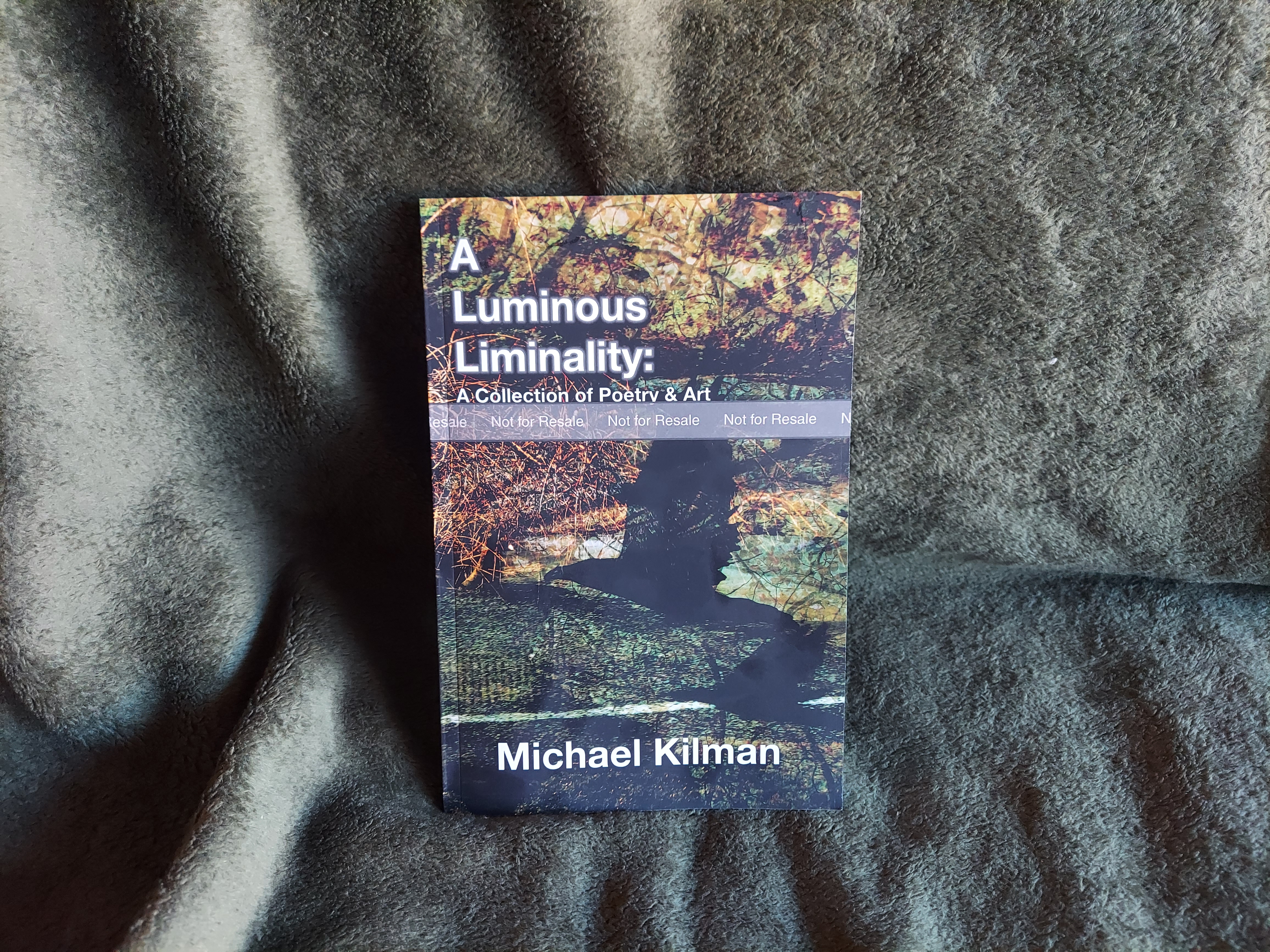
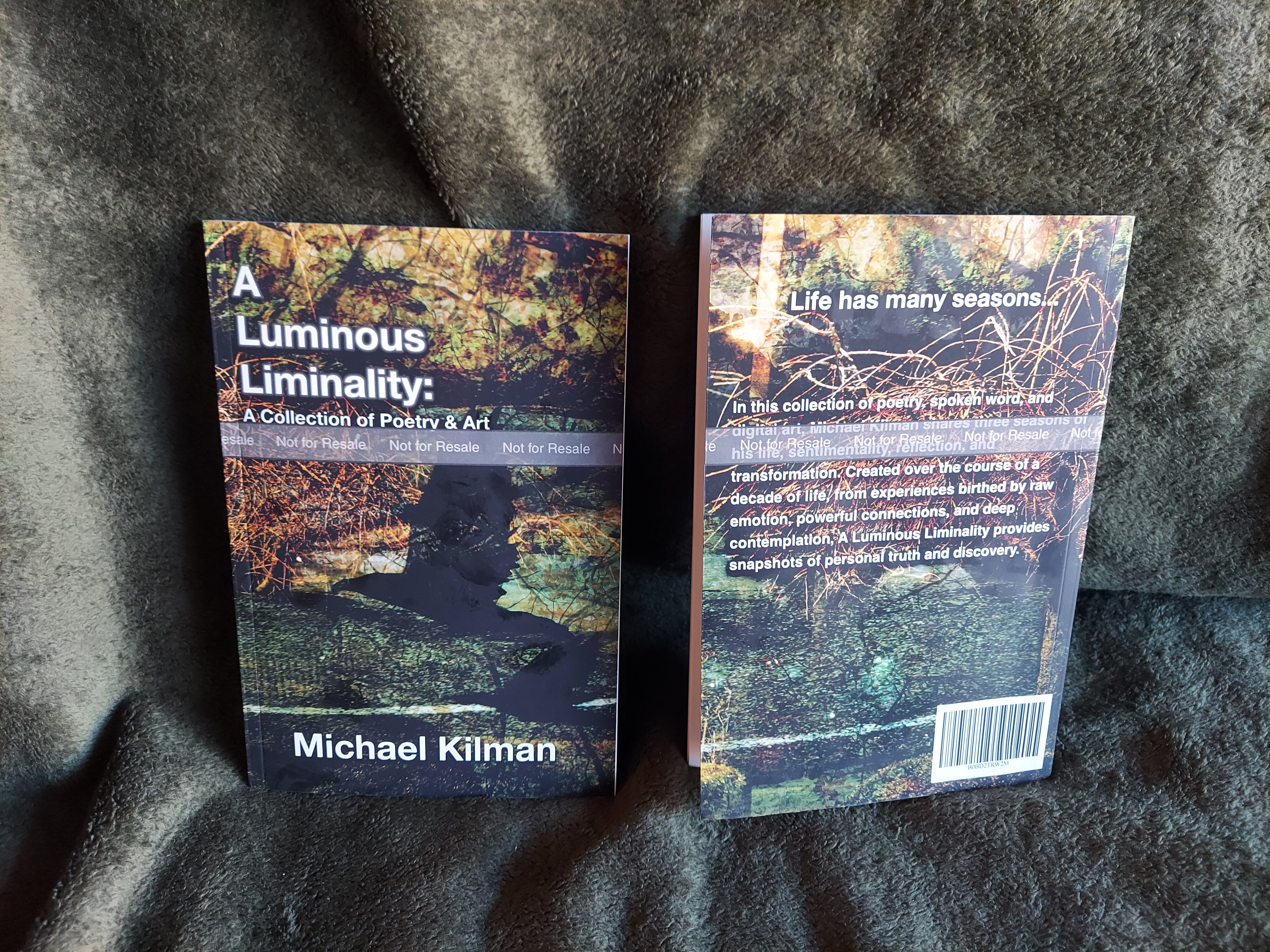
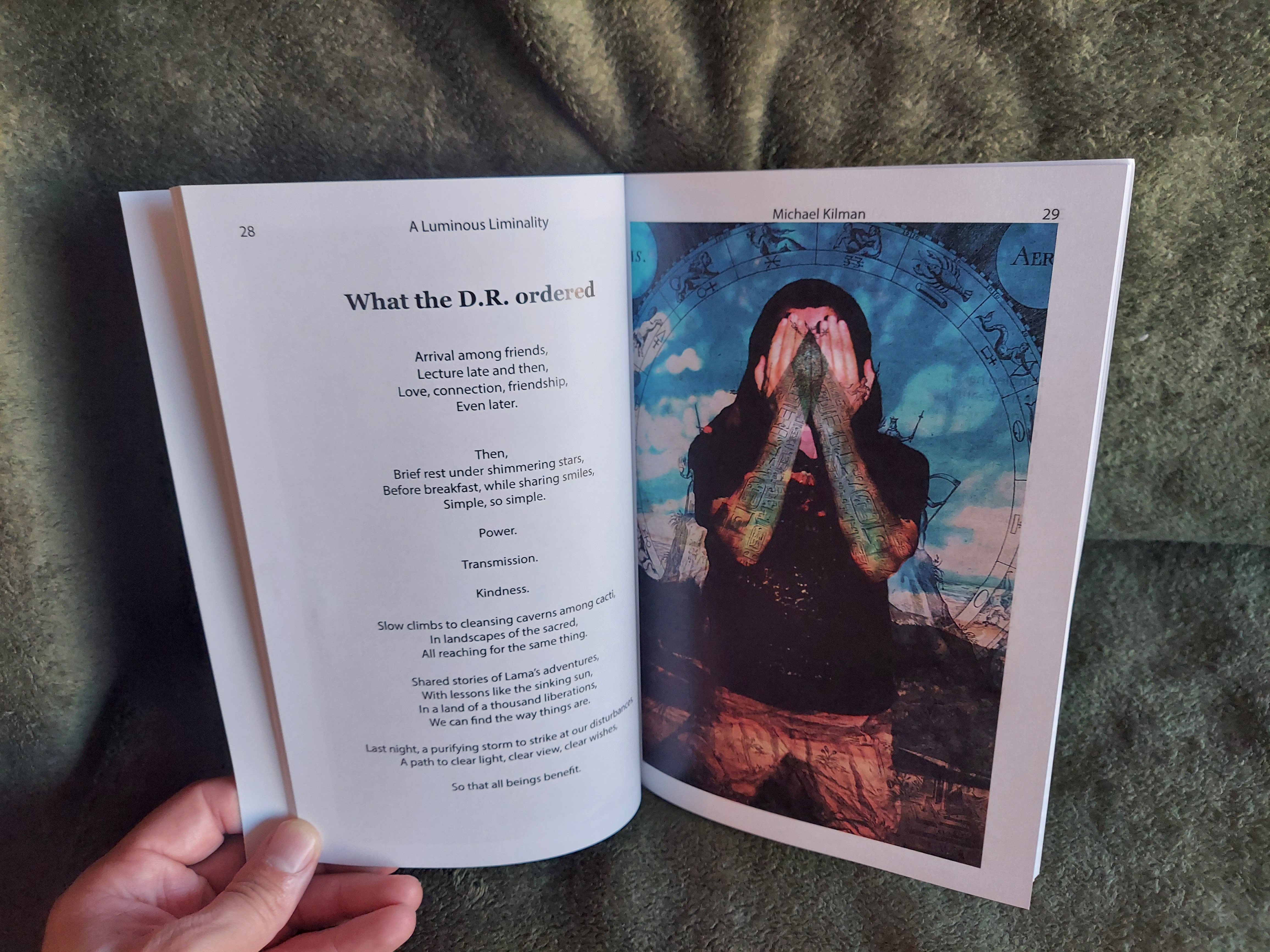
It’s release day for my newest (and sixth) book, A Luminous Liminality: A Collection of Poetry & Art. The book represents 10 years of my artwork and poetry and is my very first collection of poetry and art. This last week I got the first proofs of the book and I’ve included some pictures of the final product. A Luminous Liminality has both an ebook version and a paperback version. I recommend the paperback version to get the full experience of all the color images. Please note that prints are always available for my artwork. You can find my artwork at this page if you’re curious about it.
The book is broken down into three seasons. A season of sentimentality (poems and art about emotional life), A season of reflection (Self reflection and reflection on our culture) and, A season of transformation (realization, personal growth, change). I really wanted to show many sides of my life and experience in this book. There are poems about love, loss, hope, bitterness, frustration, hope, persistence, growth, and meditation. Oh, there’s even a poem on anthropology. The book is really about my journey over the last ten years.
A piece of poetry and artwork both titled “How To Lose A Debate On Purpose.” A quick note, a number of these pieces of artwork and poetry are being compiled into my first poetry book at the moment. It will be out before the end of 2022. More news soon!











 Loridian's Laboratory