A New Podcast and Preorder for Shades & Shapes in the Dark!

Hey everybody,

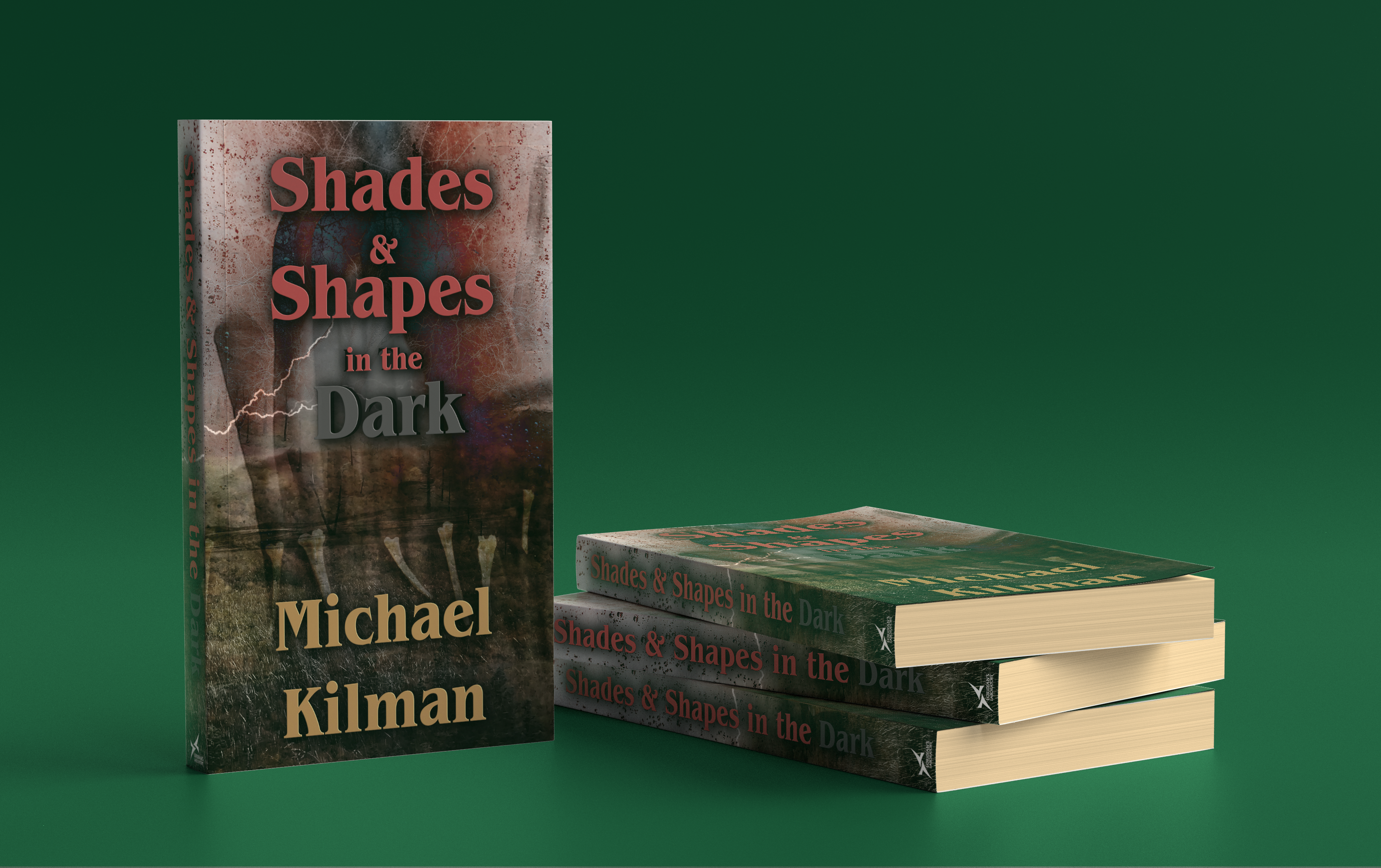
I have two pieces of news for you. The first is that the preorder for Shades & Shapes in the Dark has launched! You can preorder the ebook version from your favorite online store or you can preorder the paperback from Barnes & Noble at this link.

Want to get the book early and for free? I’m looking for 17 more Advanced Review Copy (ARC) readers. Basically, you let me know you want a copy by commenting below or shooting me an email and I’ll send you a copy in exchange for an honest review (yes even if you hate it).

The second piece of news is that me and my good friend Matt Wellstrom are launching a brand new podcast called, Resistance Reads. The podcast will explore the concepts of power and resistances through literature. Our inaugural episode will cover George Orwell’s classic novel 1984.

You can join us at the livestream here on April 19th at 11am MDT out of Denver. https://youtube.com/live/AqlLzQvCBBU?feature=share You can also watch the replay at the same link. Come join our discussion and ask your questions!

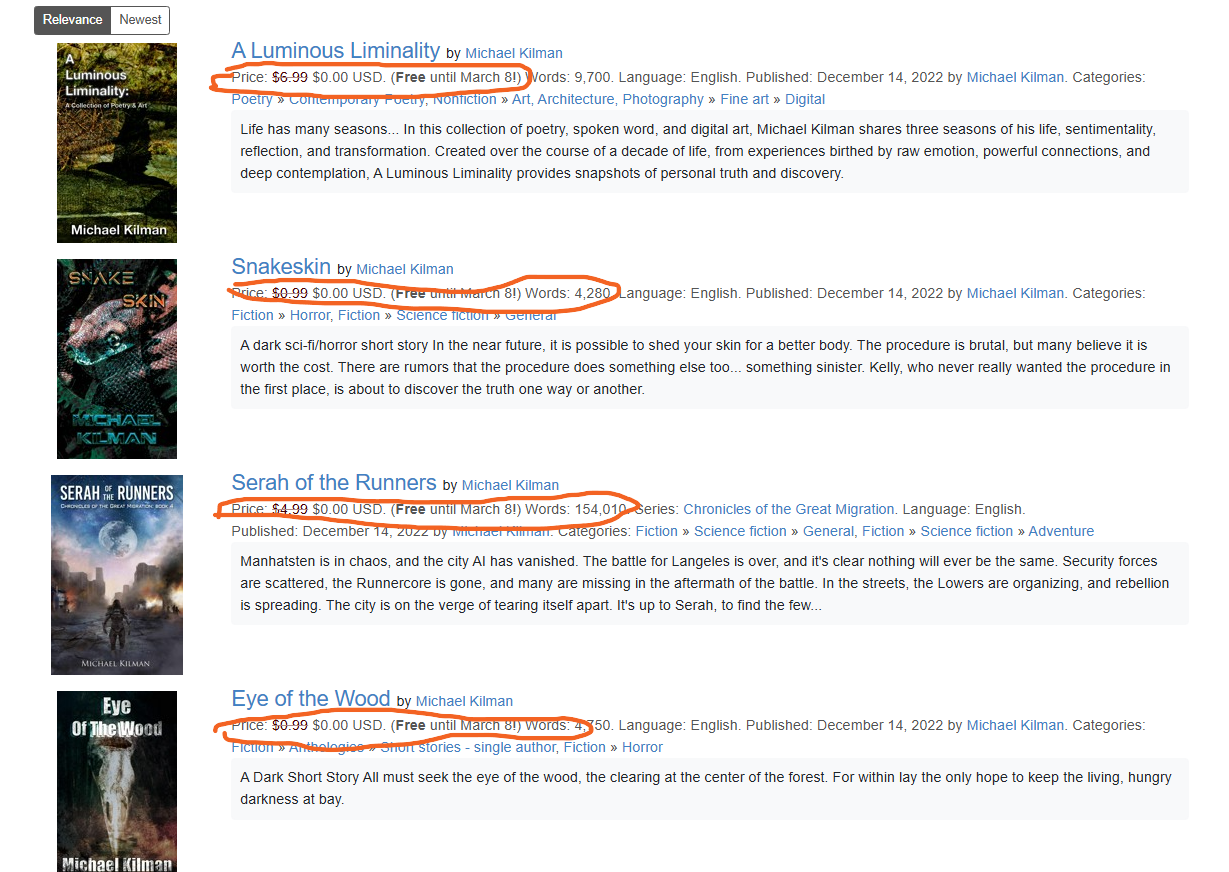
All My Books Are Free Until March 8th 2025!!!

You read that right. Everything I’ve published since 2018 is free for the next seven days on Smashwords. Trying to kick your amazon habit lately? Well, you can buy all of my books on Smashwords instead… or rather, just add them to your library because they are totally free. Even if you already have copies elsewhere, why not pick them up on a different service?


You can find them here at Smashwords!

Mishmash (A Free Comedic Short Story)

Image via Pixabay user azmeyart-design

Last week I entered a contest over at Reedsy for a short story. The prompt I chose was, choose a perspective from a Zombie, Mutant, or Infected Creature. The result? A comedic piece about a Zombie suddenly remembering himself.

It appears that my entry didn’t win, but I had so much fun writing it I thought I would share it with all of you. If you like my other comedic sci-fi stories than this one is right up your alley. Enjoy!

Mishmash

Stumbling forward and dragging one dislocated leg behind him, the creature woke from its viral-infused fugue. Its first thoughts upon waking were, where… how… what… and also, where’s dinner?

It looked around. Gray concrete lined every surface. In front of it, a gray wall rose far above. The creature’s eyes traced the wall up twenty feet or so, and saw dozens of people standing there behind a black railing under an awning. Then, it looked down and saw a moat between them and it. It tried hard to think of where it had seen something like that before, until finally, the image of a zoo popped into its head. He, and yes, it now remembered it was a he, couldn’t fathom why he would be in a zoo. Especially since he seemed to be inside of a pen.

He leaned down and dunked his hand in the water, testing the temperature, but felt no change. It occurred to him; that he felt nothing at all. Looking up, he opened his mouth to ask the people above where he was, but all that came out was a long low moan of “Misssssshhhhhhmassshhh.”

“Wow! It talks, Daddy?” asked a little girl in the pink dress with twin pigtails standing above Mishmash with the crowd.

“Well, zombies can’t talk. Not anymore. They’re too stupid. All they want to do is eat,” said the man, whose long beard hung over his bib overalls.

“Oh.” she paused for a moment and then said, “But it said Mishmash. Isn’t that a word?” asked the daughter. “It sounds like a word.”

“Well, maybe that’s its name. Maybe that’s all it remembers of being human,” replied the father.

“But if it remembers its name, then doesn’t that mean it’s not stupid?”

Changing the subject, the father said, “I don’t know. Do you want to feed it, princess?” 

“Yeah!” shouted the little girl.

Mishmash searched the crowd above for the father and the little girl. As he did, he saw motion above him. Something was falling from the sky. He tried to focus his eyes, but they didn’t work quite the way they used to. Then he saw it, a severed arm twirling through the air, and the moment he identified it, the arm smacked him right in the center of his face before it fell limp to the ground before him. He stumbled backward, his dislocated leg twisting, and he fell on his ass.

The girl squealed with laughter. “Bullseye Daddy!”

The man chuckled and pulled up on the straps of his overalls. “You sure got him good, princess.”

She clapped her hands. “Oh, I can’t wait to watch him eat it! It’s so gross when they eat. I love it!”

Her father laughed again. “Well, remember, if you’re too grossed out, we can leave. You don’t have to watch.”  

“Don’t worry, I won’t be! I told you I watched the zoo livestream feeding the zombies on YouTube all the time!” She giggled and continued, “I like it when they eat heads. It’s so weird to watch them try to bite it like an apple.” The little girl sighed and then pouted. “I wish I could get two hundred million views on my YouTube videos.”

“Me too, princess, me too. Too bad they won’t let us have our phones here or we could have recorded your bullseye. I bet a lot of people would have laughed at that.”

Confused and listening, Mishmash looked down at the arm. Then he looked up at the little girl who had thrown it. She stood at the top of a rail, a good twenty feet above, standing in the middle of the crowd. Her pink dress flapped in the gentle breeze. He scanned the crowd looking past the father in overalls and at the other spectators. Other people in the crowd wore everything from yoga pants to their Sunday best. It was a whole general mishmash of people from all walks of life.

Mishmash picked himself up, stumbling to his feet. Angry, he shook his fist and shouted at the little girl and said, “Mishhhhhhmassshhhh” He thought to himself that people really let their kids get away with anything these days. He wasn’t wrong. Imagine, reader, how you would feel in Mishmash’s situation.  

Many members of the crowd standing behind the railing above held severed limbs and assorted body parts of their own. Mishmash thought he saw one young boy holding what had to be a coiled ball of intestines. Before Mishmash could say or do anything, a shower of body parts rained down around him. He dove to the ground, covering his head as organs and limbs made squishing and splatting noises on the concrete of the enclosure.

Puzzled at the assault, Mishmash stood up again and dusted himself off. He turned and saw that, to his surprise, zombies were all around him. Terrified, he stepped back to the edge of the moat, feeling his panic rise. They ignored him.

Each creature headed toward the closest body part. He looked back down at the arm lying there in front of him. Then he looked back up at the crowd, and then, back at the Zombies. They didn’t seem very interested in him, and certainly, if they were zombies, wouldn’t they want to eat him?

With a sinking feeling, Mishmash looked down at his hands. He turned them over back and forth. They were a strange grayish color, though there were splotches of normal skin here and there. He thought, Oh no. Oh no no no no no. How had this happened? He couldn’t be a Zombie, could he? Zombies weren’t supposed to think. Something was wrong here, but he couldn’t quite remember what.

Hunger pain rose in his belly and his eyes drew to the severed arm sitting there just before him. Without thinking, he kneeled on the ground with his good leg, picked up the arm, and drew it toward his mouth. It was cold as if recently stored in a meat locker or a morgue. But that didn’t matter. He was so hungry he could barely stand it.

Mishmash opened his jaw wide so that he could bite off the biggest chunk possible, then stopped. He remembered himself, paused, and dropped the arm. It occurred to him that he really shouldn’t be doing this. It was a human arm, and he was… what? Well, obviously, not exactly human. Were zombies human? What did it mean to be human?

For a moment, dear reader, he felt tempted to go down a philosophical rabbit hole about that question, but opted instead, to examine his circumstances. He was after all a scientist. That’s right! He remembered now, he, Mishmash, was a scientist, at least in the before times.

He abandoned the arm, walking around the pen and observing the others eating their fill. Despite his desperate hunger, he felt a wave of revulsion. It was a noisy business, their hungry mouths munching and tearing at flesh and tendon. Nor did it smell much better. Zombies, he decided, smelled terrible. He sniffed himself and wondered if the moat was available for bathing. Did they provide zombies with soap here? He doubted it.  

Mishmash looked back down at his hands again and something, some fragment of memory, stirred in him. He remembered the bite. He looked down at his right hand and noticed, under the graying skin, teeth marks.  

Stumbling, he fell and remembered his dislocated leg. There was no pain. He looked down at his knee, bent at an odd angle, reached down, and straightened it with a pop. Apparently, the only discomfort he could feel was hunger. He stood, with his leg adjusted, but far from perfect, he walked back to the moat where the abandoned limb lay. It was then more memories flooded back.

“What’s it doing? What didn’t it eat the arm?” said the little girl.  

“I don’t know. Maybe it’s full?” said the father.

Another person, who Mishmash couldn’t see, said, “Zombies don’t get full, you idiot. They eat and eat and eat.”

The father said, “Then you explain what it’s doing.”

Mishmash lost the tenor of the conversation to his own thoughts.

Everything was so clear now. His name wasn’t Mishmash, it was Dr.… Dr.… well, he couldn’t remember his name, but he remembered the viral outbreak. Because the virus took a long time to transform you, the military contained the disease in a few cities. With the worst possible outcome avoided, Mishmash and his lab assistant had begun research on a vaccine to prevent future outbreaks.

He looked around again, and his heart sank. This was the pen he used to conduct his research. This was where they kept the handful of Zombies they hadn’t torched. He was in the Bronx Zoo. The body parts were from cadavers because it turned out that Zombies were picky eaters. They only liked human flesh, and you couldn’t very well have your test subjects starve to death. Funny enough, they had discovered Zombies could starve to death. However, the only other way they could die was by destroying the brain. Somehow the virus kept the rest of the flesh up and running regardless of its condition.

The virus had something to do with… immortality research? Yes, that was it. Well, here it was, basic immortality, as long as you ate people and gave up your mind. But then, why did he have a mind? There was a reason, but he couldn’t quite remember. But first things first, Mishmash had to get out of here. He clearly didn’t belong anymore.

He prepared a plea, a cry for help. And reader, I promise you he was trying his absolute best. It was just that, well, his mouth didn’t quite work the same anymore. He moaned, “Miiissssshhhhhhmassssshhhh.”

Someone above said, “Is it trying to talk to us?”

Hope filled Mishmash. They were listening. He was so damn hungry… but someone was listening! He could get out of here. Maybe they would let him go back into his lab and find a full cure. Then he could eat. Perhaps they could provide him with a snack on the way?

Something else flashed in his memory… the exposure… it wasn’t an accident. Someone had undone the restraints on the Zombies bed, just as he was injecting it with the test vaccine. He had been so close. There was something about… the zoo… ticket prices… money? The memory was incomplete. But he remembered that just before the disease spread to his brain, he had given himself a dose of the vaccine. Apparently, it hadn’t entirely worked, but now, here he was, and he was back… well, his mind anyway.  

He tried to think of anything else but the arm and ignore the ravenous hunger, and yes, his eyes kept drawing back to that arm. He didn’t want to eat it, but also, he really did. Could anyone blame him? The cadavers came from bodies donated to science. So it wasn’t like anyone was getting hurt. Dr. Mishmash, as he now thought of himself, had a disease, a virus that made you ravenous. He must have eaten human flesh before or else he wouldn’t have survived this long. He licked his lips and reached for the arm.

He stopped. No, there was no time for eating now. Mishmash focused and knew what he needed to do. He needed to escape. In order to do that, he needed to be as eloquent as possible. Yes, if he could only express himself properly, then he could escape and perhaps continue his research… and eat. He would definitely eat.

Mishmash raised one finger as if to make a pronouncement and win his freedom from the enclosure. He would tell them that his body had fought off the disease, and that he could think clearly again. He would say that, now that I’ve been through the gauntlet and out the other side, a cure was inevitable. They must trust the science.

He opened his mouth and said. “Missssssssssshhhmash. Mishmash. Mish. Mish. Mash. MMMMMMMish. Mish mash mash mash mash mish. MISH MASH!

Then he sat, exhausted. Hopefully, they understood. There were a lot of mishes and mashes there, but he was certain that he had belabored the point.

He looked up, expectant of his liberty. Knowing that any minute now, surely someone would come down and get him out of here. It would be tricky, because the other zombies were around and he certainly wouldn’t anyone to get… bitten…. He licked his lips. Unless… well, maybe he could have just a nibble. That man in the overalls was plump. Perhaps, just a taste?

No one moved. Nothing happened except for silence. Well, okay, it wasn’t silent, because behind him, he could hear his fellows munching away at their… lunch? Dinner? Did it really matter? It wasn’t like you decided, oh, arms are for breakfast and legs are for dinner. Either would be fine for any meal. His eyes drew back to that arm, still sitting there where he’d left it.

He made himself focus. It was just a matter of time till someone rescued him. Mishmash waited. His stomach rumbled. He waited some more.

Then he stood back up and tried to say something again.

“Miiiiissshh mash mash mash mish.”

Still no response. He knew it was difficult to understand his decaying vocal cords, but his tongue was working just fine. Surely they had understood some of the words he had said?

Another zombie walked up next to him. It was a woman. He looked at her lovely face and recognized his lab assistant, though he couldn’t seem to recall her name. She turned her face toward him, and he saw, with only, light horror, considering what he now understood about himself, that the cheek on her right side was entirely missing. He could see her teeth through her face.

She grabbed him by the hand, and all at once, he realized she, too, had woken from the long slumber of the zombie fugue. The test subject bit them both at the same time and Mishmash had injected her with the vaccine as well, in hopes they would both avoid the exact fate they were currently experiencing. So here it was the proof that his vaccine worked, sort of. With a little refinement, Mishmash was confident they would both find a cure and win a Nobel prize for their efforts. Also, she looked really cute standing there, with part of her face missing. Good enough to eat almost.

She said, “Maaaaagooooorrrr Magor magor…”

He nodded in agreement. The humans above didn’t seem to understand but somehow he did. Were they psychically linked somehow? Another interesting element to research. He asked her, in what he was increasingly certain was their own distinct zombie language, how long she had been… awake.

She replied, a few days, and that another, the one who had bitten them after they had given it the vaccine, had woken up as well. Unfortunately, after an attempt at a hunger strike to try to get the attention of someone, anyone, that she was no longer mindless, Magor had gone mad with hunger and eaten the only other zombie who woke from the fugue.

In Zombie, Mishmash said, “Well, at least there are still two of us, and were cured!”  

In the zombie language, which outwardly sounded like Magor Gor Mag Magggggooorr Magor magor, she said, “Well, I wouldn’t say we’re cured just yet would you Dr.? I can’t stop craving human flesh.”

“No, Dr. Magor,” replied Mishmash, “I don’t suppose we are. We will need to get back to the lab and further refine our treatment. But I’m confident we can find the cure.”

From above, the little girl said, “What are they doing, Daddy?”

“I don’t know, princess. Maybe they’re talking to one another.”

The third person, who was still not visible to either Mishmash or Magor, said, “Zombies don’t talk stupid. They just eat. Maybe they’re about to eat each other!”

“Oooo,” said the little girl. “Do they do that, Daddy?”

“I don’t know princess, they might if they’re hungry enough.”

Magor picked up the severed arm that had hit Mishmash in the face and said, “Are you gonna eat this?”

“Yes.” Said Mishmash, “I suppose I should. I must keep my mind clear.”

She handed over the arm. She was only a little hungry since she had just eaten.

Mishmash gave into his hunger.

Don’t be grossed out, reader. You would do the same thing in his situation. Just let Mishmash eat in peace. Then, maybe, he can find a way out of this.

Maybe.
The Great Magnetic Sock Migration of 2077 (Short Story)

Hey readers,

As most of you know, I write a lot of serious things. So sometimes it feels good to write something absurd and fun. This story will ultimately be part of an anthology I’ve been working on for a while but don’t expect the full release anytime soon. The anthology will be called ‘A Comedy of Mechanical Errors’ and it currently has 10 complete similar stories written in it. It’s a sort of a side project for me but I love each and every one of these stories.

Below is a free preview of the story I published for paid subscribers on substack. If you want to read the rest you can visit the link here and subscribe.

The Great Magnetic Sock Migration of 2077

By Michael Kilman

“Socks… socks Luke. Who would have thunk it?”

As the pair drove west on the highway in the old green Land Rover, Luke rolled his eyes.

He sighed. “How many are on the move now, Roger?” 

“One second, let me look.”

Roger opened up his phone and scrolled as Luke drove on. They passed scores of abandoned vehicles on the shoulder. The highway, once 4 lanes, only had enough for two cars to pass abreast, and no one was headed east anymore.

“Wow! 2,938,532,971.”

“How the hell could that be an odd number? Wasn’t that the entire point of those damn socks?”

Luke dodged a few flipped-over cars in the road. One car had a few dozen socks inching over the derelict vehicle.

“I don’t know. It’s just what the tracker says. Maybe a bird ate one of them or something.”

“What the hell would a bird eat a sock for?”

“I don’t know. There’s gotta be a reason though, right? I mean, look at those things. Hey! Maybe one of them fell into a volcano!”

Luke rolled his eyes. “They aren’t the one ring, Roger, they’re socks.”

“They ain’t just any old socks. They’re Super Socks! You know what everyone is calling this whole thing on social media?”

“Do I really want to know?”

“The… ASOCKalypse.” He paused. “Get it? Get it?”

“Is anyone actually calling it that or are you just trying to promote hashtags again?”

“Nope, not me this time. There are like a million memes about it and some of them have us and the other teams in it. Do you want to see it?”

“I’m driving. So… no thanks.”

“Asockalypse ha! I wish I’d thought of it first.”

“Millions of people are already following us and the other teams. What more do you want?”

“I don’t know… money? Fame? Memes?”

“T.S. Elliot was right.”

“What? Who?”

“The Poet. T.S. Elliot.”

Roger just blinked and stared at Luke.

Luke sighed again. “He said that the world won’t end with a bang, but a whimper. And our world is ending with socks and memes. That feels like a whimper.”

“Well there’s gonna be a pretty big bang isn’t there? I mean if we don’t stop this.”

“Okay, so a bang after the whimper.”

“The world’s gotta end somehow right?”

“With socks?”

“No, the Asockalypse!” Roger had a massive grin on his face. 

Want to read the rest? Become a paid subscriber of my substack and get a free short story or exclusive content every month.

Launching My Substack


Hello everyone,
I decided to launch a Substack to connect with my fans of my work. I will still continue posting here on this website as always, but additional content will available on substack. The content on there will include my artwork, poetry, blogs about writing and worldbuilding, personal growth, anthropology, philsophy, YouTube Videos, Podcasts, and Recorded discussions and more.

The vast majority of my posts on substack will be free to anyone, you need only sign up for a free account. But, I will also have paid subscriber content as well include free access to every short story I publish and sometimes advanced review copies or audiobooks versions of my work. So, if you enjoy my work, consider heading over to my substack and signing up and supporting me and the things I create.


https://loridianslaboratory.substack.com/

Adding Diversity to your Writing (Panel Discussion Cosine Comic-Con 2023 in Colorado Springs)

This last weekend I had a great time at Cosine Comic-con. I was on several panels as both participant and moderator and sat in on a number of great discussions. As always, I try to record some of the panels that I think might be helpful for writing or a good resource for people. You can find the recording of, Adding Diversity to your Writing, below. This panel included myself and the following panelists:

Betsy Dornbusch

Betsy Dornbusch writes epic fantasy, and has dabbled in science fiction, thrillers, and erotica. Her short fiction has appeared in over twenty magazines and anthologies, and she’s the author of three novellas. Her first fantasy novel came out in 2012 and her latest trilogy, Books of the Seven Eyes, wrapped up with Enemy in 2017. The Silver Scar, a standalone future fantasy novel, was called “a spellbinding saga” by Publisher’s Weekly.


Thea Hutcheson (Moderator)

Thea Hutcheson explores far away lands full of magic and science with one hand holding hope and the other full of wonder while she burns up pages with lust, leather, and latex, brimming over with juicy bits. She lives in an economically depressed, unscenic, nearly historic small city in Colorado. She is a factotum when she is filling the time between bouts at the computer.

Martha Wells

Martha Wells has been an SF/F writer since her first fantasy novel was published in 1993, and her work includes The Books of the Raksura series, The Death of the Necromancer, the Fall of Ile-Rien trilogy, The Murderbot Diaries series, media tie-in fiction for Star WarsStargate: Atlantis, and Magic: the Gathering, as well as short fiction, YA novels, and non-fiction. She has won Nebula Awards, Hugo Awards, and Locus Awards, and her work has appeared on the Philip K. Dick Award ballot, the BSFA Award ballot, the USA Today Bestseller List, and the New York Times Bestseller List. She is a member of the Texas Literary Hall of Fame, and her books have been published in twenty-two languages.

Snakeskin (A Sci-Fi Short Story)

I’m happy to announce the release of another short story of mine. This is a dark sci-fi horror story. It just officially went up for preorder and will be available October 17th at all your favorite digital stores.

A dark sci-fi/horror short story

In the near future, it is possible to shed your skin for a better body. The procedure is brutal, but many believe it is worth the cost. There are rumors that the procedure does something else too… something sinister. Kelly, who never really wanted the procedure in the first place, is about to discover the truth one way or another.

You can find it here

Guest on Indie Book Talk Podcast

A few weeks ago, my co-author Kyra Wellstrom and I recorded an episode with Indie Book Talk. The podcast episode was a lot of fun. We talked about worldbuilding, anthropology, and writing more generally. The episode is on the shorter side (only 24 minutes) so it’s a great discussion of the lot of the things we do in a quick and interesting episode. The episode came out this morning!

Check it out here!

Happy 4th Birthday Mimi of the Nowhere! An Announcement, Why My Series Isn’t Dystopian, And Why Book 5 Has Been Slow Coming

Today is the 4th anniversary of my first novel, Mimi of the Nowhere going live on Amazon, Kobo, and Barnes and Noble. In the last 4 years, there have been four books published in the series since that date, with more on the way. I am approaching the end of the first draft of book 5, The Children of AEIS and expect it to be out late summer.

For those who of you who have been following the series, you may have noticed it’s been two years between book 4 and book 5. Why is this? Well, as I am sure so many of you have experienced, the Covid-19 pandemic made life a bit more complicated for a while. But in addition to that, in June of 2020 I suffered a major head injury during a cycling accident. I struggled to read or write anything for almost 6 months. I would have occasional little bursts of creativity during that time, but I wrote and read very little. I was diagnosed with post concussion syndrome and I can say now, that after almost 2 years, I finally have a great deal of normality with only occasional concussion related issues.

This spring and summer I am back in the full swing of writing. And so there is another announcement. The Children of AEIS became rather lengthy, well over 1000 pages. If you’ve been following the series, you might no why… the world went from one walking city, to multiple, and then in book 4… the whole solar system began to open up. Because of it’s length, I have decided to split it into two books. Which will release within six months of each other. The new entry to the series, means the series will now be seven books in length. Book six is titled, “A War For The Heavens.” While book 5 focuses on the survivors of the aftermath of the Battle for Langeles, book 6 will return back to Manhatsten with their new allies the Lunites, and a conflict that is growing with ROAM. Book 7, A Hand to the Stars, will focus on the final battles for the fate of all remaining walking cities and the solar system itself.

You know, another thing I have been thinking about… my series never really fit quite right into the dystopian literature. Things are hard yes, but not hopeless. There is a lot of oppression, a lot of social control, but there are good things as well. It’s much more complex than the label of dystopian. My project here isn’t to talk about how awful society can be and the fear around the slide downhill… instead, this series is something different. I recently discovered an article on polytopias, about stories where the fundamental driving force of the story is that of change and diversity itself. I realized that the heart of everything happening my fictional universe fits this approach so much better. Definitely give that article a read if you want more info about polytopias. The author correctly points out Kim Stanley Robinson’s Mars trilogy and the Expanse as important examples of polytopias, and stories about change and diversity are definitely my approach.

Thank you to all of you who continue to follow my work. I appreciate every single one of you. I don’t have many fans, but the ones I do are the absolute best.

Why Your Narrative Design Team Needs An Anthropologist or at Least Some Anthropology

I’m an avid gamer and science fiction author in addition to being an anthropologist. So for me, worldbuilding is everything. A bad worldbuild immediately turns me off to games, and I know that as gamers become more sophisticated, many people are feeling the same. First of all, some of you may be asking, Just what is Anthropology? Well, for a quick answer, it’s the study of humans and cultures. Anthropologists like myself spend years studying culture, identity, and cultural systems. We also have a unique approach that not only helps with building a fictional world but is vital for creating a realistic and immersive world system. (For more on what Anthropology is, check out my YouTube series Anthropology in 10 minutes or Less)

Below are a few reasons an Anthropologist (or at least some anthropology) could augment the quality of your game and the experience of your gamers.

1. Holism.


The concept of Holism is a vital component in anthropology and is one of the three elements of Anthropology that make it unique from all other social sciences. Holism is the very real and applicable concept, that culture and identity are an integrated system, and that when you change one thing, it’s going to change everything. Think of the famous chaos theory concept, the Butterfly Effect, that the smallest changes can have a massive and unpredictable ripple effect outward.

What does this mean? Well, your fictional economic system, your family life, your political system, your religion, your ethnic system, your culture’s attitudes towards death, their biology, their environment, the kinds of things that they make, and more, are all deeply interrelated and connected. So when you’re building a fictional world, it’s important to consider these relationships and how they all relate to systems of power, identity, freedom, oppression, and so on. It sounds like a lot doesn’t it? It is. But it’s also why Anthropologists are essentially jacks of all trades. Our job is to understand how these systems operate and change. We look at the big picture of how societies operate as well as how biology and the environment impact us. Ultimately, culture is an adaptation to biological, environmental, and social forces. A holistic approach helps us understand those relationships.


2. More Immersive and Realistic Interactions and Game Changes


Creating a fictional world in game, film, or written form is a massive undertaking, and for gaming and other interactive mediums, considering culture can absolutely make or break a game. It doesn’t mean you have to get worldbuilding perfect, (very few games around have really truly holistic worlds but there are more with each passing year) but, it will also help you to think about the causes, and consequences of the actions of not only the NPC’s but the characters as well. Think about how much more interesting the choices in your games can be for characters if, their actions and choices early game create ongoing cultural changes. Imagine if allying with an NPC early in a game could have real, culture-wide consequences that ripple outward in interesting and meaningful ways (Not just who you get to be friends with later) What would look like? Well, that’s where an anthropologist could come in. We have more then a century of research on what culture changes looks like and how it manifests. For example, when I recently consulted for a major tech company, we talked about how the 1918 pandemic shifted our standards of beauty and made things like tanning popular, and altered our architecture to include more sunlight and open spaces in our buildings in the United States.


3. Anthropologists Are Intercultural Communicators


Our job as anthropologists is not only to study and understand cultural systems but to also act as intercultural communicators. We help different kinds of cultures and subcultures communicate and work together. It’s also why so many tech companies these days hire UX and Design Anthropologists because we understand elements of human behavior that a lot of other people miss. Anthropologists study human behavior and cultural trends and how people experience the world across cultures. So if you want to release an app in India, or China, or Germany, they will necessarily require different cultural considerations. Within a game with diverse populations, towns, and political factions, this becomes vital.

Remember that potential change I was just talking about early game as a potentially major change agent in this hypothetical game world? Your choice of who you align with or interact within the real world can have some hefty political ramifications. Early on in my field research experiences, I learned that not every group, even within a single culture is going to react the same way to change and some may or may not be able to communicate the impact of those changes effectively. One thing you learn really quickly when you go out in the field and work with people and do research is that even the most positive and useful changes you help a culture make will have all kinds of strange and unexpected consequences. Further, no matter what the change, someone is always going to be disenfranchised and will push back against the changes, even if they are beneficial for everyone but themselves. An anthropologist who has been in the field and studied culture for years of their life is going to help you think critically about what those changes will do and how different groups will interact with them.

4. Diversity Is A Strength, Especially if You Want An Immersive Fictional World

There’s a lot of discussions these days about representation and diversity, and rightfully so. The gaming community has been grappling with being more inclusive, not only in the makeup of companies but also in gaming content itself. The reality is, the lack of diversity in your game or film, or writing project is actually just simply, bad writing. The world is diverse and complex, your game should be too. But what do you do if you want to write a game about groups or cultures that are unfamiliar to you? Well first, do some background research at the very least. But ideally, you should reach out and work with different cultures and groups that you are portraying (yes even if they are an analogue… actually, especially if they are an analog). An anthropologist can help mediate these conversations and help all interested parties get around some of the communication traps and internal biases that we all have. Without doing the research, might inadvertently create a stereotypical culture that disenfranchises a real culture and create a headache for your gaming company. Remember, bias is not a comment on your character, it’s just the blind spots in your knowledge and it’s an anthropologist’s job to figure out, how these biases get in the way of communication across cultures.

The more complex and diverse your world is, the more immersive it will feel. You want your gamers to feel like they just stepped into an actual world with diverse characters with different skills, hopes, dreams, and inclinations don’t you? If you understand diversity, this becomes so much easier.

5. Imagination Isn’t Always the Same Across Cultures


There’s a problem with a lot of the fantasy novels. They are all the same. So many just take lifted D&D mechanics or they take place in the same European-based cultures that surround 15th– 17th-century technologies. There are some notable exceptions, but you see in the fantasy fiction world, time and time again, the same recycled tropes and storylines. A lot of gaming RPGs suffer the same fate. They don’t offer anything unique or interesting. Personally, interesting game mechanics just aren’t enough to really capture my attention for the long haul. I need an interesting story and world and characters that I care about. The reason things have become stagnant in a lot of media is that we have limited ourselves to the imagination of just a few cultures and traditions. The world is full of amazing, diverse, and unique perspectives to consider in creating fictional worlds, whether based on something real, or something totally new.

Until relatively recently, creating digital games was really only available in a few cultures around the world. But in the past decade or so, that’s changed. Consider the game Never Alone, also known as Kisima Inŋitchuŋa in the indigenous language. It’s a unique game that tells a story about the Iñupiaq culture. In fact, the whole game is in the traditional language with English subtitles. My favorite part as an anthropologist? Not only was the game created by indigenous people for indigenous people thus offering a unique experience, but the game offers interviews with Iñupiaq elders that unlock as you complete each level. This gives your gamers a richer experience and helps expand our imaginations and the possibilities of our future as a species. This is important, because as I said in my recent Ted Talk on this topic, what we imagine matters.

6. Anthropology is a Toolkit

All this above by the way is why me and my colleague Kyra Wellstrom decided to sit down and work on a book, just for gamers, fiction writers, and filmmakers that teaches core concepts in Anthropology. The book is called, Build Better Worlds: An Introduction to Anthropology for Game Designers, Fiction Writers, and Filmmakers. We wanted to create a quick and easy guide for those who may not be able to hire an anthropologist for consulting on their projects and something that wouldn’t require you to dig through a bunch of textbooks to find answers. The book covers so many of the crucial elements of cultural systems because well, viewing the world from an anthropological viewpoint is a toolkit to better understand the how and why of culture and identity. With well over a century of anthropological research, we have a lot of answers and unique approaches to questions about culture. A little anthropology goes a long way.

Over the years I’ve been creating free resources for creatives to help them think about important questions in their fictional worlds, like cognitive mapping, notions of purity, the purpose of mythology, and more on my website. These resources include podcast episodes, recorded panels at cons, and a host of other tips and things to consider in your projects. I hope all of this helps you to build a better world.

Want to hire an anthropologist to consult on your game? Visit our webpage for more info.