Live Tonight: How Anthropology Makes Your Worldbuilding Feel Real

Tonight at 7pm (Denver, CO Time), I’ll be livestreaming and fielding questions about how to use Anthropology to build fictional worlds.

If you’re a writer or creative struggling with worldbuilding or, if something in your fictional world doesn’t quite fit, this is the place to bring all your questions. You can join live and ask questions in real time, or if you can’t make it, drop a question the comments ahead of time, and I’ll do my best to address them during the livestream.

Watch live here: As an Anthropologist about Worldbuilding

Some possible avenues of discussion include:

• Building believable cultures and societies
• Using anthropology in fantasy and science fiction
• Worldbuilding through dialogue and character interaction
• Power, resistance, and social systems in fiction
• Avoiding shallow or stereotypical cultures
• Making fictional societies feel real without exposition dumps

This livestream is about all of you. Quite of few of you have followed my work over the years, and I wanted to do something to give back. And, if people find this useful, I’d love to do a recurring thing.

Hope to see you tonight!

Michael

Stories, Power, and Resistance: A New Focus for 2026

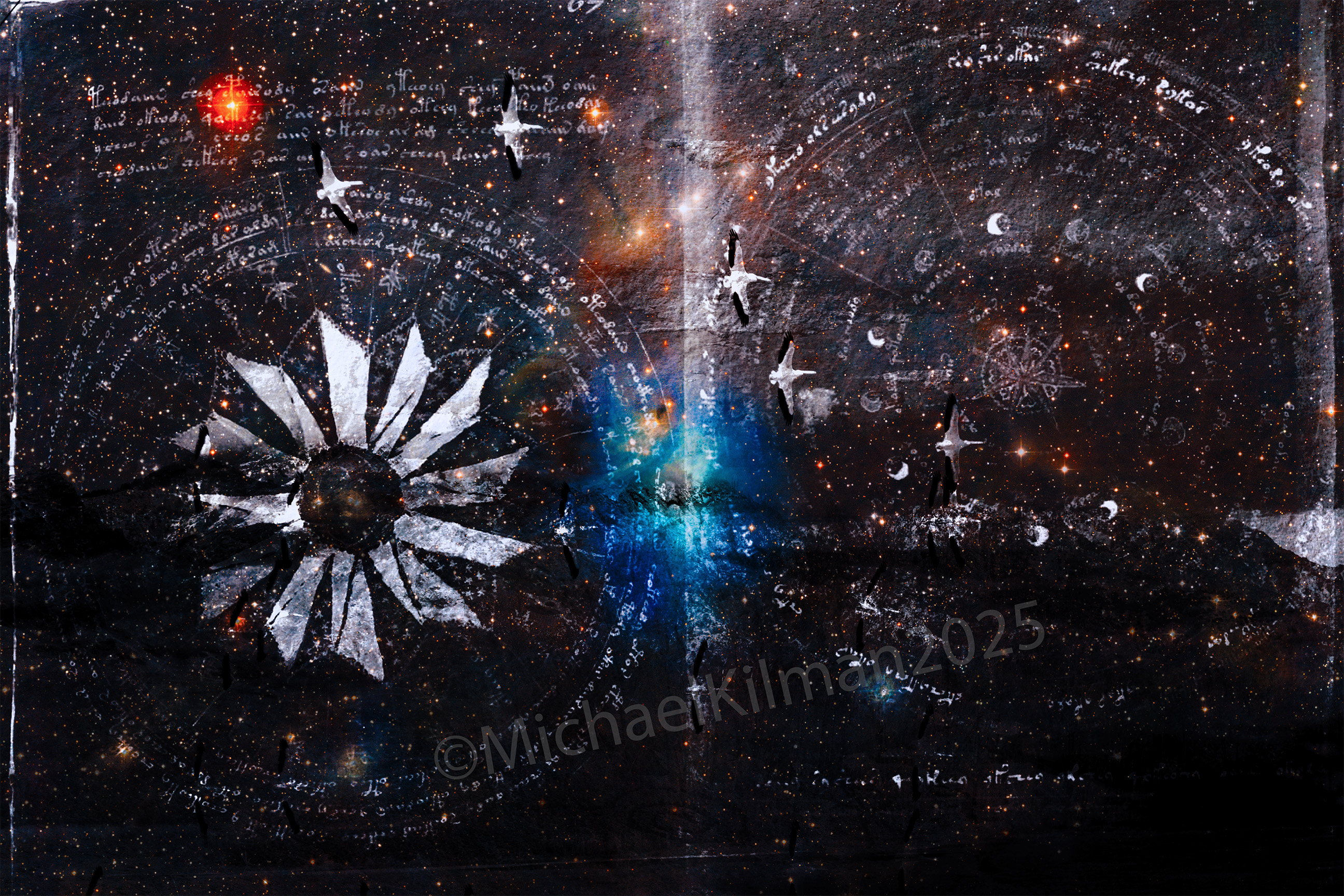
Original Digital Art: Inner Sanctum of the Celestial

Endings and beginnings have a way of forcing honesty.

For me, 2025 did that on every level. Personally, physically, and politically. Like many people in the United States, I could not ignore what was happening around me. That reckoning is what led to the creation of the Resistance Reads podcast. Then, in September, a cycling accident during the Denver Century resulted in reconstructive surgery on my left thumb and months of recovery. An interruption like that has a way of clarifying what truly matters.

What I returned to was simple.

My deepest commitment is to writing books, telling meaningful stories, and using anthropology to help people better understand themselves and the societies they live in.

A Refocused Direction

As a result, my work is more intentionally focused moving into 2026. This is not a dramatic change so much as a narrowing of attention toward what I do best and care about most. I want to be clear about that direction so readers know what to expect.

This site and my Substack will center on storytelling, culture, power, resistance, and transformation, especially through speculative fiction and anthropological insight.

What’s Coming This Year

Books

I will be publishing at least one book this year, possibly two. I plan to share transparent updates on drafting, revision, and release as those projects move forward. At least one audiobook will also be released. I have a big announcement about a stand alone book coming very soon, but I’m also working on Through and Endless Darkness Gleaming (Shades and Shapes in the Dark #2) and The Children of AEIS (Chronicles of the Great Migration #5).

Short Fiction

I’m currently revising several short stories. Some will be submitted to magazines and journals. Others will be shared directly with readers, with select pieces available to paid subscribers.

Paid Subscriber Content

Paid subscribers to my substack receive early access to novels, behind-the-scenes reflections on the writing process, and deeper explorations of anthropology and worldbuilding. That said, there will always be substantial free content available. I am aware of subscription fatigue (I certainly feel it myself) and want this work to remain accessible. If I could do this all for free, I would, but the more support I have, the more content I’m able to make.

Resistance Reads Podcast

The Resistance Reads podcast continues. Matt (my cohost) and I are excited about what’s ahead in 2026. The first episode of the year covers Buffalo Hunter Hunter by Stephen Graham Jones. Conversations about banned books, power, and resistance are also live on the NEW Resistance Reads YouTube channel, alongside major podcast platforms including Apple, Spotify, Amazon, and iHeartRadio.

Ask an Anthropologist (Live)

This year I am launching live YouTube Q and A sessions focused on anthropology and storytelling. The first session, Ask an Anthropologist About Worldbuilding, takes place on January 13, with additional topics to follow. Future sessions will be shaped by reader and viewer interest.

Looking Ahead

If these themes resonate with you, I am glad you are here. If not, that is okay too. My goal this year is focused, meaningful creation, grounded in curiosity and care for how stories shape the world we live in.

If you are following along, I would genuinely love to know what you are most interested in exploring this year: books, anthropology, or the intersection of politics and fiction.

With curiosity,
Michael Kilman

Progress updates on upcoming books will be posted on the homepage of LoridiansLaboratory.com every few months for readers who enjoy following projects as they take shape.

I’m Teaching at the Creative Colorado Writer’s Retreat (And Other Updates)

It’s been a minute, so I have a few pieces of news and they kind of involve most areas of my creative work, as well as a book chapter I wrote in an Anthropology book.

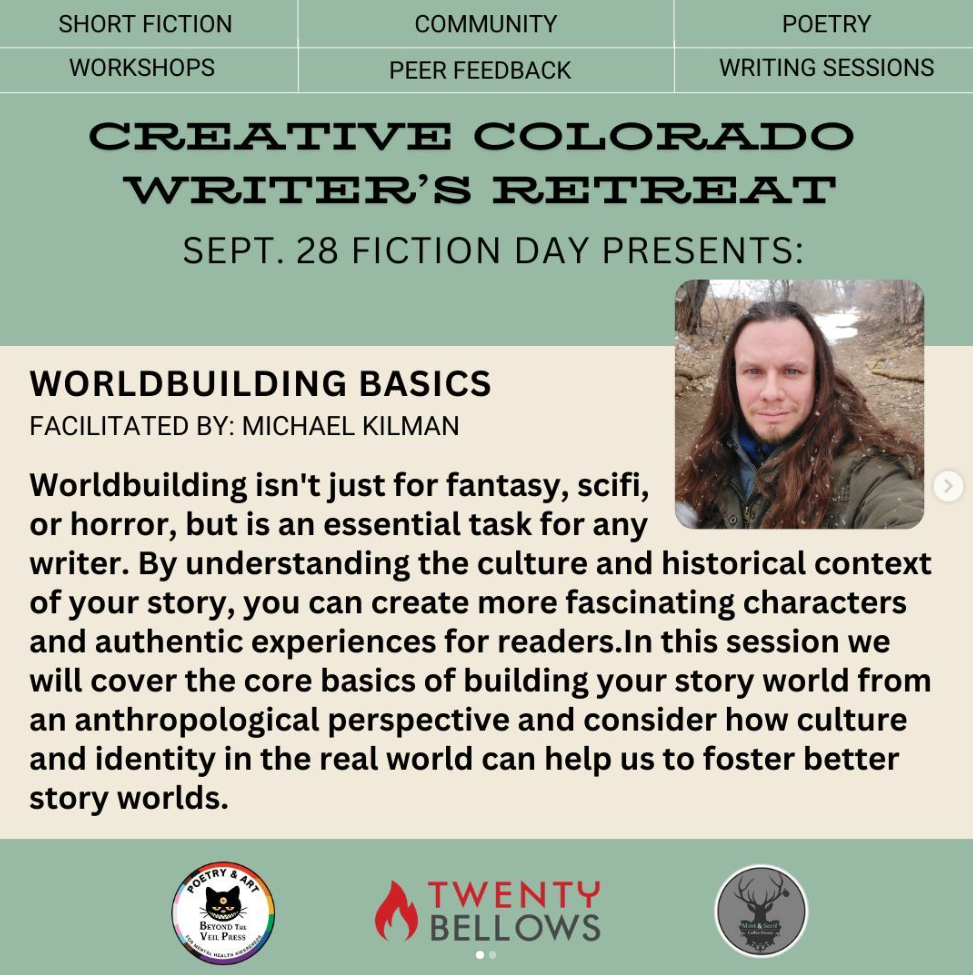
First up is that for the second year in a row, I will be teaching a session at the Creative Colorado Writer’s Retreat run by the incredible small press, Twenty Bellows. I have to say, I think this year has some of the most talented teachers of both poetry and prose in their line up. You can find out more about it here.

For my part, I’ll be teaching a session titled: Worldbuilding Without Info Dumping: How to Master Reader Immersion in Your Writing. My session will be on Saturday September 20th starting at 2:40 Pm.

The goal of the workshop will be to explore worldbuilding without exposition and instead looking how to build through dialogue and action so that your reader connects more deeply to your characters in the middle of the flow of the story.

But wait! There’s more!

At 11am on the second day of the writer retreat, we’re having a book fair. The book fair runs 11 am to 1 pm. I’ll have a table there if you want me to sign your books or pick up a copy of one of my 7 books. Again, there are many very talented authors at the book fair and It’s gonna be a ton of fun!

In other news, Resistances Reads Episode 8 goes live Monday September 15th at 7pm over on YouTube. And if you haven’t seen yet, we’re now on all the major podcast services. Episode 8 will cover the book, Black Empire by George S. Schuyler originally serialized in the 1930s, and is an early example of Afrofuturism. Literatura Obscura will air it’s 3rd episode this week as we discuss the book Ishamel by Daniel Quinn. It’s a novel about a telepathic gorilla who teaches a man the secrets to saving the world.

In terms of book updates, I have something to admit… I’ve been working on a secret project and it’s been distracting me from other things. But, I’m not quite ready to discuss that 8th and decidedly stand alone novel just yet. I am also working at building some of the lore right now for Shades & Shapes in the Dark universe. For those of you who read the first book that came out last may, you might suspect that it’s not really just a horror novel, but also edging into something more. In Through and Endless Darkness Dreaming (Book 2) Clarissa will discover that there’s more creatures out there, than just her own tormenter, Demon and that the world of magic is so much bigger than she realizes.

I am, also, slowly spending time in the world of The Chronicles of the Great Migration. I promise, I am still working on The Children of AEIS, and the final two other books of the series. They will get done.

One final announcement. This one is in the world of Anthropology. I recently published a chapter in the book, Exploring Digital Ethnography: From Principles to Practice. My chapter is titled: Worldbuilding as Pedagogy: Teaching Anthropology and Diversity in Contentious Classrooms. Now this is an academic volume, so while it’s not cheap, you absolutely can purchase it here. There are some great chapters in this book covering a variety of digital and interactive approaches to anthropology.

But if you just want to read my chapter… well… if you contact me, we might be able to find a way…

Until Next Time.

Tomorrow, The Shadow Wakes!!! (Shades & Shape in the Dark Arrives)

I’m so excited to announce, that tomorrow, my dark fantasy horror novel, Shades & Shapes in the Dark launches!

You can find Shades & Shapes in the Dark in paperback and ebook here!

The Audiobook is still finishing up production but will follow close behind in the next week or two. I will announce when that arrives.

To celebrate the release, me and several of my amazing author friends are gathering at Prodigy Coffee where we will be sharing some of our work. I’m so very fortunate to have such talented author friends. Check out their bios and links in the slides below!

If you’re in the Denver area tomorrow, you should join us from 1pm-3pm at Prodigy Coffee!

You can also check out the first and second chapters of Shades & Shapes in the Dark over on YouTube if you’re curious but aren’t sure if it’s for you.

Only 24 Hours To Help Me Fund My Novel Shades & Shapes in the Dark!

It’s down to the wire! Only a little over 24 hours to go and my Indiegogo campaign for Shades and Shapes in the Dark is only 49% funded. I need help crossing the finish line! I need help crossing the finish line!

Don’t forget, the first two chapters are already up on YouTube in audiobook format, which I’ve linked below.

There are tons of perks for those who contribute, including bookmarks, coffee mugs, signed copies, audiobook editions and, even T-shirts. So head over to the Indiegogo page and check them out!

Mishmash (A Free Comedic Short Story)

Image via Pixabay user azmeyart-design

Last week I entered a contest over at Reedsy for a short story. The prompt I chose was, choose a perspective from a Zombie, Mutant, or Infected Creature. The result? A comedic piece about a Zombie suddenly remembering himself.

It appears that my entry didn’t win, but I had so much fun writing it I thought I would share it with all of you. If you like my other comedic sci-fi stories than this one is right up your alley. Enjoy!

Mishmash

Stumbling forward and dragging one dislocated leg behind him, the creature woke from its viral-infused fugue. Its first thoughts upon waking were, where… how… what… and also, where’s dinner?

It looked around. Gray concrete lined every surface. In front of it, a gray wall rose far above. The creature’s eyes traced the wall up twenty feet or so, and saw dozens of people standing there behind a black railing under an awning. Then, it looked down and saw a moat between them and it. It tried hard to think of where it had seen something like that before, until finally, the image of a zoo popped into its head. He, and yes, it now remembered it was a he, couldn’t fathom why he would be in a zoo. Especially since he seemed to be inside of a pen.

He leaned down and dunked his hand in the water, testing the temperature, but felt no change. It occurred to him; that he felt nothing at all. Looking up, he opened his mouth to ask the people above where he was, but all that came out was a long low moan of “Misssssshhhhhhmassshhh.”

“Wow! It talks, Daddy?” asked a little girl in the pink dress with twin pigtails standing above Mishmash with the crowd.

“Well, zombies can’t talk. Not anymore. They’re too stupid. All they want to do is eat,” said the man, whose long beard hung over his bib overalls.

“Oh.” she paused for a moment and then said, “But it said Mishmash. Isn’t that a word?” asked the daughter. “It sounds like a word.”

“Well, maybe that’s its name. Maybe that’s all it remembers of being human,” replied the father.

“But if it remembers its name, then doesn’t that mean it’s not stupid?”

Changing the subject, the father said, “I don’t know. Do you want to feed it, princess?” 

“Yeah!” shouted the little girl.

Mishmash searched the crowd above for the father and the little girl. As he did, he saw motion above him. Something was falling from the sky. He tried to focus his eyes, but they didn’t work quite the way they used to. Then he saw it, a severed arm twirling through the air, and the moment he identified it, the arm smacked him right in the center of his face before it fell limp to the ground before him. He stumbled backward, his dislocated leg twisting, and he fell on his ass.

The girl squealed with laughter. “Bullseye Daddy!”

The man chuckled and pulled up on the straps of his overalls. “You sure got him good, princess.”

She clapped her hands. “Oh, I can’t wait to watch him eat it! It’s so gross when they eat. I love it!”

Her father laughed again. “Well, remember, if you’re too grossed out, we can leave. You don’t have to watch.”  

“Don’t worry, I won’t be! I told you I watched the zoo livestream feeding the zombies on YouTube all the time!” She giggled and continued, “I like it when they eat heads. It’s so weird to watch them try to bite it like an apple.” The little girl sighed and then pouted. “I wish I could get two hundred million views on my YouTube videos.”

“Me too, princess, me too. Too bad they won’t let us have our phones here or we could have recorded your bullseye. I bet a lot of people would have laughed at that.”

Confused and listening, Mishmash looked down at the arm. Then he looked up at the little girl who had thrown it. She stood at the top of a rail, a good twenty feet above, standing in the middle of the crowd. Her pink dress flapped in the gentle breeze. He scanned the crowd looking past the father in overalls and at the other spectators. Other people in the crowd wore everything from yoga pants to their Sunday best. It was a whole general mishmash of people from all walks of life.

Mishmash picked himself up, stumbling to his feet. Angry, he shook his fist and shouted at the little girl and said, “Mishhhhhhmassshhhh” He thought to himself that people really let their kids get away with anything these days. He wasn’t wrong. Imagine, reader, how you would feel in Mishmash’s situation.  

Many members of the crowd standing behind the railing above held severed limbs and assorted body parts of their own. Mishmash thought he saw one young boy holding what had to be a coiled ball of intestines. Before Mishmash could say or do anything, a shower of body parts rained down around him. He dove to the ground, covering his head as organs and limbs made squishing and splatting noises on the concrete of the enclosure.

Puzzled at the assault, Mishmash stood up again and dusted himself off. He turned and saw that, to his surprise, zombies were all around him. Terrified, he stepped back to the edge of the moat, feeling his panic rise. They ignored him.

Each creature headed toward the closest body part. He looked back down at the arm lying there in front of him. Then he looked back up at the crowd, and then, back at the Zombies. They didn’t seem very interested in him, and certainly, if they were zombies, wouldn’t they want to eat him?

With a sinking feeling, Mishmash looked down at his hands. He turned them over back and forth. They were a strange grayish color, though there were splotches of normal skin here and there. He thought, Oh no. Oh no no no no no. How had this happened? He couldn’t be a Zombie, could he? Zombies weren’t supposed to think. Something was wrong here, but he couldn’t quite remember what.

Hunger pain rose in his belly and his eyes drew to the severed arm sitting there just before him. Without thinking, he kneeled on the ground with his good leg, picked up the arm, and drew it toward his mouth. It was cold as if recently stored in a meat locker or a morgue. But that didn’t matter. He was so hungry he could barely stand it.

Mishmash opened his jaw wide so that he could bite off the biggest chunk possible, then stopped. He remembered himself, paused, and dropped the arm. It occurred to him that he really shouldn’t be doing this. It was a human arm, and he was… what? Well, obviously, not exactly human. Were zombies human? What did it mean to be human?

For a moment, dear reader, he felt tempted to go down a philosophical rabbit hole about that question, but opted instead, to examine his circumstances. He was after all a scientist. That’s right! He remembered now, he, Mishmash, was a scientist, at least in the before times.

He abandoned the arm, walking around the pen and observing the others eating their fill. Despite his desperate hunger, he felt a wave of revulsion. It was a noisy business, their hungry mouths munching and tearing at flesh and tendon. Nor did it smell much better. Zombies, he decided, smelled terrible. He sniffed himself and wondered if the moat was available for bathing. Did they provide zombies with soap here? He doubted it.  

Mishmash looked back down at his hands again and something, some fragment of memory, stirred in him. He remembered the bite. He looked down at his right hand and noticed, under the graying skin, teeth marks.  

Stumbling, he fell and remembered his dislocated leg. There was no pain. He looked down at his knee, bent at an odd angle, reached down, and straightened it with a pop. Apparently, the only discomfort he could feel was hunger. He stood, with his leg adjusted, but far from perfect, he walked back to the moat where the abandoned limb lay. It was then more memories flooded back.

“What’s it doing? What didn’t it eat the arm?” said the little girl.  

“I don’t know. Maybe it’s full?” said the father.

Another person, who Mishmash couldn’t see, said, “Zombies don’t get full, you idiot. They eat and eat and eat.”

The father said, “Then you explain what it’s doing.”

Mishmash lost the tenor of the conversation to his own thoughts.

Everything was so clear now. His name wasn’t Mishmash, it was Dr.… Dr.… well, he couldn’t remember his name, but he remembered the viral outbreak. Because the virus took a long time to transform you, the military contained the disease in a few cities. With the worst possible outcome avoided, Mishmash and his lab assistant had begun research on a vaccine to prevent future outbreaks.

He looked around again, and his heart sank. This was the pen he used to conduct his research. This was where they kept the handful of Zombies they hadn’t torched. He was in the Bronx Zoo. The body parts were from cadavers because it turned out that Zombies were picky eaters. They only liked human flesh, and you couldn’t very well have your test subjects starve to death. Funny enough, they had discovered Zombies could starve to death. However, the only other way they could die was by destroying the brain. Somehow the virus kept the rest of the flesh up and running regardless of its condition.

The virus had something to do with… immortality research? Yes, that was it. Well, here it was, basic immortality, as long as you ate people and gave up your mind. But then, why did he have a mind? There was a reason, but he couldn’t quite remember. But first things first, Mishmash had to get out of here. He clearly didn’t belong anymore.

He prepared a plea, a cry for help. And reader, I promise you he was trying his absolute best. It was just that, well, his mouth didn’t quite work the same anymore. He moaned, “Miiissssshhhhhhmassssshhhh.”

Someone above said, “Is it trying to talk to us?”

Hope filled Mishmash. They were listening. He was so damn hungry… but someone was listening! He could get out of here. Maybe they would let him go back into his lab and find a full cure. Then he could eat. Perhaps they could provide him with a snack on the way?

Something else flashed in his memory… the exposure… it wasn’t an accident. Someone had undone the restraints on the Zombies bed, just as he was injecting it with the test vaccine. He had been so close. There was something about… the zoo… ticket prices… money? The memory was incomplete. But he remembered that just before the disease spread to his brain, he had given himself a dose of the vaccine. Apparently, it hadn’t entirely worked, but now, here he was, and he was back… well, his mind anyway.  

He tried to think of anything else but the arm and ignore the ravenous hunger, and yes, his eyes kept drawing back to that arm. He didn’t want to eat it, but also, he really did. Could anyone blame him? The cadavers came from bodies donated to science. So it wasn’t like anyone was getting hurt. Dr. Mishmash, as he now thought of himself, had a disease, a virus that made you ravenous. He must have eaten human flesh before or else he wouldn’t have survived this long. He licked his lips and reached for the arm.

He stopped. No, there was no time for eating now. Mishmash focused and knew what he needed to do. He needed to escape. In order to do that, he needed to be as eloquent as possible. Yes, if he could only express himself properly, then he could escape and perhaps continue his research… and eat. He would definitely eat.

Mishmash raised one finger as if to make a pronouncement and win his freedom from the enclosure. He would tell them that his body had fought off the disease, and that he could think clearly again. He would say that, now that I’ve been through the gauntlet and out the other side, a cure was inevitable. They must trust the science.

He opened his mouth and said. “Missssssssssshhhmash. Mishmash. Mish. Mish. Mash. MMMMMMMish. Mish mash mash mash mash mish. MISH MASH!

Then he sat, exhausted. Hopefully, they understood. There were a lot of mishes and mashes there, but he was certain that he had belabored the point.

He looked up, expectant of his liberty. Knowing that any minute now, surely someone would come down and get him out of here. It would be tricky, because the other zombies were around and he certainly wouldn’t anyone to get… bitten…. He licked his lips. Unless… well, maybe he could have just a nibble. That man in the overalls was plump. Perhaps, just a taste?

No one moved. Nothing happened except for silence. Well, okay, it wasn’t silent, because behind him, he could hear his fellows munching away at their… lunch? Dinner? Did it really matter? It wasn’t like you decided, oh, arms are for breakfast and legs are for dinner. Either would be fine for any meal. His eyes drew back to that arm, still sitting there where he’d left it.

He made himself focus. It was just a matter of time till someone rescued him. Mishmash waited. His stomach rumbled. He waited some more.

Then he stood back up and tried to say something again.

“Miiiiissshh mash mash mash mish.”

Still no response. He knew it was difficult to understand his decaying vocal cords, but his tongue was working just fine. Surely they had understood some of the words he had said?

Another zombie walked up next to him. It was a woman. He looked at her lovely face and recognized his lab assistant, though he couldn’t seem to recall her name. She turned her face toward him, and he saw, with only, light horror, considering what he now understood about himself, that the cheek on her right side was entirely missing. He could see her teeth through her face.

She grabbed him by the hand, and all at once, he realized she, too, had woken from the long slumber of the zombie fugue. The test subject bit them both at the same time and Mishmash had injected her with the vaccine as well, in hopes they would both avoid the exact fate they were currently experiencing. So here it was the proof that his vaccine worked, sort of. With a little refinement, Mishmash was confident they would both find a cure and win a Nobel prize for their efforts. Also, she looked really cute standing there, with part of her face missing. Good enough to eat almost.

She said, “Maaaaagooooorrrr Magor magor…”

He nodded in agreement. The humans above didn’t seem to understand but somehow he did. Were they psychically linked somehow? Another interesting element to research. He asked her, in what he was increasingly certain was their own distinct zombie language, how long she had been… awake.

She replied, a few days, and that another, the one who had bitten them after they had given it the vaccine, had woken up as well. Unfortunately, after an attempt at a hunger strike to try to get the attention of someone, anyone, that she was no longer mindless, Magor had gone mad with hunger and eaten the only other zombie who woke from the fugue.

In Zombie, Mishmash said, “Well, at least there are still two of us, and were cured!”  

In the zombie language, which outwardly sounded like Magor Gor Mag Magggggooorr Magor magor, she said, “Well, I wouldn’t say we’re cured just yet would you Dr.? I can’t stop craving human flesh.”

“No, Dr. Magor,” replied Mishmash, “I don’t suppose we are. We will need to get back to the lab and further refine our treatment. But I’m confident we can find the cure.”

From above, the little girl said, “What are they doing, Daddy?”

“I don’t know, princess. Maybe they’re talking to one another.”

The third person, who was still not visible to either Mishmash or Magor, said, “Zombies don’t talk stupid. They just eat. Maybe they’re about to eat each other!”

“Oooo,” said the little girl. “Do they do that, Daddy?”

“I don’t know princess, they might if they’re hungry enough.”

Magor picked up the severed arm that had hit Mishmash in the face and said, “Are you gonna eat this?”

“Yes.” Said Mishmash, “I suppose I should. I must keep my mind clear.”

She handed over the arm. She was only a little hungry since she had just eaten.

Mishmash gave into his hunger.

Don’t be grossed out, reader. You would do the same thing in his situation. Just let Mishmash eat in peace. Then, maybe, he can find a way out of this.

Maybe.
A Poem from “Shades and Shapes in the Dark” Chapter 10: The Shadow of Samhain

Preorder for my novel, Shades and Shapes in the Dark will begin soon! The book is headed off to the editor next week. The nove is a dark fantasy/horror story set beginning in the 90s and span 40 years. The story is about a dark force, that follows the main character Clarissa through her life, and how she must learn to fight back, ultimately drawing on ancient magic and wisdom. The first book begins when she is only 9 years old, and encounters the shadowlike creature for the first time.

Each chapter in the novel has a poem that opens the piece. Sometimes this poem is something to do with the character, sometimes narrative information for the reader, sometimes foreshadowing, and sometimes it includes a bit of the lore of the world.

Chapter 10 is titled: The Shadow of Samhain. It takes place on Halloween and, of course, since it’s the season, I thought I would share that opening poem.

The Shadow of Samhain

Come all ye, gathering shades,
The time of Samhain is at hand,
We will rise to rot and scatter,
Our blight across the land.

For the first of us comes at witching hour,
To seek his contractual prize,
Lust for power brings him strength,
With every victim’s demise

But a bargain struck will not go unpaid,
A boon of power is owed,
It matters not who is struck down,
Nor the depth and breadth of your woe

More news of the novel, including the release date and more is just around the corner!

News, Podcasts, A Writing Workshop, and Publishing Updates September 2024

Hey all, I know it’s been a while since I have had updates so I have several things to post about today. Sorry for the long message, but I’ve broken things down so you can easily skim to the information you want.

The first is the reason that things are so delayed. This summer I joined Teach for America and last month I officially became a High School English and Language Arts teacher for 11th and 12th grade. Let me tell you, that’s an extremely busy job.

Despite the very long hours I am working right now, I’ve managed to make a lot of steady progress on my forthcoming novels. I am currently on a streak of 574 days or writing without skipping. 500 or so of those days had a minimum of 1000 words a day. So I make progress on something every single day (though I must admit at least 50 of those days I deleted the words right after I finished them but hey, you gotta get those bad words out of the way for the good ones to shine).

Here is the current status of my books that I am actively working on:

Shades and Shapes in the Dark is currently in it’s final pass before it heads off to the editor. ETA for book 1 is either October 17th or November 17th depending on the amount of edits required (How much red pen my editor uses).

The series is now 4 books with the following titles and progress level:

Book 1 “Shades and Shapes in the Dark” is in final edits with an ETA in October or November.

Book 2 “Though An Endless Darkness Gleaming” is 75% of Draft 1

Book 3: “An Illumination of Extraordinary Madness” is 50% of Draft 1

Book 4: “The Nature of Twilight At Dawn” is 30% of Draft 1

I currently expect to finish draft 1 of Book 2 by November 1st and to use NaNoWriMo to finish (or get close to finishing) the first draft of book 3

The Children of AEIS and The Chronicles of the Great Migration final two books, A War For the Heavens and A Hand to the Stars are still on their way. The Children of AEIS is sitting at around 75% first draft completion. The largest reason for the delay was a major concussion only two months after the release of Serah of the Runners. This derailed me pretty solidly and right now, when I have free time on top of writing, I am working through creating notes of the 4 books because my memory of them appears to be a little lacking from first the injury and then the passage of time. But, they are in progress and they absolutely will get finished sometime in the near future.

Welcoming the Muse


My poetic essay, Writing is Living was selected for publication by Twenty Bellows Press this summer. The piece is about life as an author in the 21st century. There will be a release party sometime this fall and I will provide more information as the date approaches. Needless to say, I’m thrilled to have another short of mine published this year. That makes 2 short pieces of writing picked up by publishers.

How to Write for the Future Podcast

I also recently appeared on a second episode of Write for the Future. This podcasts covers some basics of worldbuilding. The host also spent time across several episodes highlighting some of the key features of Kyra Wellstrom and I’s book, Build Better Worlds. I have linked the second episode where I guest starred as well as the episodes that surround our book below.

Part 1

Part 2

Additional Episodes that Cover Our Book

What is Cultural Context? (Build Better Worlds, 1 of 4)

Myth, Imagined Past, and Cultural Purity in Fiction (Build Better Worlds, 2 of 4)

The Sacred: Religion and Mysticism (Build Better Worlds, 3 of 4)

Economics: More Than Money and Markets (Build Better Worlds, 4 of 4)

Twenty Bellows Writing Retreat in Denver, CO

My last piece of news is that back in July I was asked to teach a session at the Creative Colorado Writers Retreat hosted by Twenty Bellows Publishing Company. I feel so honored to be a part of this retreat as it includes some of the most talented and knowledgeable writers in Denver.

You can find out more about this retreat here


That’s it for updates (I know there were a lot). I’m confident my next update will be release news! I hope everyone is having a great holiday weekend (if you’re American and reading this).

Worldbuilding Part 7: Schismogenesis, Taboo, and Identity

How do we create identities? How do we decide what kinds of things are taboo in society? How do we know what is clean or dirty? Have you ever thought about the fact that sometimes, we reinforce our choices and values through rebellion and/or opposition?

It might be obvious why some things are taboo, or at least there is some sense of rationalism surrounding those ideas. It’s taboo to eat out of the garbage, since the likelihood you will get sick is high and that’s where we put the things we wish to discard. But why are there taboos surrounding colors of clothing or beards, or types of clothing or lack of clothing? Is there a rational reason a man can’t wear a bright pink bikini on a hot summer day in American society? Why does this make us uncomfortable? Is there a reason that it’s not considered manly? Keep in mind, by reason, I mean an objective scientific one. Don’t worry, you’re not going to find a picture of me in a bright pink bikini below, I promise. But when you’re building a fictional world, understanding why a society formulates taboos and norms can be really useful.

In this entry on worldbuilding, we are going to examine a way to think about how people form their identities and cultures using the concept of schismogenesis.

(Note: You can find the earlier entries on worldbuilding, including podcasts and a Ted Talk here)

Like these posts? Subscribe to my Substack to Get Emails When I’ve Posted Something.

What is Schismogenesis?

Coined by Anthropologist Gregory Bateson in the 1930s, the term schismogenesis means essentially creation through division. By looking at your identity and behavior, I acknowledge how we are different, and thus solidify who I am. This often manifests as opposition. The most obvious form of schismogenesis is the rebellion of teenagers, who form their identity based on challenging acceptable behavior. Through opposition, they create identity. But this isn’t just a teenager thing, cultures and people do this all the time. It’s why suppressing differences, can actually make them stronger. The identity becomes more legitimate, more solid, because you fight against it.

Let’s return to bikinis.

I (apparently) am the kind of man who wears a bright pink bikini in public, and you, (assuming you’re a male in this example and of the status quo in American society) do not. Thus, I am behaving inappropriately in society, and you are not. You, will try to get me to conform. You will probably mock me for my strange behavior. You may seek to make me feel ashamed of wearing my bright pink bikini out in public. I will do one of two things. Either, I will capitulate, and take off my bikini and switch to the culturally acceptable norm of swimming trunks, or I will continue my rebellion and seek to recruit others who think like me. Thus, I will form my identity through opposition.

These kinds of things happen every moment of every day across every culture. Power and resistance are constantly in play on every level. Think of all the debates going on right now in your culture about what people should and should not do. There are hundreds of topics to choose from.

Let’s look at a more serious example. Take the pork taboo. Lots of people speculate why both Jews and Muslims have a pork taboo. People have puzzled over this idea for centuries. This isn’t just limited to Jews or Muslims either. Why do some cultures say that certain foods are clean, and others are dirty? There are entire lists of foods that people eat in one location in the world, but gag just thinking about them in another.

(Note: If you want to read a whole book on this topic and you are an anthropology nerd, consider Mary Douglas’s award winning 1966 book Purity and Danger: An Analysis of the Concepts of Pollution and Taboo)

But why pork? Well, if you ask a Jew or a Muslim, the answer you’ll likely get is that pigs are filthy animals. They are living garbage disposals and love to live in their own shit and piss and eat whatever you put in front of them. Why, they ask, would you eat such a creature as this?

The reality though, is that pigs are not like this out in the wild. In fact, when I was doing research in a rural village in Mexico in the northern state of Nueve Leon back in 2008, the pigs they had in those villages were far from disgusting or dirty. They grazed in fields alongside the other animals and ate similar things. They didn’t live in mud, they lived alongside all the other animals. So the filthy ‘nature’ of the pig that is the central complaint of the taboo is something artificially created by human action, not nature. Often cultures and people will come up with logical explanations for their taboos to justify their practices.

That doesn’t mean we should disrespect our Jewish or Muslim friends by forcing pork on them. Every culture has things it forbids that defy rationality or reason. We all have superstitions and traditions that aren’t based on evidence. The point here is not to judge, but to understand how this works to better assist you in building fictional worlds.

One possible explanation for the pork taboo is schismogenesis. In the ancient world, there was a period for the Jewish people known as the Babylonian Captivity or the Babylonian Exile. Many Jews were forced to live under the control of the Babylonian empire after the Babylonians conquered the Kingdom of Judah beginning first around 598 BCE. The Babylonians captured and enslaved many of the Jewish people.

There were two large staples of the Babylonian diet that both became taboo under the Kashrut, the dietary restrictions of the Jewish people. The first was pork, and the second was horse. Both foods were common in Babylon at the time. The enslaved Jews did not consume this food previously. Thus, as their enslavement continued, they ate foods similar to that of their homeland, and not of those who enslaved them. This certainly contributed in at least some way to the prohibition, though it may not have been the only cause.

But here we see, at least in part, schismogenesis in action. The Jews, under the yoke of an oppressor, didn’t want to partake in the food of those who had enslaved them, hence, their identity surrounding their food taboo. Several generations lived under these conditions, then, when the Persians conquered the Babylonians and allowed Jews to return to Palestine, many of those ideas circulated into the wider culture. Food is common as an important identity marker in many cultures, this is especially true in populations that have been historically oppressed.

Now again, there are many debates on the pork taboo, and this is only one possible explanation. In fact, most cultural taboos and restrictions can come from several causes at once. But, schismogenesis is useful because it helps clear up confusion in a culture. If the enemy other is doing something, and you don’t want to be like the enemy, then you can avoid doing that thing. This solidifies who you are as a culture and with it, identity. In our case, it helps create more complex fictional characters.

Here are few things to consider if you want to employ the concept of schismogenesis in your fictional world.

1.    What are the core values of each of the fictional cultures you are building?

If you’re setting up a world where multiple major cultures will fight for control, then the first place to begin is where their core values lie.

–        What kinds of things are important to your culture?

–        What taboos do they have?

–        What things to they exaggerate or emphasize about their adversaries?

–        What qualities do they wish to cultivate in individuals on an ideal level?

–        What does their mythology say about core values (refer to Worldbuilding Part 4 – Six Things to Think about When Construction Myth in Fiction if you need help with this)?

If you take these things and sketch out what each culture is doing in these worlds, you will have a good place to see potential conflict between the different ideas of morality and/or taboo in the cultures.

This is especially true if you have a culture that has been conquered by another. Acts of rebellion don’t end at violence or protest. They can manifest in everyday experiences. In fact, when you stress a culture out, there is always a core group of people who will try to preserve important elements of their culture, hence, the rise of fundamentalists. They want to go back to the way things were before the changes came. It doesn’t matter that you can never truly return to the way things were, people want that old sense of safety and security of their cultural norms.

This is why we see groups like the Amish, whose very existence is in opposition to the changes wrought by modern technology. I grew up in part on the east coast, and not far outside of Philadelphia, it was common to see the Amish on the road in their horse and buggy, slowing down traffic. The way they choose to live is a form of schismogenesis. It might not feel subversive to us to live in that way, but to them, it is.

Which brings me to another point. Cultures aren’t homogeneous. There are all kinds of diverse approaches and ways to live within cultures. Be sure to consider that as you highlight the values and taboos of the larger culture above. You will want some wiggle room for resistance, for factionalism, even as larger conflicts between nations are happening. People disagree on pretty much everything, and sometimes that disagreement is a huge part of their identity.

2.    The minor differences matter

Yes, your cultures will argue over the big stuff. But the minor differences matter too. Every culture has a different protocol for body language, for dress, for the kinds of sounds and colors they like and dislike, and so on. Every little thing you do comes from making comparisons against others. While we focus on the things we like and enjoy, we often spend even more time on the things we don’t like or find disgusting as ways of acknowledging who we are.

Small things like how a culture eats can mark identity. Much of Europe didn’t adopt forks until the 17th or 18th century (depending on what region) because they were considered either unmanly or excessive. Just imagine, someone, at some point, was complaining about how feminine it was to use a fork. Yes, that really happened. Someone else decided to use a fork anyway, probably a teenager.

Even generations within cultures employ schismogenesis. Think about what different generations say about each other. I’m a millennial and hear constant complaints from older generations about us. I’m almost forty now, so obviously millennials aren’t that young anymore. I’ve noticed that there are a lot of complaints among my fellow millennials about Zoomers already. We make constant comparisons about all the little things we do differently.

You don’t have to pick big things for schismogenesis, in fact, sometimes a lot of little things add up to create stark differences. Remember, as I’ve said repeatedly in these entries, and in my book Build Better Worlds, culture is a performance. It’s a way of enacting practices to mark who you are and what you value. That isn’t just the big stuff, it’s all the little things too.

3.    Living within a cultural script

Every culture has a kind of script, a set of rules to live by that are both formal (laws) or informal (norms). Some cultures (like our own) make the concepts of choice and freedom paramount to their core values. But if you step outside the bounds of their norms, there are still all kinds of ways you can be disenfranchised. Think of the debates surrounding the right way to be a man in our own society. Forks and pink bikinis aside, these discussions aren’t about objective truth.

In fact, the irony of this discussion is that if choice and freedom were truly at the center of the debate, there wouldn’t be arguments about what makes a “real man”. Men would just go out and do whatever they wanted and that would be manly. These same scripts that proscribe masculinity limit agency (freedom of movement within a culture). There’s no freedom by living up to the expectations of a cultural script, but there is a sense of unity, an imagined comradery. (Note: See Benedict Anderson’s 1990 book Imagined Communities for the Anthropology Nerds out there) Though we may never meet most other Americans, there are certain behaviors and identity markers that are expected to establish a sense of unity across the culture.

This isn’t about good or bad, this is what cultures do. How a culture maintains itself, or how it changes, is an endless conversation taking form in every arena of every culture. These masculine norms aren’t about freedom, it is about expectations, about clearing up confusion to make identifying what is male and what is female in clear terms. Humans in general like things simple. Unfortunately, very little about humans is simple. We might idealize certain behaviors or how many genders we think we are, but of course, certain behaviors that are beneficial and unifying to one group will naturally be oppressive and divisive for another. This is exactly why, opposition can be a core part of identity.

With all that in mind, take a moment to consider, what kind of cultural scripts are used in your fictional world. There are certainly trends among humans. Male domination, though not universal, is common in the modern world. There are still matriarchies out there, but they are few and far between because of the larger patterns of empire and conquest.

A few things to consider with cultural scripts:

–        Remember Cognitive Maps (from the last post on worldbuilding) and how biological differences, magic systems, or superpowers will necessitate different brains and thus, different cultures.

–        Different political systems, like the matriarchy mentioned above, would have different scripts

–        Different economic systems, like a gift economy, or a system that uses potlatching, would have different scripts about what wealth and power look like

–        Different religions, for example, one without deities, are going to focus on different scripts.

–        Remember that culture is holistic, that every part of culture connects into every other part of culture, the scripts about behavior and identity will mirror all these elements put together

4.   Enforcing identity and Solidifying Resistance

In order for a cultural script to be useful, it has to be enforced. In some societies, there are laws about how people dress. They enforce what activities different groups can participate in, how they should appear in public, and so on. In addition to these formal laws, or in a situation where there isn’t written law, rumors and gossip act as a kind of social surveillance to enforce expected behavior. Gossip is likely the oldest form of surveillance and uses shame and guilt as a weapon against anyone who doesn’t fit neatly into cultural scripts. If that sounds like high school, you’re not wrong. Humans have been doing this to each other since we were… well, humans.

Remember, these scripts are also created in part because a culture doesn’t want to behave like the other. They want to mark themselves as distinct and different. They don’t want to engage in the behaviors of the enemy other, dress like the enemy, eat like the enemy, or even talk like the enemy. Groups that are focused on differences will often advocate for exclusionary rules or policies that limit the kinds of diversity possible. They will shame and embarrass those who don’t fit in the mold. Often, they have a fear that this other, this adversary, will creep in and take their culture away from them by changing things or forcing them to change.

We even do this on a large scale. The 1978 book, Orientalism, by Edwards Said, highlights the perceptions of Europe and its false dichotomy of the Eastern world vs Western world. The book is an attempt to critique our stereotypes of the Eastern world, and how empire, colonialism, and bias played a role in our understanding of world history and cultural analysis.

According to Said, men of the Orient were portrayed as culturally backward, physically weak, and feminine. This reinforced the ideas of Western masculinity. Of course, perceptions of the men of the Orient were just stereotypes. And nothing robs people of their freedom quite like a stereotype.  Raj from The Big Bang Theory, and Fez from That 70s Show, are stereotypical examples of Orientalism in action. Both the characters struggle to understand Western culture and are awkward. Both characters spend a lot more time with the women of the group and struggle to relate to the men in the same way. Both characters are mocked for their physical weakness.

Cultures will often create assumed cultural scripts for their enemy. We know these scripts as stereotypes. We expect the enemy to fit only within these boxes, and are often surprised when they don’t. This is not a product of only one culture, all cultures do this. We use our norms and rules to compare ourselves to the cultures we don’t like because they are a direct enemy, or because we consider them less civilized. But it works in a paternal dimension too. Paternalism in this case is the notion that we are more rational or advanced and must help civilize the “savage”.

What are the benefits of using Schismogenesis in fiction?

Employing schismogenesis creates all kinds of fertile ground for storytelling. There will be characters who highlight the differences between each group and hold conservative views about the way things have always been. There will be characters who think that some of these arbitrary things are well… arbitrary. They will accuse the conservatives of living in the past and highlight the ways that the past was ugly. These are the progressives of your society. They often advocate against these kinds of differences. However, they will also employ schismogenesis against those who they disagree with too, often the conservatives of their culture.

Just because you are liberal or progressive doesn’t mean you’re free of bias. No one is free of bias and oversimplistic thinking. We all generalize the people we disagree with. I catch myself doing it all the time. After all, it’s much easier to disagree with someone if you take away the nuance and complexity of their argument and create strawmen that are easy to knock down. We all have things we are bias about and we even know that some of them are arbitrary. Your characters absolutely should too.

There’s a third group in a mix, the ones who stand in the middle. These bicultural individuals (they can certainly have more than two cultural backgrounds) don’t have a specific set of rules or scripts to follow for their identity or they have more than one. Individuals like this are born in the middle of multiple scripts, being forced to discern how to move through the world. They could be mixed ethnicities and thus get culture from each parent, or perhaps they are an immigrant or refugee born in one culture, but now living in another. Every person who stands in the middle will take unique positions on different aspects of their identity and culture. Immigrants should be just as diverse and complex in their approach to the world as characters who are monocultural. Some immigrants may take on the dominant norms as an act of rebellion to their parents. Others may take on the traditions of their homeland to resist assimilation. Schismogenesis in the real world creates all kinds of diverse identities and experiences and in fiction, richer characters, backstories, and worldbuilding.

Consider:

–        How do your characters compare themselves to other cultures and individuals?

–        Why do they make that comparison? Are they jealous? Are they fascinated? Is the grass greener? Is the other more barbaric?

–        Do they see some good things and some bad things about the other?

–        What generation are they a part of? Are there changes in technology for that culture or maybe some new cultural practice or experience has arrived?

–        Has contact with another culture happened recently?

–        Has there been a change in the political or economic structure?

Some Final Thoughts

Norms change. We don’t consider forks unmanly anymore. Though I guess the jury is still out on men in pink bikinis. Every generation gains new ideas, and loses some old ones. Maybe in the era of social media things are changing faster than before, but we need a much longer view, in terms of decades, to really understand what social media is doing to us. Sometimes, changes that appear bad in the beginning create really interesting changes in the long term.  

In building your world you could start out with one group of norms and rules for a society and then change the power dynamics of the situation to suddenly force those norms out. Brandon Sanderson does this masterfully in the Stormlight archives. At the beginning of the series, having light-colored eyes automatically means you are a person of rank and privilege. Being a poor light eyes is far better than being a wealthy dark eyes. Light eyes or dark, both groups have their own internal hierarchies as well. But, as the series goes on, and the return of old magic changes the colors of some people’s eyes, the power dynamic of eye color changes, and many of the characters are forced to confront the arbitrary nature of the light eye, dark eye, dichotomy, each in their own way.

The best stories are ones that show truth. The truth about most of what we do as humans is that it’s arbitrary. We have certain standards and taboos that do serve purposes. Some help protect people from harm in both short-term and long-term situations. Eating garbage or marrying your sibling are not wise moves and thus those taboos are useful.

However, many things we hold as important are really just cultural preferences. Loving your culture isn’t wrong. It’s just that these things don’t have any root in objective truth. That doesn’t mean that they don’t have value. There are many beautiful traditions the world over that some consider strange, while others find unity and comfort in them.

It’s all complicated. Wonderfully complicated. I think too often we look at complexity and throw up our arms and say, it’s too much effort to understand. But I think it’s better to be curious. But then, that is why I became an Anthropologist.

Writing honestly means to look at the world and understanding it for what it is. The world you create in fiction, is a reflection of who you are. Sometimes that means to create the best worlds, we have to step outside of what’s comfortable or easy. Good worldbuilding means you need to understand the cultures you’re creating. You need to hold what they see as sacred in your mind. Immerse yourself in their worlds. Live through your characters and embrace the wonderful complexity of the world you’re creating. Maybe try a little schismogenesis on for size.

After all, what’s more fun than being a creator?

Happy Worldbuilding!

P.S. I lied about the picture of me in a bikini…  

Shades and Shapes in the Dark

Sometimes a story or a character simply won’t leave me alone. It intrudes in every idle moment and even in dreams. It refuses to go away until I do something about it.

I guess that’s my way of saying that I’ve been working on a new book. Yes, I know there are other projects… but this one just won’t stop pestering me.

I’ve only told two people who are close to me about it, but in the last month (one of the reasons for my lack of posting anything) I’ve written 47,000 words in this book. I am hesitant to make any promises for when it will be finished (or any of my other projects) but it seems to me, if I keep writing this pace, it will be finished by the end of the fall season and perhaps sooner.

The book is both Dark Fantasy and Horror and is titled Shades and Shapes In the Dark. And though it is still a work in progress, I am going to share an excerpt here for everyone, and the first full chapter for my wonderful paid subscribers over on Substack

Here is the blurb for the book:

A Girl, A Skateboard, And Four Decades of Darkness…

When nine year old Clarissa chased a thief through the woods and stumbled upon a strange meadow, she had no idea that the creature living within would begin following her and feeding on her for the next four decades. Now, she must reflect on her life, and all the ways in which the creature she has named Demon has tormented her. For somewhere in her long experience there must be an answer to defeat it once and for all, or she will face a fate worse than death.

Shades and Shapes in the Dark

By Michael Kilman

Part 1

A Game of Shapes and Shadows

Those shades and shapes in the dark,

From which we draw our desires,

Shape our way of knowing,

Of where best to put our ire.

We cannot see the murky mists,

With our eyes shut ever so tight

Where we leave behind only corpses,

And journey into endless night.

Oh how we take and take some more

For thieving is our business.

We are a shadow of what we once were

When we know only stiffness

Where ever you go is where you are

No matter how fast you’re running,

No magic, nor wisdom, can set you free,

From your mind’s endless cunning.

Come,

Let us wonder through trains of thought

And let the forms take their shape

For having read this far already

Know now, Reader,

There is no escape…

Chapter 1

Tonight, she would stand before Demon for the last time. It was the last time because, now, tonight, as the cold crept in under her skin on the darkest night of the year, and as the snow pelted her face with it’s cold harsh kisses, she would end it. She was tired of running, tired of hiding, tired of the manipulations and the games the creature had visited up on her these long years. Her torment would end before the sun rose over the snowy meadow.

She had not come here for suicide, far from it. She was no conciliatory party accepting defeat and sewing for peace. There could be no peace between them. It was time to surrender to her fate, here, tonight, no matter her fortune. She would fight with all her being until one lay dead. At least, she hoped Demon could die. Perhaps it could not. But as they say, fortune favors the bold. And her boldness was the sharpest of edges.

It had taken everything from her. Through the years it had stripped away all pretense of happiness, so that only unease remained. Only a species of longing stretched out through her loneliness as if a single gossamer thread, balancing all of her life, were holding her up. And she was dangling, oh, she was dangling now. So what use was anything but surrender?

She had come here because this is where it all began. It was the origin story of her suffering, and her brushes with madness. She had looked for Demon’s lair, for the telltale sign of bones or bodies, but she found nothing in the forest. Clarissa had wandered for through the forest for endless hours in the last month. She had learned the nature of every tree and fern she could find. Still, there was no hint of the permanence of the creature, no domicile for which it sought shelter between feedings. As the year drew closed, both on the calendar and her journey around the sun for the forty-ninth time, she had decided to return where it all began.  

After she and the creature had met at this crossroad of life and fortune, she had come back one other time to confront it. She had thought it defeated then, but it returned just as fall inevitably follows summer. Clarissa wasn’t ready to die during her last confrontation. She was now. Perhaps that would make all the difference. Certainly something would change after tonight.

It would speak tonight. She had no reason to be certain of a such a thing, but it felt right being here. It didn’t matter that the fear nipped at any exposed skin. Nor, did it matter that if she was wrong it would kill her. It was right to be here, as if she stood at the crossroads of sanity and madness.

It was only because of the snow catching the light of the full moon peaking through the clouds that she could see something emerge into the meadow. There was no sound, save for the soft flutter of snowflakes as they gathered on the tall grass, sliding down to touch the earth and gather together. She wished she could gather like that with others. What a grand thing it would be to build something, some life with other people, but Demon had made certain of her isolation.

The trees bent outward, away from the meadow, and no animal ever dared tread here. There were no tell-tale signs of tracks crossing the open space. Any animal who did come near never made it much further than the edge of the meadow before falling into first death, and then decay and ruin. There was a circle of small bones and corpses ringing the meadow, marking it off as a place of sacrifice. When she had seen those skeletons and the strange growth of trees for the first time all those years ago, it had given her pause. Unfortunately, by then it was too late. She had already stepped inside what she now thought of as, the ritual grounds.

She had spilled blood here. It didn’t matter if it was an accident. She was certain now that, by spilling blood in the meadow, she had woken Demon and begun the unending torment that was her life.

Something was moving on the edge of the wood. It rarely let her see it in all its form and being. Mostly it lurked in the shadows, satisfied to feed on her from a distance, to terrorize with uncertainty. Mostly she only saw shapes and shades of the dark, from which it sipped on her. Even now after four decades Clarissa could close her eyes and hear the soft slurping sounds it made as it sipped from the shadows in the corners of spaces. Perhaps, she thought, it cost a lot for it to take full shape. She couldn’t be sure if it was more terrifying in full form, or as a shadow, but both were the just shades of the same color of fear.  

It did not want her dead, at least she didn’t think so. It’s purpose was like a plague that left scarred survivors. Perhaps it was a parasite. She suspected it was her fear, anger, and sorrow on which it fed. For it always appeared when she was deep in possession by strong emotions or it sought to create them. When it appeared, her joy would turn sour in her mouth. Love would wilt away under the drought of goodness so that all that was left was her fixation on fear, then anger, then hatred, and finally despair.

She called it Demon. But she didn’t believe in Deities. Some might argue that the existence of such an evil would demand a deity, but why should it? No, for Clarissa, gods and devils were just lazy stories that people told themselves to feel better about their life. She spat at their simplicity. It would be so easy to hope that some god or goddess would come aid her, to defend her, to send some sign to press forward. But in forty years of torment, she had seen nothing to suggest divine intervention. No, she was on her own. Here she was now, standing in the frozen meadow, forced into a confrontation with some supernatural being. She couldn’t deny magic, but magic didn’t mean there were gods or devils or heavens, or hells.

She called it demon only because she didn’t know what else to call it. It was an animal of some kind, perhaps not one bound by the same rules and principles of our her own existence, but it seemed to follow at least some rules. At first, she had called it shadow, but that wasn’t right. Shadows couldn’t kill. Light disrupted shadows. Demon disliked the light, but… once, it had shown itself in the height of the noonday sun. That moment was forever fixed it in her memory as the moment when her passion was stolen from her, when her one refuge was taken.

There was a soft crunching noise in the snow, now several inches deep. The wind picked up. It did not howl, but it shook the snow from the tops the surrounding trees and cast it into the air like confetti. Somehow she knew that the wind was Demon’s doing and on the back of the wind, she could feel its laughter.

Footfalls emerged before her. She could see impressions forming in the snow. Silence fell. Demon had arrived.

She lifted her flashlight and shone it at the spot. Demon raised its arm to shield it’s eyes, taking a few steps backward. But there was no hiss of burning, or wince of pain, though she had bought the brightest flashlight money could buy. After a moment it let its long jagged arms, relax by it’s side. Spikes protruded every few inches, starting small at its wrists and then growing in size until they stood six inches tall on its shoulders. They reminded her rotting teeth made of something like solidified tar. It’s eyes were like giant black orbs, deep as the darkness it inhabited. To stare into them was to feel a sucking sensation on your soul. Clarissa knew from long experience, that to stare into them, was to risk everything. She stared at them now, fixing her will on Demon.

Become a paid subscriber over on substack to read the rest of this chapter