One of my most difficult days teaching college anthropology happened in the spring of 2017. We were discussing political systems. Tensions were high. Two students, one liberal, one conservative, stood up and started screaming at one another in the middle of class. I had to take both outside, separate them, and deescalate. Classrooms were growing increasingly contentious, a reflection of the escalating political climate of the United States.
In the fall of 2019 I wrote the article, 17 Things I Have Learned Teaching Anthropology and Cultural Diversity. If you haven’t stumbled on it before, it’s about insights I gained in my early days of lecturing. In this difficult political climate, I knew that these conversations about diversity and culture were more important than ever. So, after that shouting match in 2017, I began experimenting with different methods to teach anthropology and diversity.
As I was writing that article in 2019, I discussed how contentious the classroom had become with my soon to be co-author, Kyra Wellstrom. Both of us had been teaching anthropology for more than five years at that point, and had seen firsthand the changes in our classrooms with each passing semester.
Rethinking Worldbuilding
It wasn’t just the classrooms Kyra and I discussed. Both of us were frustrated with the inaccurate worldbuilding in fiction, films, and games. There were two books contributing to this problem, Sapiens and Guns, Germs, and Steel. Anthropologists have debunked both books, though they remain popular. Both sell an overly simplistic narrative about culture and history that doesn’t hold up to any real scrutiny.
Why did we care so much? Well, what we imagine matters. If your culture is constantly creating stories based on inaccurate information and stereotypes, that becomes part of the public consciousness. So, bad worldbuilding can actually reinforce biases and in some cases, bigotry. On the other end of the spectrum, good worldbuilding can help people have greater empathy, source possible solutions to real-world problems, and deconstruct stereotypes. Fictional settings are ideal for playing with ideas, especially if you’re a creative.
As we began writing the book, we realized we could potentially help solve two problems at the same time. By writing an accessible text on anthropology for worldbuilding, we could help people write more accurate and immersive fiction. We also realized that we could use the book in our classrooms to approach contentious topics from a different direction.
Each of us took the model and experimented with it in different ways.
I tried several experiments in my classroom. The first was to have individuals build their own worlds. And while students seemed to enjoy this approach, it did nothing to address the tension in this classroom. If anything, students doubled down on their opinions. I quickly realized that having individual students do their own projects, isolated them from others. Unfortunately this further entrenched them in their own worldviews which was the opposite of my goal. It’s easy to become myopic when you’re in your own head.
What Changed Everything
After two semesters and some student surveys, I took a different approach. This time I tried group worldbuilding.
It changed everything.
Each student was assigned to a group of 3-5 people, and through three key projects throughout the term, they built fictional worlds together. Their final assignment was to present their fictional world creatively to teach the entire class. I encouraged them to use their own backgrounds, knowledge, and skills in their projects.
There were so many brilliant final projects. Some did plays (in full costumes), created videos, and built tabletop or board games. We had mock news reports and political campaigns, hilarious tourism brochures, original music, languages, recipes and so much more. Finals week became a space of play instead of stress.
While, no model is perfect, and there are some students who hate group work, it completely changed the conversations in class. Since I began the worldbuilding approach, I’ve never had another shouting match in my classroom. Instead, more students showed up to class ready to discuss. They understood that our in-class content and conversations helped them improve their fictional worlds. Instead of viewing a classmate with a different opinion as a challenge, suddenly their differences were fuel for building a more nuanced and holistic fictional world.
In these projects, they were practicing compromise and gaining experience finding common ground to work toward a mutual goal. They were rehearsing democracy, a skill we must always practice if we are to keep it.
But it wasn’t always easy. That’s kind of the point. Some groups had problems working together. One group project was derailed by a the collapse of a romantic relationship, and I had to work with the students to find a way to resolve things. Sometimes things didn’t get resolved, and a student dropped the class. Classrooms shouldn’t be uniform and tidy things. If they were, how could anyone learn? This whole human thing we do is complicated. That’s what anthropology is all about: trying to understand the complexity of the human experience.
The last 12 years, since I first began teaching, I’ve learned as much, if not more, than in all my coursework and field research in graduate school.
Watching our country lean more and more toward authoritarianism and away from democracy in the last decade, it’s been my classroom that’s given me hope. Because I saw firsthand that how you approach these contentious issues is almost as important as the topic itself. I’ve learned that no matter how difficult the discussion is, there is a way to get most people to learn to see humanity in one another.
If I were to add anything to my old 17 Things article, it would be this: You cannot find meaning out in the world, you have to create it. Sure, you can always let other people create meaning for you, but if you do that, you’ll be stuck in a life that’s not your own. If we want to build a better world for our descendants, if we want to be good ancestors to future generations, then we have to create meaning together to build a better world.
Are you experimenting with worldbuilding, pedagogy, or collaborative learning in your own work? I’m always interested in learning about different approaches or helping others to actualize theirs. Feel free to reach out with your thoughts or questions. I also occasionally host worldbuilding Q&A sessions over on YouTube for creatives.
What’s the right amount of worldbuilding for your story? Maps, architecture, magic, religion, language, myth? The answer… it depends.
In this clip from our last episode of the Ask an Anthropologist About Worldbuilding livestream, I break down how to decide what’s essential for your story, whether you’re writing a 6,000-word short or the first book in a multi-volume epic.
Want help with your worldbuilding? Join us on February 3rd and I’ll field your questions. Can’t make it that day? Put your questions in the comments and I’ll do my best to address them. Click here for the next livestream episode (or watch the replay if you’re seeing this after February 3rd)
Tonight at 7pm (Denver, CO Time), I’ll be livestreaming and fielding questions about how to use Anthropology to build fictional worlds.
If you’re a writer or creative struggling with worldbuilding or, if something in your fictional world doesn’t quite fit, this is the place to bring all your questions. You can join live and ask questions in real time, or if you can’t make it, drop a question the comments ahead of time, and I’ll do my best to address them during the livestream.
• Building believable cultures and societies • Using anthropology in fantasy and science fiction • Worldbuilding through dialogue and character interaction • Power, resistance, and social systems in fiction • Avoiding shallow or stereotypical cultures • Making fictional societies feel real without exposition dumps
This livestream is about all of you. Quite of few of you have followed my work over the years, and I wanted to do something to give back. And, if people find this useful, I’d love to do a recurring thing.
Original Digital Art: Inner Sanctum of the Celestial
Endings and beginnings have a way of forcing honesty.
For me, 2025 did that on every level. Personally, physically, and politically. Like many people in the United States, I could not ignore what was happening around me. That reckoning is what led to the creation of the Resistance Reads podcast. Then, in September, a cycling accident during the Denver Century resulted in reconstructive surgery on my left thumb and months of recovery. An interruption like that has a way of clarifying what truly matters.
What I returned to was simple.
My deepest commitment is to writing books, telling meaningful stories, and using anthropology to help people better understand themselves and the societies they live in.
A Refocused Direction
As a result, my work is more intentionally focused moving into 2026. This is not a dramatic change so much as a narrowing of attention toward what I do best and care about most. I want to be clear about that direction so readers know what to expect.
This site and my Substack will center on storytelling, culture, power, resistance, and transformation, especially through speculative fiction and anthropological insight.
What’s Coming This Year
Books
I will be publishing at least one book this year, possibly two. I plan to share transparent updates on drafting, revision, and release as those projects move forward. At least one audiobook will also be released. I have a big announcement about a stand alone book coming very soon, but I’m also working on Through and Endless Darkness Gleaming (Shades and Shapes in the Dark #2) and The Children of AEIS (Chronicles of the Great Migration #5).
Short Fiction
I’m currently revising several short stories. Some will be submitted to magazines and journals. Others will be shared directly with readers, with select pieces available to paid subscribers.
Paid Subscriber Content
Paid subscribers to my substack receive early access to novels, behind-the-scenes reflections on the writing process, and deeper explorations of anthropology and worldbuilding. That said, there will always be substantial free content available. I am aware of subscription fatigue (I certainly feel it myself) and want this work to remain accessible. If I could do this all for free, I would, but the more support I have, the more content I’m able to make.
This year I am launching live YouTube Q and A sessions focused on anthropology and storytelling. The first session, Ask an Anthropologist About Worldbuilding, takes place on January 13, with additional topics to follow. Future sessions will be shaped by reader and viewer interest.
Looking Ahead
If these themes resonate with you, I am glad you are here. If not, that is okay too. My goal this year is focused, meaningful creation, grounded in curiosity and care for how stories shape the world we live in.
If you are following along, I would genuinely love to know what you are most interested in exploring this year: books, anthropology, or the intersection of politics and fiction.
With curiosity, Michael Kilman
Progress updates on upcoming books will be posted on the homepage of LoridiansLaboratory.com every few months for readers who enjoy following projects as they take shape.
It’s been a minute, so I have a few pieces of news and they kind of involve most areas of my creative work, as well as a book chapter I wrote in an Anthropology book.
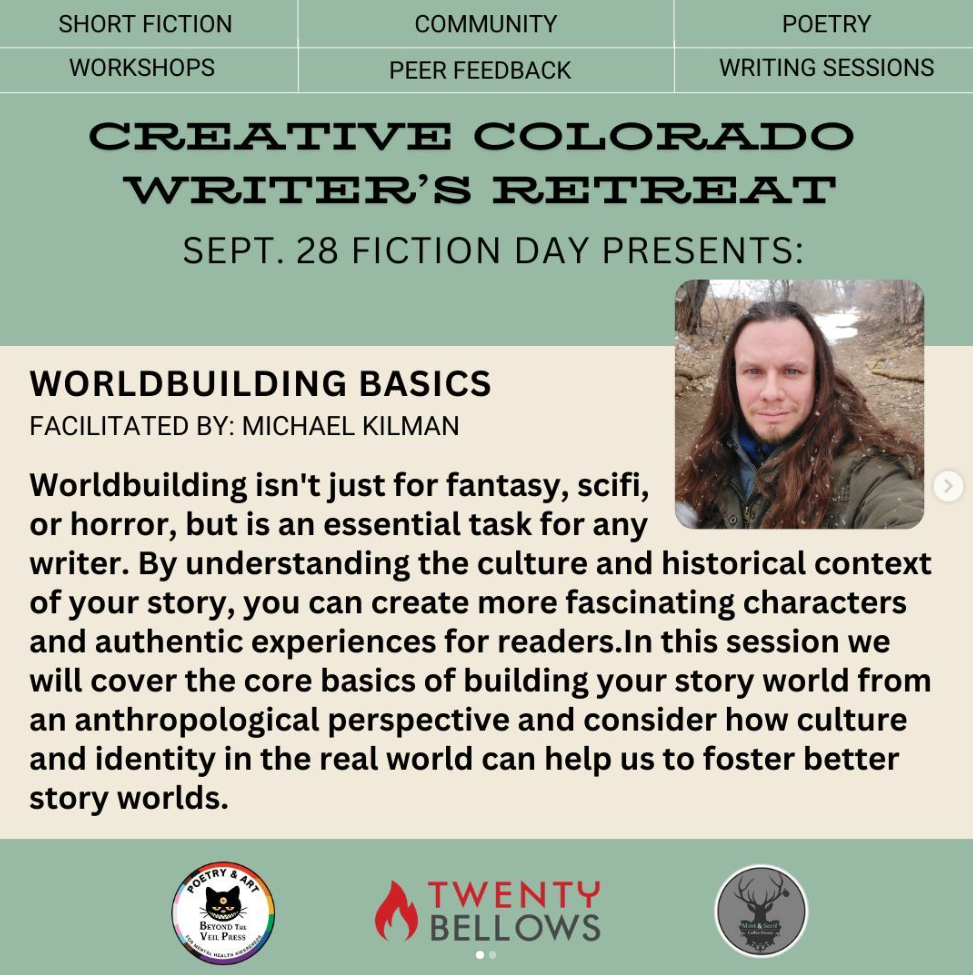
First up is that for the second year in a row, I will be teaching a session at the Creative Colorado Writer’s Retreat run by the incredible small press, Twenty Bellows. I have to say, I think this year has some of the most talented teachers of both poetry and prose in their line up. You can find out more about it here.
For my part, I’ll be teaching a session titled: Worldbuilding Without Info Dumping: How to Master Reader Immersion in Your Writing. My session will be on Saturday September 20th starting at 2:40 Pm.
The goal of the workshop will be to explore worldbuilding without exposition and instead looking how to build through dialogue and action so that your reader connects more deeply to your characters in the middle of the flow of the story.
But wait! There’s more!
At 11am on the second day of the writer retreat, we’re having a book fair. The book fair runs 11 am to 1 pm. I’ll have a table there if you want me to sign your books or pick up a copy of one of my 7 books. Again, there are many very talented authors at the book fair and It’s gonna be a ton of fun!
In other news, Resistances Reads Episode 8 goes live Monday September 15th at 7pm over on YouTube. And if you haven’t seen yet, we’re now on all the major podcast services. Episode 8 will cover the book, Black Empire by George S. Schuyler originally serialized in the 1930s, and is an early example of Afrofuturism. Literatura Obscura will air it’s 3rd episode this week as we discuss the book Ishamel by Daniel Quinn. It’s a novel about a telepathic gorilla who teaches a man the secrets to saving the world.
In terms of book updates, I have something to admit… I’ve been working on a secret project and it’s been distracting me from other things. But, I’m not quite ready to discuss that 8th and decidedly stand alone novel just yet. I am also working at building some of the lore right now for Shades & Shapes in the Dark universe. For those of you who read the first book that came out last may, you might suspect that it’s not really just a horror novel, but also edging into something more. In Through and Endless Darkness Dreaming (Book 2) Clarissa will discover that there’s more creatures out there, than just her own tormenter, Demon and that the world of magic is so much bigger than she realizes.
I am, also, slowly spending time in the world of The Chronicles of the Great Migration. I promise, I am still working on The Children of AEIS, and the final two other books of the series. They will get done.
One final announcement. This one is in the world of Anthropology. I recently published a chapter in the book, Exploring Digital Ethnography: From Principles to Practice. My chapter is titled: Worldbuilding as Pedagogy: Teaching Anthropology and Diversity in Contentious Classrooms. Now this is an academic volume, so while it’s not cheap, you absolutely can purchase it here. There are some great chapters in this book covering a variety of digital and interactive approaches to anthropology.
But if you just want to read my chapter… well… if you contact me, we might be able to find a way…
Hey all, I know it’s been a while since I have had updates so I have several things to post about today. Sorry for the long message, but I’ve broken things down so you can easily skim to the information you want.
The first is the reason that things are so delayed. This summer I joined Teach for America and last month I officially became a High School English and Language Arts teacher for 11th and 12th grade. Let me tell you, that’s an extremely busy job.
Despite the very long hours I am working right now, I’ve managed to make a lot of steady progress on my forthcoming novels. I am currently on a streak of 574 days or writing without skipping. 500 or so of those days had a minimum of 1000 words a day. So I make progress on something every single day (though I must admit at least 50 of those days I deleted the words right after I finished them but hey, you gotta get those bad words out of the way for the good ones to shine).
Here is the current status of my books that I am actively working on:
Shades and Shapes in the Dark is currently in it’s final pass before it heads off to the editor. ETA for book 1 is either October 17th or November 17th depending on the amount of edits required (How much red pen my editor uses).
The series is now 4 books with the following titles and progress level:
Book 1 “Shades and Shapes in the Dark” is in final edits with an ETA in October or November.
Book 2 “Though An Endless Darkness Gleaming” is 75% of Draft 1
Book 3: “An Illumination of Extraordinary Madness” is 50% of Draft 1
Book 4: “The Nature of Twilight At Dawn” is 30% of Draft 1
I currently expect to finish draft 1 of Book 2 by November 1st and to use NaNoWriMo to finish (or get close to finishing) the first draft of book 3
The Children of AEIS and The Chronicles of the Great Migration final two books, A War For the Heavens and A Hand to the Stars are still on their way. The Children of AEIS is sitting at around 75% first draft completion. The largest reason for the delay was a major concussion only two months after the release of Serah of the Runners. This derailed me pretty solidly and right now, when I have free time on top of writing, I am working through creating notes of the 4 books because my memory of them appears to be a little lacking from first the injury and then the passage of time. But, they are in progress and they absolutely will get finished sometime in the near future.
Welcoming the Muse
My poetic essay, Writing is Living was selected for publication by Twenty Bellows Press this summer. The piece is about life as an author in the 21st century. There will be a release party sometime this fall and I will provide more information as the date approaches. Needless to say, I’m thrilled to have another short of mine published this year. That makes 2 short pieces of writing picked up by publishers.
How to Write for the Future Podcast
I also recently appeared on a second episode of Write for the Future. This podcasts covers some basics of worldbuilding. The host also spent time across several episodes highlighting some of the key features of Kyra Wellstrom and I’s book, Build Better Worlds. I have linked the second episode where I guest starred as well as the episodes that surround our book below.
My last piece of news is that back in July I was asked to teach a session at the Creative Colorado Writers Retreat hosted by Twenty Bellows Publishing Company. I feel so honored to be a part of this retreat as it includes some of the most talented and knowledgeable writers in Denver.
That’s it for updates (I know there were a lot). I’m confident my next update will be release news! I hope everyone is having a great holiday weekend (if you’re American and reading this).
How do we create identities? How do we decide what kinds of things are taboo in society? How do we know what is clean or dirty? Have you ever thought about the fact that sometimes, we reinforce our choices and values through rebellion and/or opposition?
It might be obvious why some things are taboo, or at least there is some sense of rationalism surrounding those ideas. It’s taboo to eat out of the garbage, since the likelihood you will get sick is high and that’s where we put the things we wish to discard. But why are there taboos surrounding colors of clothing or beards, or types of clothing or lack of clothing? Is there a rational reason a man can’t wear a bright pink bikini on a hot summer day in American society? Why does this make us uncomfortable? Is there a reason that it’s not considered manly? Keep in mind, by reason, I mean an objective scientific one. Don’t worry, you’re not going to find a picture of me in a bright pink bikini below, I promise. But when you’re building a fictional world, understanding why a society formulates taboos and norms can be really useful.
In this entry on worldbuilding, we are going to examine a way to think about how people form their identities and cultures using the concept of schismogenesis.
Coined by Anthropologist Gregory Bateson in the 1930s, the term schismogenesis means essentially creation through division. By looking at your identity and behavior, I acknowledge how we are different, and thus solidify who I am. This often manifests as opposition. The most obvious form of schismogenesis is the rebellion of teenagers, who form their identity based on challenging acceptable behavior. Through opposition, they create identity. But this isn’t just a teenager thing, cultures and people do this all the time. It’s why suppressing differences, can actually make them stronger. The identity becomes more legitimate, more solid, because you fight against it.
Let’s return to bikinis.
I (apparently) am the kind of man who wears a bright pink bikini in public, and you, (assuming you’re a male in this example and of the status quo in American society) do not. Thus, I am behaving inappropriately in society, and you are not. You, will try to get me to conform. You will probably mock me for my strange behavior. You may seek to make me feel ashamed of wearing my bright pink bikini out in public. I will do one of two things. Either, I will capitulate, and take off my bikini and switch to the culturally acceptable norm of swimming trunks, or I will continue my rebellion and seek to recruit others who think like me. Thus, I will form my identity through opposition.
These kinds of things happen every moment of every day across every culture. Power and resistance are constantly in play on every level. Think of all the debates going on right now in your culture about what people should and should not do. There are hundreds of topics to choose from.
Let’s look at a more serious example. Take the pork taboo. Lots of people speculate why both Jews and Muslims have a pork taboo. People have puzzled over this idea for centuries. This isn’t just limited to Jews or Muslims either. Why do some cultures say that certain foods are clean, and others are dirty? There are entire lists of foods that people eat in one location in the world, but gag just thinking about them in another.
(Note: If you want to read a whole book on this topic and you are an anthropology nerd, consider Mary Douglas’s award winning 1966 book Purity and Danger: An Analysis of the Concepts of Pollution and Taboo)
But why pork? Well, if you ask a Jew or a Muslim, the answer you’ll likely get is that pigs are filthy animals. They are living garbage disposals and love to live in their own shit and piss and eat whatever you put in front of them. Why, they ask, would you eat such a creature as this?
The reality though, is that pigs are not like this out in the wild. In fact, when I was doing research in a rural village in Mexico in the northern state of Nueve Leon back in 2008, the pigs they had in those villages were far from disgusting or dirty. They grazed in fields alongside the other animals and ate similar things. They didn’t live in mud, they lived alongside all the other animals. So the filthy ‘nature’ of the pig that is the central complaint of the taboo is something artificially created by human action, not nature. Often cultures and people will come up with logical explanations for their taboos to justify their practices.
That doesn’t mean we should disrespect our Jewish or Muslim friends by forcing pork on them. Every culture has things it forbids that defy rationality or reason. We all have superstitions and traditions that aren’t based on evidence. The point here is not to judge, but to understand how this works to better assist you in building fictional worlds.
One possible explanation for the pork taboo is schismogenesis. In the ancient world, there was a period for the Jewish people known as the Babylonian Captivity or the Babylonian Exile. Many Jews were forced to live under the control of the Babylonian empire after the Babylonians conquered the Kingdom of Judah beginning first around 598 BCE. The Babylonians captured and enslaved many of the Jewish people.
There were two large staples of the Babylonian diet that both became taboo under the Kashrut, the dietary restrictions of the Jewish people. The first was pork, and the second was horse. Both foods were common in Babylon at the time. The enslaved Jews did not consume this food previously. Thus, as their enslavement continued, they ate foods similar to that of their homeland, and not of those who enslaved them. This certainly contributed in at least some way to the prohibition, though it may not have been the only cause.
But here we see, at least in part, schismogenesis in action. The Jews, under the yoke of an oppressor, didn’t want to partake in the food of those who had enslaved them, hence, their identity surrounding their food taboo. Several generations lived under these conditions, then, when the Persians conquered the Babylonians and allowed Jews to return to Palestine, many of those ideas circulated into the wider culture. Food is common as an important identity marker in many cultures, this is especially true in populations that have been historically oppressed.
Now again, there are many debates on the pork taboo, and this is only one possible explanation. In fact, most cultural taboos and restrictions can come from several causes at once. But, schismogenesis is useful because it helps clear up confusion in a culture. If the enemy other is doing something, and you don’t want to be like the enemy, then you can avoid doing that thing. This solidifies who you are as a culture and with it, identity. In our case, it helps create more complex fictional characters.
Here are few things to consider if you want to employ the concept of schismogenesis in your fictional world.
1. What are the core values of each of the fictional cultures you are building?
If you’re setting up a world where multiple major cultures will fight for control, then the first place to begin is where their core values lie.
– What kinds of things are important to your culture?
– What taboos do they have?
– What things to they exaggerate or emphasize about their adversaries?
– What qualities do they wish to cultivate in individuals on an ideal level?
If you take these things and sketch out what each culture is doing in these worlds, you will have a good place to see potential conflict between the different ideas of morality and/or taboo in the cultures.
This is especially true if you have a culture that has been conquered by another. Acts of rebellion don’t end at violence or protest. They can manifest in everyday experiences. In fact, when you stress a culture out, there is always a core group of people who will try to preserve important elements of their culture, hence, the rise of fundamentalists. They want to go back to the way things were before the changes came. It doesn’t matter that you can never truly return to the way things were, people want that old sense of safety and security of their cultural norms.
This is why we see groups like the Amish, whose very existence is in opposition to the changes wrought by modern technology. I grew up in part on the east coast, and not far outside of Philadelphia, it was common to see the Amish on the road in their horse and buggy, slowing down traffic. The way they choose to live is a form of schismogenesis. It might not feel subversive to us to live in that way, but to them, it is.
Which brings me to another point. Cultures aren’t homogeneous. There are all kinds of diverse approaches and ways to live within cultures. Be sure to consider that as you highlight the values and taboos of the larger culture above. You will want some wiggle room for resistance, for factionalism, even as larger conflicts between nations are happening. People disagree on pretty much everything, and sometimes that disagreement is a huge part of their identity.
2. The minor differences matter
Yes, your cultures will argue over the big stuff. But the minor differences matter too. Every culture has a different protocol for body language, for dress, for the kinds of sounds and colors they like and dislike, and so on. Every little thing you do comes from making comparisons against others. While we focus on the things we like and enjoy, we often spend even more time on the things we don’t like or find disgusting as ways of acknowledging who we are.
Small things like how a culture eats can mark identity. Much of Europe didn’t adopt forks until the 17th or 18th century (depending on what region) because they were considered either unmanly or excessive. Just imagine, someone, at some point, was complaining about how feminine it was to use a fork. Yes, that really happened. Someone else decided to use a fork anyway, probably a teenager.
Even generations within cultures employ schismogenesis. Think about what different generations say about each other. I’m a millennial and hear constant complaints from older generations about us. I’m almost forty now, so obviously millennials aren’t that young anymore. I’ve noticed that there are a lot of complaints among my fellow millennials about Zoomers already. We make constant comparisons about all the little things we do differently.
You don’t have to pick big things for schismogenesis, in fact, sometimes a lot of little things add up to create stark differences. Remember, as I’ve said repeatedly in these entries, and in my book Build Better Worlds, culture is a performance. It’s a way of enacting practices to mark who you are and what you value. That isn’t just the big stuff, it’s all the little things too.
3. Living within a cultural script
Every culture has a kind of script, a set of rules to live by that are both formal (laws) or informal (norms). Some cultures (like our own) make the concepts of choice and freedom paramount to their core values. But if you step outside the bounds of their norms, there are still all kinds of ways you can be disenfranchised. Think of the debates surrounding the right way to be a man in our own society. Forks and pink bikinis aside, these discussions aren’t about objective truth.
In fact, the irony of this discussion is that if choice and freedom were truly at the center of the debate, there wouldn’t be arguments about what makes a “real man”. Men would just go out and do whatever they wanted and that would be manly. These same scripts that proscribe masculinity limit agency (freedom of movement within a culture). There’s no freedom by living up to the expectations of a cultural script, but there is a sense of unity, an imagined comradery. (Note: See Benedict Anderson’s 1990 book Imagined Communities for the Anthropology Nerds out there) Though we may never meet most other Americans, there are certain behaviors and identity markers that are expected to establish a sense of unity across the culture.
This isn’t about good or bad, this is what cultures do. How a culture maintains itself, or how it changes, is an endless conversation taking form in every arena of every culture. These masculine norms aren’t about freedom, it is about expectations, about clearing up confusion to make identifying what is male and what is female in clear terms. Humans in general like things simple. Unfortunately, very little about humans is simple. We might idealize certain behaviors or how many genders we think we are, but of course, certain behaviors that are beneficial and unifying to one group will naturally be oppressive and divisive for another. This is exactly why, opposition can be a core part of identity.
With all that in mind, take a moment to consider, what kind of cultural scripts are used in your fictional world. There are certainly trends among humans. Male domination, though not universal, is common in the modern world. There are still matriarchies out there, but they are few and far between because of the larger patterns of empire and conquest.
– Different political systems, like the matriarchy mentioned above, would have different scripts
– Different economic systems, like a gift economy, or a system that uses potlatching, would have different scripts about what wealth and power look like
– Different religions, for example, one without deities, are going to focus on different scripts.
– Remember that culture is holistic, that every part of culture connects into every other part of culture, the scripts about behavior and identity will mirror all these elements put together
4. Enforcing identity and Solidifying Resistance
In order for a cultural script to be useful, it has to be enforced. In some societies, there are laws about how people dress. They enforce what activities different groups can participate in, how they should appear in public, and so on. In addition to these formal laws, or in a situation where there isn’t written law, rumors and gossip act as a kind of social surveillance to enforce expected behavior. Gossip is likely the oldest form of surveillance and uses shame and guilt as a weapon against anyone who doesn’t fit neatly into cultural scripts. If that sounds like high school, you’re not wrong. Humans have been doing this to each other since we were… well, humans.
Remember, these scripts are also created in part because a culture doesn’t want to behave like the other. They want to mark themselves as distinct and different. They don’t want to engage in the behaviors of the enemy other, dress like the enemy, eat like the enemy, or even talk like the enemy. Groups that are focused on differences will often advocate for exclusionary rules or policies that limit the kinds of diversity possible. They will shame and embarrass those who don’t fit in the mold. Often, they have a fear that this other, this adversary, will creep in and take their culture away from them by changing things or forcing them to change.
We even do this on a large scale. The 1978 book, Orientalism, by Edwards Said, highlights the perceptions of Europe and its false dichotomy of the Eastern world vs Western world. The book is an attempt to critique our stereotypes of the Eastern world, and how empire, colonialism, and bias played a role in our understanding of world history and cultural analysis.
According to Said, men of the Orient were portrayed as culturally backward, physically weak, and feminine. This reinforced the ideas of Western masculinity. Of course, perceptions of the men of the Orient were just stereotypes. And nothing robs people of their freedom quite like a stereotype. Raj from The Big Bang Theory, and Fez from That 70s Show, are stereotypical examples of Orientalism in action. Both the characters struggle to understand Western culture and are awkward. Both characters spend a lot more time with the women of the group and struggle to relate to the men in the same way. Both characters are mocked for their physical weakness.
Cultures will often create assumed cultural scripts for their enemy. We know these scripts as stereotypes. We expect the enemy to fit only within these boxes, and are often surprised when they don’t. This is not a product of only one culture, all cultures do this. We use our norms and rules to compare ourselves to the cultures we don’t like because they are a direct enemy, or because we consider them less civilized. But it works in a paternal dimension too. Paternalism in this case is the notion that we are more rational or advanced and must help civilize the “savage”.
What are the benefits of using Schismogenesis in fiction?
Employing schismogenesis creates all kinds of fertile ground for storytelling. There will be characters who highlight the differences between each group and hold conservative views about the way things have always been. There will be characters who think that some of these arbitrary things are well… arbitrary. They will accuse the conservatives of living in the past and highlight the ways that the past was ugly. These are the progressives of your society. They often advocate against these kinds of differences. However, they will also employ schismogenesis against those who they disagree with too, often the conservatives of their culture.
Just because you are liberal or progressive doesn’t mean you’re free of bias. No one is free of bias and oversimplistic thinking. We all generalize the people we disagree with. I catch myself doing it all the time. After all, it’s much easier to disagree with someone if you take away the nuance and complexity of their argument and create strawmen that are easy to knock down. We all have things we are bias about and we even know that some of them are arbitrary. Your characters absolutely should too.
There’s a third group in a mix, the ones who stand in the middle. These bicultural individuals (they can certainly have more than two cultural backgrounds) don’t have a specific set of rules or scripts to follow for their identity or they have more than one. Individuals like this are born in the middle of multiple scripts, being forced to discern how to move through the world. They could be mixed ethnicities and thus get culture from each parent, or perhaps they are an immigrant or refugee born in one culture, but now living in another. Every person who stands in the middle will take unique positions on different aspects of their identity and culture. Immigrants should be just as diverse and complex in their approach to the world as characters who are monocultural. Some immigrants may take on the dominant norms as an act of rebellion to their parents. Others may take on the traditions of their homeland to resist assimilation. Schismogenesis in the real world creates all kinds of diverse identities and experiences and in fiction, richer characters, backstories, and worldbuilding.
Consider:
– How do your characters compare themselves to other cultures and individuals?
– Why do they make that comparison? Are they jealous? Are they fascinated? Is the grass greener? Is the other more barbaric?
– Do they see some good things and some bad things about the other?
– What generation are they a part of? Are there changes in technology for that culture or maybe some new cultural practice or experience has arrived?
– Has contact with another culture happened recently?
– Has there been a change in the political or economic structure?
Some Final Thoughts
Norms change. We don’t consider forks unmanly anymore. Though I guess the jury is still out on men in pink bikinis. Every generation gains new ideas, and loses some old ones. Maybe in the era of social media things are changing faster than before, but we need a much longer view, in terms of decades, to really understand what social media is doing to us. Sometimes, changes that appear bad in the beginning create really interesting changes in the long term.
In building your world you could start out with one group of norms and rules for a society and then change the power dynamics of the situation to suddenly force those norms out. Brandon Sanderson does this masterfully in the Stormlight archives. At the beginning of the series, having light-colored eyes automatically means you are a person of rank and privilege. Being a poor light eyes is far better than being a wealthy dark eyes. Light eyes or dark, both groups have their own internal hierarchies as well. But, as the series goes on, and the return of old magic changes the colors of some people’s eyes, the power dynamic of eye color changes, and many of the characters are forced to confront the arbitrary nature of the light eye, dark eye, dichotomy, each in their own way.
The best stories are ones that show truth. The truth about most of what we do as humans is that it’s arbitrary. We have certain standards and taboos that do serve purposes. Some help protect people from harm in both short-term and long-term situations. Eating garbage or marrying your sibling are not wise moves and thus those taboos are useful.
However, many things we hold as important are really just cultural preferences. Loving your culture isn’t wrong. It’s just that these things don’t have any root in objective truth. That doesn’t mean that they don’t have value. There are many beautiful traditions the world over that some consider strange, while others find unity and comfort in them.
It’s all complicated. Wonderfully complicated. I think too often we look at complexity and throw up our arms and say, it’s too much effort to understand. But I think it’s better to be curious. But then, that is why I became an Anthropologist.
Writing honestly means to look at the world and understanding it for what it is. The world you create in fiction, is a reflection of who you are. Sometimes that means to create the best worlds, we have to step outside of what’s comfortable or easy. Good worldbuilding means you need to understand the cultures you’re creating. You need to hold what they see as sacred in your mind. Immerse yourself in their worlds. Live through your characters and embrace the wonderful complexity of the world you’re creating. Maybe try a little schismogenesis on for size.
This essay went out to my substack. Considering subscribing for updates on tons of free content. And if you are curious about my work, and want to support me you can become a paid subscriber to read exclusive and early access to fiction, audiobooks and more.
Like music, good writing often has a rhythm and a flow. There are always exceptions of course, but if you want your readers to connect with your content, it can be helpful to consider the four elements below.
This essay will focus mainly on fiction. Non-fiction has a different set of elements, and maybe I will write about that soon (comment below if you’re interested in that).
Before I dive in, It’s important to note, that style is really important here too. Different writers use these elements in different ways, but, finding your way to balance them, can help your writing immensely. Often, thinking about how to balance these elements is better done in your second draft. Why? Well, often the first draft is more about discovery. What’s happening? Why is it happening? Once you have the core basics of what you want the scene to accomplish, then you can go back through and apply these elements. Of course, as you practice, you’ll get better at doing it the first time around too.
As I cover each element, I’m going to write a sample scene using the elements. Each element will build on the previous scene. The first iteration of the scene will only include dialogue. With each element, we will add another layer to the same scene.
Let’s dive in.
Element 1: Dialogue
What makes dialogue compelling? Have you ever stopped and read your favorite scenes of dialogue?
There are a few key ingredients to dialogue. But before we get into that, it’s good to note that dialogue in real life, is not the same as fiction. You can’t listen to real-world conversations to help with fictional dialogue.
When I was in graduate school a huge part of my job was transcribing interviews and roundtable discussions. I spent hundreds of hours typing up conversations. It wasn’t long before I discovered that most people don’t follow the same grammatical rules that we do when we are writing. Good dialogue has to simulate conversation but is cleaner and more to the point. No one wants to read all the ums and pauses and false starts. So a first tip is to consider studying how your favorite novels or films set up quality dialogue.
Beyond the flow of dialogue, it’s vital to consider your characters’ interests. What does your character want out of this conversation? What’s their agenda? Do they just want a cup of coffee or are they trying to persuade someone else to take action?
Every person in the dialogue should have some kind of agenda, even if the agenda is to try and remain neutral or understand what the other character is trying to say. How does that agenda tie into their larger goals? Or does it? Maybe their goal is to relax and their neighbor is pestering them. Maybe the conversation is with a powerful person whose goal is to take over the world.
Dialogues are often games of power, persuasion, and coercion. We use our words to enforce norms in society. We use them to get what we want or prevent something from happening. We use words to connect with people or share our feelings just as often as we use them to compete. Always consider how these conversations drive the plot and character development.
Each of your characters will use different kinds of words and phrases. A ten-year-old, unless they are a prodigy, is unlikely to use big words and scientific jargon. They are also less likely to be self-reflective. However, if the 10-year-old is trying to sound smart (because their agenda is to sound more grown up in a group of grown-ups) it can be fun to have the child use the words incorrectly.
You can also use a conversation between an adult and a child to reveal something about your world. The adult can explain elements of your world or story to your child that might be difficult to do in other ways. Children and newcomers to a world are often useful tool for helping your reader to understand your story more organically through dialogue than a long info dump.
Personally, I am not a huge fan of incorporating a lot of dialects into writing. In the Harry Potter series, for example, I loathe reading the Hagrid Dialogue out loud to my kids. That’s because sometimes it’s hard to understand what the character is saying. You have to read the sentence several times and that kind of dialogue can pull you out of the story and leave you feeling frustrated. Your use of accents or dialects should never pull the reader out of the story. You want to draw people in, not frustrate them and force them to read the same line several times to understand what’s happening. There are always exceptions of course, but generally, I suggest avoiding distracting dialects.
On the other hand, if there are certain words or phrases that a character always uses, it can be a good way to build personality or remind your reader of their quirks. Just don’t overuse this. We have all encountered the annoying person who uses the same phrases over and over. Though, this too can be a tool in writing. Perhaps your main character is exhausted by their neighbor who says the same phrase six times in a single conversation. But remember, a little bit goes a long way.
Avoid adverbs. I’m not one of those writers who says never use them, adverbs have their place. But if you always have to write something like, ‘She spoke softly’ or ‘He said with certainty’ then you aren’t really balancing out the other elements. There are lots of other tools in our writing kits that help us understand tone and emotion. Dialogue can be good for showing the reader things, but avoid telling your reader about the tone or feelings of the character. Let the character share their own thoughts and feelings as much as possible.
There are definitely more things to think about with dialogue but considering these key points can significantly improve your dialogue. If you want to dive deeper into dialogue specifically, I highly recommend the book ‘How to Write Dazzling Dialogue’. It’s a pretty quick read and covers some additional key points about how to improve that particular part of your writing.
Scene Example Part 1: Just Dialogue
Stephanie said, “I’m leaving for a reason.”
Grandma said, “But we need you here on the farm.”
“Bert isn’t going to college. He’ll stay here forever.”
“One person isn’t enough to take care of all the animals.”
“So hire someone.”
“You don’t care about your family?”
“It’s not that grandma. I do care. But this place. It’s just not me. I don’t feel like I fit in here. I want to find where I belong.”
“Stephanie, of course you fit in here. I couldn’t do any of this without you. And besides, Bert isn’t going to marry anyone. He’s not going to have kids. This farm has been in the family for generations and you’re just going to abandon us?”
“It’s not abandoning you. I have to find myself. I’m an artist Grandma. I need inspiration.”
“You can paint here!”
“Paint what? Barns? Trees? Farmers? No. I want to travel the world and paint all the amazing things I see.”
Element 2: Action
Action isn’t necessarily violence. Action is also motion. It’s everyday tasks. It’s moving around in the space and inhabiting it. Action is important because you don’t want your character floating around in a void, you want them to be living breathing beings inhabiting an interesting space.
Is your character cooking dinner while talking to their grandmother?
Are they brewing a magical potion to curse their enemies while discussing their evil master plan with their assistant?
Action and Dialogue work together in beats. The dialogue in the example above is an okay start but when we only have the words, were missing so much more of the lived experience of these two characters. Dialogue and action have beats and melodies just like music.
If you have only dialogue and no action, there’s no room for the reader to pause and consider. Action can give dialogue some breathing room. It can add quirks to each character and deepen the emotions of the dialogue.
Maybe it’s just me, but I struggle to stay interested when there is too much action. A big battle scene, a one-on-one fight, a massive explosion, or a scene where someone is fleeing a monster can be a lot of fun to read and write. But if your characters never stop to catch their breath, if every chapter has a scene where someone is fleeing a monster, if your entire book is a battle… you’re going to bore the hell out of most readers. There are certainly people who will read nonstop action. Hollywood counts on some of those people to consume their endless sequels of Fast and Furious, but even those movies, have downtime.
Action should serve a purpose in the story. Yes, you can absolutely write cool action scenes and they’re definitely fun to write, but why? What does this do to drive the story?
Frank Herbert was notorious for cutting out the vast majority of the big battles in his Dune books, and Dune is hands down the best-selling sci-fi novel of all time. There’s lots of action in the books, but you don’t hear very much about the big interstellar battles as Paul Atredies conquers the galaxy. And while not everyone loves Dune, it’s one of the most important science fiction novels in history. There are lots of ways to approach action.
Why does that bomb need to go off? Why do two rivals have to fight that battle? Or rather, why do you need to show the battle? Is your main character a warrior so the audience needs to see their skills or use of magic? Is important to show them fighting for their life against an evil shapeshifting clown? If your story contains a lot of battles, it’s not necessary to show every element of every battle. Choose important moments in longer moments to highlight important actions. Don’t make the mistake of the Transformers movies and have ninety minutes of a two-hour film dedicated to fight scenes. Those movies make my eyes glaze over because it’s just action, action, action.
Be strategic with your action. Too much and you might have readers putting down your book, too little and they won’t understand the scene the way you want them to.
Scene Example Part 2: Dialogue and Action
Stephanie stirred the marinara and said, “I’m leaving for a reason.”
Grandma kneaded the dough on the adjacent countertop. She pressed her hands much harder in the dough than needed, “But we need you here on the farm.”
Adding in some more garlic, Stephanie stopped and turned facing her grandmother. “Bert isn’t going to college. He’ll stay here forever.”
Grandma sighed shook her head. “One person isn’t enough to take care of all the animals.”
“So hire someone.”
Grandma stopped kneading the dough and put her hands on her hips, scattering flower on the floor. “You don’t care about your family?”
Stephanie turned back to the pot, adding seasoning to the sauce. “It’s not that grandma. I do care. But this place? It’s just not me. I don’t feel like I fit in here. I want to find where I belong.”
Her grandmother leaned into the rolling pin and flattened the dough. “Of course you fit in here! I couldn’t do any of this without you. And besides, Bert isn’t going to marry anyone. He’s not going to have kids. This farm has been in the family for generations and you’re just going to abandon us?”
“It’s not abandoning you. I have to find myself. I’m an artist Grandma. I need inspiration.”
“You can paint here!”
“Paint what? Barns? Trees? Farmers? No. I want to travel the world and paint all the amazing things I see.” She waved her arms around spattering droplets of marinara on the countertops.
Element 3: Worldbuilding
Worldbuilding is the cultural and environmental setting your characters are in. It’s the kinds of cultural elements you’ll see in the seen giving your story more context.
– What time in history does your story take place?
-What is the level of technology?
-Are the characters indoors? Outdoors?
-What kinds of things decorate their walls?
-What kind of furniture or objects fill the room?
-What does the landscape look like? Can people walk in it or do they need a space suit?
We cultivate our spaces based on cultural knowledge and personal experiences. But personal experience is also bound by culture. If you live in a different culture you will naturally have different experiences. Think about the culture and the setting of your scene. In our example, we have a family farm and a young girl dreaming of traveling the world and painting. What kind of cultural details are important to make the world feel real?
Worldbuilding should be realistic. No, I don’t mean you can’t use magic, or spaceships, or supernatural forces, I mean your world must be internally consistent and holistic. What does that mean? It means that there are manyl ways that sentient creatures (like humans) interact and adapt to the world they live in both socially and physically.
-Every culture has limitations and gaps in knowledge. What are your characters?
-What are the power dynamics between the characters? Who tries to assert power? Who tries to resist it? The rebellious teenager who wants to travel the world and paint is trying to both resist the power of the older generation and assert her own.
-Do they fit within the status quo of the culture or is one character challenging the status quo?
-How does their identity fit, or not fit, into the culture?
A few sentences here or there can add a little more context to the world in which the characters inhabit. Everyone always says to avoid info dumping. But what if you have to introduce the reader to a giant walking city, telepathy, and what it’s like to be homeless in this environment in a single scene? How can you avoid info dumping? The balance between these elements (including the next and final one) can help you to draw your readers in and make a scene more compelling, while at the same time introducing interesting concepts or ideas to your story.
If you want a full book chapter that includes worldbuilding through, dialogue, action, and the environment, you might consider listening to audio narration of the first chapter of my novel “Mimi of the Nowhere” for free over on YouTube.
Scene Example 3: Dialogue, Action, and Worldbuilding
Under the warm light of the kitchen, Stephanie stirred the marinara and said, “I’m leaving for a reason.”
Grandma kneaded the dough on the adjacent countertop. She pressed her hands much harder in the dough than needed. “But we need you here on the farm.”
First, adding in some more garlic she had bought that morning from the farmers market, Stephanie stopped and turned facing her grandmother. “Bert isn’t going to college. He’ll stay here forever.”
Grandma sighed shook her head. “One person isn’t enough to take care of all the animals.”
Cornelius the Rooster picked that moment to jump up and peck at the kitchen window.
“So hire someone.”
Grandma stopped kneading the dough and put her hands on her hips, scattering flower on the peeling linoleum floor. “You don’t care about your family?” She grabbed the ancient rolling pin, that had probably been around as long as she was alive. Two white handprints lingered on her apron as she worked the dough.
Stephanie turned back to the pot, adding seasoning to the sauce. “It’s not that grandma. I do care. But this place? It’s just not me. I don’t feel like I fit in here. I want to find where I belong.”
Rain replaced the rooster, drumming on the window.
Her grandmother leaned into the rolling pin and flattened the dough. “Of course you fit in here! I couldn’t do any of this without you. And besides, Bert isn’t going to marry anyone. He’s not going to have kids. This farm has been in the family for generations and you’re just going to abandon us?”
“It’s not abandoning you. I have to find myself. I’m an artist Grandma. I need inspiration.”
“You can paint here. Your family loves you. We’ll miss you.” She nodded toward the family portraits on the wall, taken semi-often over the last hundred years. The older photos were black and white and gradually changed to a printed copy Grandma had reluctantly taken with her cell phone.
“Paint what? Barns? Trees? Farmers? No. I want to travel the world and paint all the amazing things I see.” She waved her arms around spattering droplets of marinara on the countertops. Similar stains speckled the walls from past disagreements, a map of misunderstandings.
Element 4: Internal Life
Internal life is what’s happening in the character’s mind. Not every scene needs a great deal of internal life, and in some situations, it might make sense to cut it entirely. But I think that internal life can be a powerful ally in writing a scene that connects the reader to the character’s emotions. It can also show how a character has changed in a longer story.
One of my favorite fantasy writers, Brent Weeks, does a fantastic job of using the internal life of his characters to show how they reflect on what’s happening to them and how they’ve changed over time. When you read either one of his famous book series, The Lightbringer, or the Night Angel series, that inner life helps you to feel that you’re growing with the character and you feel a deeper connection.
Things to consider about the element of inner life:
-What are the character’s thoughts and feelings?
-How do they think about what the other person just said?
-How do they feel about the place? The weather? The political situation?
-What do they think about themselves?
-What emotions are most potent in the scene?
-What things do they ruminate on? What can’t they stop thinking or worrying about?
-Do they have trauma? What things force them to relive that trauma?
-What motivates them?
-What are they afraid of?
-How does the internal life reflect the outer conditions?
Be careful, too much internal life can slow the scene down to the point where it’s hard for the reader to focus. If you’re always in the character’s head, the scene can feel bloated. Some books focus so much on inner life that nothing happens for most of a chapter. That may or may not be good for your story. Consider carefully.
Scene Example 4: All Four Elements
Under the warm light of the kitchen, Stephanie stirred the marinara and said, “I’m leaving for a reason.”
Grandma kneaded the dough on the adjacent countertop. She pressed her hands much harder in the dough than needed. “But we need you here on the farm.”
What did they need her for? She barely tended the animals anymore. She couldn’t understand why her grandmother was pushing so hard to keep her around.
First adding in some more garlic she had bought that morning from the farmers market, Stephanie stopped and turned facing her grandmother. “Bert isn’t going to college. He’ll stay here forever.”
Her baby brother loved this place. He was up early every single day with the animals, spent hours on the tractor, and loved the work. But Bert was a loner. He only left the farm to go on supply runs.
Grandma sighed shook her head. “One person isn’t enough to take care of all the animals.”
Cornelius the Rooster picked that moment to jump up and peck at the kitchen window. She hated that damn bird. It woke her every morning and pecked at the window all the time. She definitely wouldn’t miss him.
“So hire someone.”
Grandma stopped kneading the dough and put her hands on her hips, scattering flower on the peeling linoleum floor. “You don’t care about your family?” She grabbed the ancient rolling pin, that had probably been around as long as she was alive. Two white handprints lingered on her apron as she worked the dough.
Stephanie turned back to the pot, adding seasoning to the sauce. “It’s not that grandma. I do care. But this place? It’s just not me. I don’t feel like I fit in here. I want to find where I belong.”
The rain replaced the rooster, drumming on the window. She’d almost rather the rooster. Stephanie was so tired of the rain, of the endless months of overcast. She wanted to be somewhere warm and sunny.
Her grandmother leaned into the rolling pin and flattened the dough. “Of course you fit in here! I couldn’t do any of this without you. And besides, Bert isn’t going to marry anyone. He’s not going to have kids. This farm has been in the family for generations and you’re just going to abandon us?”
And there it was. She wanted Stephanie to become the typical barefoot and pregnant farmer’s wife. And who the hell would she stick around for? There weren’t exactly a lot of good options around here. After high school, all the fun people had gone off to college. After her parents had died, she had stayed for three years until Bert graduated. But she dreamed of New York and Paris and London. And she wanted to see those places before she even considered kids.
“It’s not abandoning you. I have to find myself. I’m an artist Grandma. I need inspiration.”
“You can paint here. Your family loves you. We’ll miss you.” She nodded toward the family portraits on the wall, taken semi-often over the last hundred years. The older photos were black and white and gradually changed to a printed copy Grandma had reluctantly taken with her cell phone.
“Paint what? Barns? Trees? Farmers? No. I want to travel the world and paint all the amazing things I see.” She waved her arms around spattering droplets of marinara on the countertops. Similar stains speckled the walls from past disagreements, a map of misunderstandings.
Concluding Thoughts
Take a look at how much more we know about the character’s motivations and the world in which they inhabit in the last example compared to the first one where we only use dialogue. How I use these elements will certainly be different than how you use them, but I hope the scene examples will help illuminate how you might approach and improve your own scenes.
Even if you choose to skip one of these elements, or if you use one far less than the others, it’s important to consider how each of these approaches is used and integrated into the scene to breathe life into your characters. These aren’t rules, these are suggestions. At the end of the day, you decide how to approach your style of writing.
I write essays like this to help readers like you understand the core foundations so that they can truly understand the nature of the art and craft of writing. After all, the world is a better place with better stories. And I believe that stories can save the world.
I hope this was helpful! Best of luck with all of your writing! Feel free to add questions or comments below.
This last weekend I had a great time at Cosine Comic-con. I was on several panels as both participant and moderator and sat in on a number of great discussions. As always, I try to record some of the panels that I think might be helpful for writing or a good resource for people. You can find the recording of, Adding Diversity to your Writing, below. This panel included myself and the following panelists:
Betsy Dornbusch writes epic fantasy, and has dabbled in science fiction, thrillers, and erotica. Her short fiction has appeared in over twenty magazines and anthologies, and she’s the author of three novellas. Her first fantasy novel came out in 2012 and her latest trilogy, Books of the Seven Eyes, wrapped up with Enemy in 2017. The Silver Scar, a standalone future fantasy novel, was called “a spellbinding saga” by Publisher’s Weekly.
Thea Hutcheson explores far away lands full of magic and science with one hand holding hope and the other full of wonder while she burns up pages with lust, leather, and latex, brimming over with juicy bits. She lives in an economically depressed, unscenic, nearly historic small city in Colorado. She is a factotum when she is filling the time between bouts at the computer.
Martha Wells has been an SF/F writer since her first fantasy novel was published in 1993, and her work includes The Books of the Raksura series, The Death of the Necromancer, the Fall of Ile-Rien trilogy, The Murderbot Diaries series, media tie-in fiction for Star Wars, Stargate: Atlantis, and Magic: the Gathering, as well as short fiction, YA novels, and non-fiction. She has won Nebula Awards, Hugo Awards, and Locus Awards, and her work has appeared on the Philip K. Dick Award ballot, the BSFA Award ballot, the USA Today Bestseller List, and the New York Times Bestseller List. She is a member of the Texas Literary Hall of Fame, and her books have been published in twenty-two languages.
Recently, the editor of Anthropology News reached out to me and asked me if I would contribute an article for their fall magazine. The result was How to Build A Complex Character With Anthropology. I was really honored to be a part of AAA news since I’ve been reading and engaging with their content for a number of years.