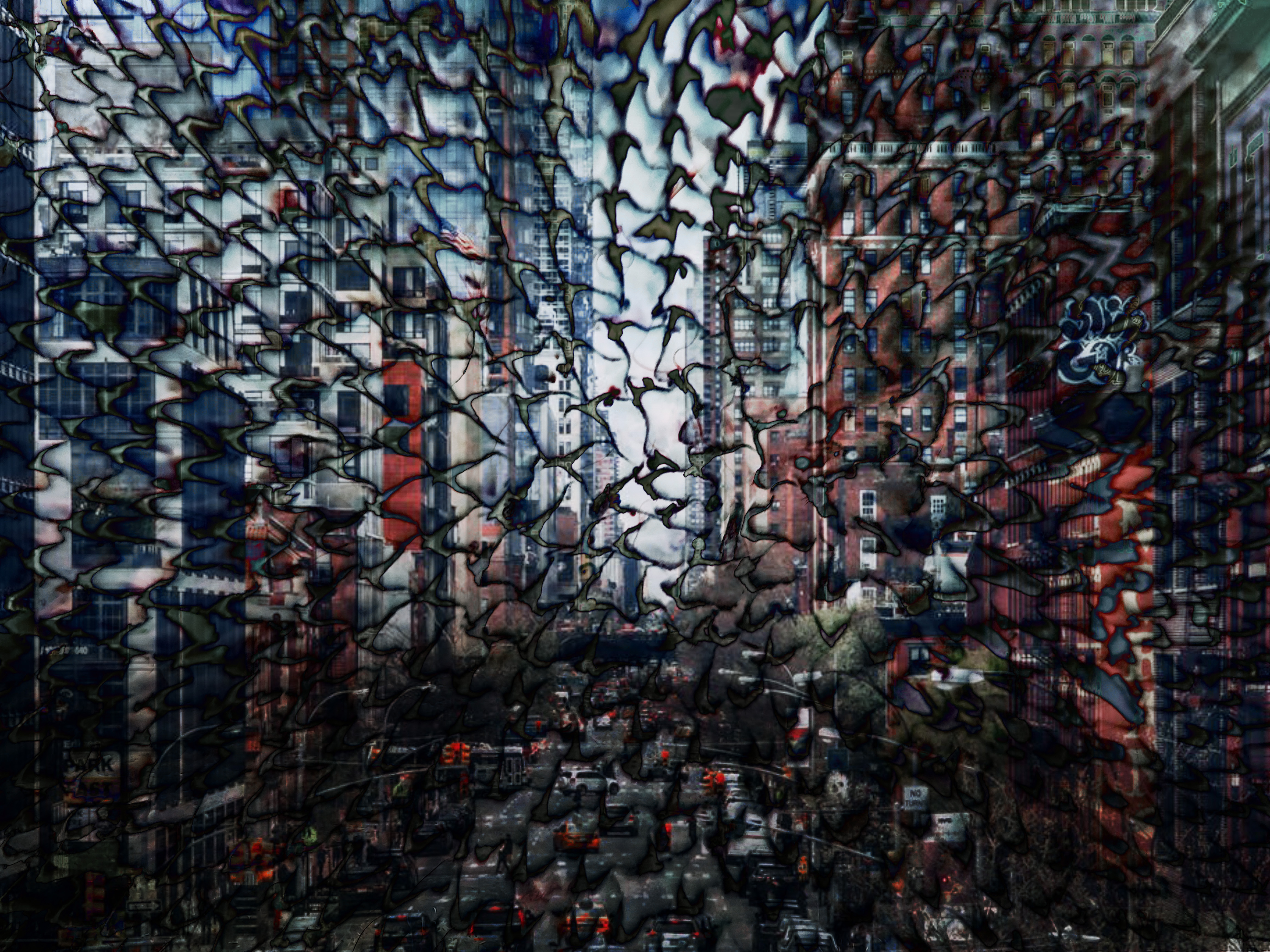
My first piece of poetry for 2022. The artwork is a photo collage of several images. Enjoy!
TuT! TuT!
There is a theme to be found in the hollow cheeks of children with their wide vacant eyes. Their gaze fixed on concrete with only the occasional stare as you walk past, curious, and ever certain of the sins of the last age.
Their tear ducts are empty from an era of dispossession, obsession.
Tut tut
Their dreams are the broken glass you walk on with bare feet.
I traverse hulking skeletons along their spine. In hidden highways I stride past the corridors of indifference. Saturated with knowing.
The markets make gamblers of us, casting bones in cups, with aged, choked knuckles, that align our lots with one unblinking eye.
Tut tut
Nerves splice open and raw, and in the light, only exposure
There was failure there in the corner, passing for a human, with arms outstretched in asking, looking for any reason to find two solid feet to stand on.
His teeth were clean but his thoughts were of days when the fix was fresh. When color nourished every pour. He is poorer for it.
Tut tut
I turn my head, not wanting to see a possible future.
You don’t hear the children play anymore between these concrete monsters, it is the commerce, the smell of flat wages, caffeinated mornings, and empty bottles in the evening, that drive us to wanting
And any hope of fresh air rots in our complacent cowardice
Tut tut
My stomach aches, the pill caused a hemorrhage again
There is a trembling in my pocket, and as I slide my hand against it, to quiet it’s nagging, I realized I’ve lost all the silence and stillness, maybe forever.
I cannot adjourn from this court of chaos. There is no detachment, just desire.
Tut Tut
The engines scream in my ears as the gears grind for another cycle. My anger is but a thumbprint away.
What should you feel as you pace through passageway of the damned? All the sulfur stinging your eyes in between rows of unkind smiles, glaring at you like idiot passengers on a doomed train car.
Drink it in, for the fountain must not overflow and everyone’s stomach must be distended before the sun kisses the earth.
Tut Tut
The screams always die before my throat can catch them.
Grass, fields, pasture lay ahead, the eye of the storm. With shouting, rasping, chuckling fervor, I pass through the gates.
There are ducks lolling just out of the reach of so many unleashed hounds, and people pampered in concrete corners.
Tut Tut
Their grief has no knowledge here.
Sitting, I wait for the fall, for a stall, for anything. But I am left waiting and wasting, sitting in the center of the eye and staring at the hulks on my periphery. Knowing they are watching every minute of rest. Flailing me with their guilt.
They are always looming, day or night, they block out stars and dreams
Tut Tut
They were built with rage in mind, and a coffin around the corner.
I hear it. A close, friendly conspiracy. Shoulders pressed together and whispers of the young for an honest days work. They stand, run, in search for sign in splashing creeks. They hunger for the chase of minnows between toes, with plastic cup in hand.
Dunking, wishing, smiles, even in the mistakes. In folly they fly past the skeletons, and into the forest to where they always belonged.
My Co-Author, Kyra Wellstrom and I had the great privilege of being asked on one of the coolest podcasts (well, for anthropologists anyway haha) around. This last summer we recorded a discussion with This Anthro Life. The episode is about worldbuilding and nerd culture.
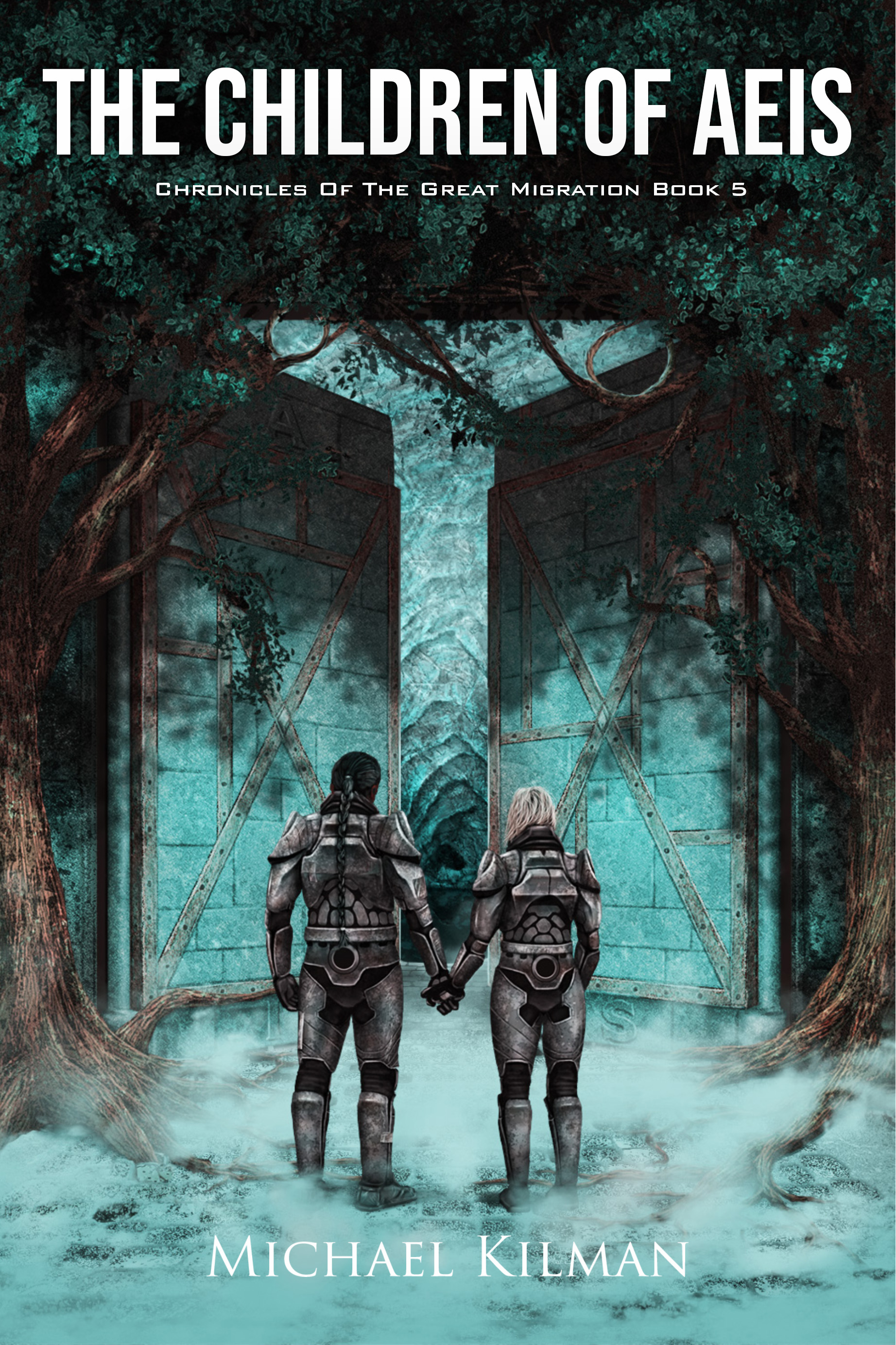
The Children of AEIS, the fifth book in my sci-fi series The Chronicles of the Great Migration, now has a cover! I am so incredibly happy with this cover. The artwork for this cover was created by the very talented Jon Stubbington. Definitely check out his amazing work.
Though I don’t have a firm date for release for the book yet, it will certainly be out before the end of spring of 2022. The Children of AEIS is the penultimate entry into this series, followed finally by A Hand to the Stars.
From the back of the book:
In the penultimate entry of the Chronicles of The Great Migration, Alexa Turon, Runner 17, Major Daniels, and their allies must learn the secrets of the mysterious AEIS and the underground city of Lastion if they hope to discover the key to defeat Miranda once and for all. Above, those aboard Manhatsten scrambles to deal with a new crisis from ROAM.
But from the ashes of the Battle for Langeles and the conflict with the Children of Gaia, a new power rises, one unlike any the world has ever known. It has only one goal, to consume.
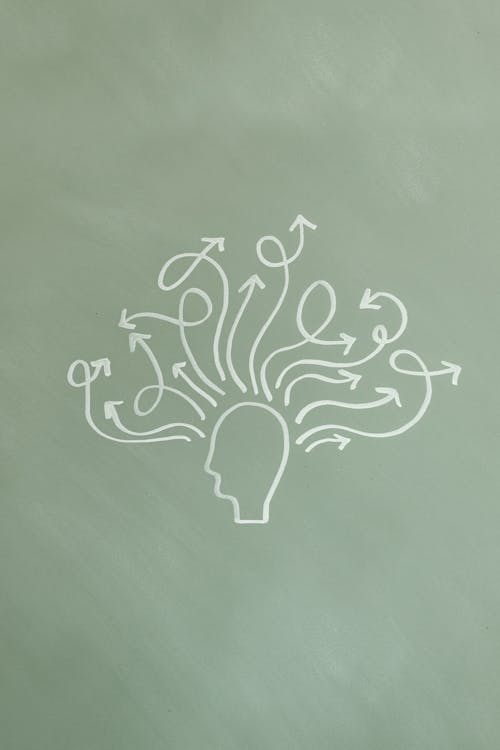
Recently, I had a discussion with a friend about what kind of biological costs superpowers or magic might have on the biology of the brain. We discussed the impact of cognitive maps based on different biological and environmental systems, and why these are things that might be useful to consider for building fictional worlds. The reality is, the one thing so often overlooked in fictional worldbuilding, is that different species, and different mutations (in regards to superpowers or magic powers) would have a profound impact on the brain structure and perception of the living person/creature. So, it’s worth at least considering a few elements in how a cognitive map, and how a special ability or power might not just impact individual characters, but also fictional cultures as a whole.
“A cognitive map is an internal neural representation of the landscape in which an animal travels. Animals that use cognitive maps can “visualize” the landscape and solve orientation problems by referring to these maps. While it is generally accepted that birds and mammals can form cognitive maps, and that the hippocampus is the most important part of the brain in their formation, considerable controversy has centered around whether other animals, such as honeybees, can form similar maps.”
Different animals have different cognitive maps. Different kinds of sensory input changes how a particular species would navigate their environment. Say for example a Mantis Shrimp, which has the most complex visual system of any creature on this planet, would have an entirely different cognitive map than a human. Why? Because humans have 3 photoreceptors in their eyes, a Mantis Shrimp has 12-16 depending on which variety of mantis shrimp you’re talking about.
Now imagine for a moment, a mantis shrimp took an evolutionarily leap and became as intelligent and as self-aware as the human species, but still had that same complex visual system. Naturally, their cognitive map would be far different than humans.
Well, one sci-fi author by the name of Adrian Tchaikovsky, played with this idea (though not specifically mantis shrimp) in his books, Children of Time, and it’s sequel Children of Ruin.
Children of Time and Children of Ruin
Without giving too much away, Tchaikovsky’s books Children of Time and Children of Ruin, ask the question, what kind of civilization would a spider, an octopus, and a kind of fungi analog build if they were genetically engineered to evolve human level, or greater intelligence. The answer? One that is a hell of a lot different than humans. But, at the same time, a creature, regardless of its cognitive map, still has to solve the problem of energy, or rather how do you build a large-scale civilization and economic system that could support a large population with different cognitive maps. So even though their maps might be different, to build civilization there would be some overlapping concerns.
For example, (and again I am not going to give away too many spoilers and ruin these amazing books for you) Tchaikovsky, at the beginning of Children of Time, introduces a jumping spider that has been accidentally introduced to a virus that will artificially accelerate its intelligence. The spiders, with completely different senses, biological imperatives, and priorities, build a civilization throughout the book. This civilization is based on a creature that not only builds a web but uses it as a primary means of communication. In this particular species, the male is much smaller and is often eaten after mating with a female, and thus, their world also includes a component of significant gender inequality, where the larger female spiders control civilization. Tchaikovsky, uses these differences to highlight how difficult communication would be with a species with a fundamentally different cognitive map than humans.
So it’s something to think about. If you have giant intelligent snake people in your fictional world, you would have different cognitive maps.
Oh and also, another bone to pick about video game worlds like the Elder Scrolls, Argonians and Kadjit would never, ever be able to mimic human speech, and certainly not English. This is also a problem with the Planet of the Apes series. Biologically speaking, the physical apparatus of a mouth, nose, throat, tongue, teeth, pharynx, larynx, and other parts create a specific kind of instrument from which certain sounds are produced by humans. It’s why some animals make noises that humans could never mimic. So an Argonian speaking English would be akin to trying to get trumpet noises out of a violin, it’s completely impossible. Of course, with your fictional world you can certainly do what you like, but understand that even other primates can’t mimic the same sounds humans make. It’s why Koko the Gorilla, and Kanzi the Chimpanzee, both used sign language and/or soundboards to communicate with humans because they physically can’t produce the sounds for human language.
Different Cultures Have Different Cognitive Maps
In the book, Don’t Sleep There Are Snakes: Life and Language in the Amazonian Jungle, linguistic anthropologist Daniel Everett discusses the Piraha tribe who live on the Amazon. Though he never explicitly discusses cognitive maps, at one point in the book, he takes some of the men from the Piraha, to a Brazilian City. While there, the members of the tribe are almost hit by cars, and have, what are basically anxiety attacks about being in the city. They really hate it. Why? Well first, Everett then talks about his own experiences in the Jungle for the first few years. In one story, he talks about a python hanging from a tree that the Piraha spot without a second thought. They try to point it out to him, but he can’t see it no matter how hard he tries. He talks about several other instances when he just wasn’t able to see or experience the things the Piraha tribe were, and he had, what was basically anxiety about it similar to the men’s experiences in the city.
One of the things that cultures do, is map their environment as they learn to navigate it. So, if you’re suddenly dropped in a new environment, say, as a Piraha person in a city they have never been to, or an Anthropologist, who grew up in a suburb and suddenly finds themselves in the dense jungle, the cognitive maps you have used your whole life will no longer function properly and you will struggle to adapt until you can construct a new cognitive map (which can take years for completely foreign environments). This is in part what creates culture shock for people who travel to other countries and cultures.
Remember, a cognitive map, is a mental picture of the environment around you. Over time, these maps become a part of our subconscious assumptions of the world and structure our biases. Different cultures are the result of different environmental conditions, and thus will have a different cognitive map as a result. Now, of course, the variation in which these maps can come in, is limited by human biology, but it’s work thinking about as you are building fictional worlds, that different cultures will have different perceptions and priorities based on the physical and cultural conditions on the ground. Of course, this certainly relates to my YouTube episode on the Sapir-Whorf Hypothesis and is worth considering, how this also impacts language.
Neurodivergence, The Brain, and Super Powers
There are more than a few problems with the way that Super Powers and Magic use are displayed in popular fiction. Now granted, these aren’t things that occur to most people (myself included until recently) and of course, part of worldbuilding is the suspension of belief. But if you are doing a hard magic system, something you might want to consider is the physical toll that superpowers or magic might have on the nervous system and the configuration of the brain.
By definition, someone with super powers or the ability to wield magic would necessarily be neurodivergent. This term means, essentially, that the person’s brain would not work the same as the average population (Of course if your goal is to make a world where the norm is magic users, they would have normal cognition for that world).
I myself have a form of neurodivergence called Prosopagnosia, also known as faceblindness. This means that I am not able to hold faces in my memory the way that most people can. It can be incredibly frustrating when dealing with large crowds, but once I discovered I had the condition, I was able to create new strategies for moving and interacting through the world. You could say, in fact, that I, had to have a different cognitive map to function. Neurodivergence comes in a lot of flavors, it’s most often associated with people with psychiatric disorders, autism, ADHD, and a host of other conditions that humans have in the modern world. Divergence doesn’t make anyone less of a person, but it does mean that their cognitive maps are different.
Take Albert Einstein for instance. There are many who suggest that he was neurodivergent. There is speculation that he might have had one or all of the following: Dyslexia, Dyspraxia, on the Autism Spectrum, and possibly ADHD. There are a number of reasons for these speculations including his difficulty with social situations and his inability to function in traditional European school systems. But here’s the point, he was a super genius and that had a cognitive cost. His cognitive map was far different from the average human and the way he navigated that environment was different from most people. This, in turn, allowed him to tackle questions that most human beings could not, and he changed the world as a result.
Again, this isn’t saying that one kind of brain is necessarily better or worse than another, but that, in fact, different brains will approach problems and solutions differently. It’s one of the reasons that, I argue in my Ted Talk, that diversity is one of the most powerful tools in our arsenal as humans. But be warned, I’ve met quite a few people who believe they are better or worse than others because their brain is different, that’s simply not true. It’s like arguing which fruit is objectively the tastiest. It’s pointless. But it is empowering to understand how your own brain works isn’t it?
So, back to superpowers. One thing you might want to consider if your character has, say, telepathy or telekinesis, is that they would in fact be neurodivergent. They would have completely different senses that were required for those abilities to function.
Different sense perceptions necessitate different cognitive maps. After all, cognitive maps are built from our sense perception. You use all of your senses to build a mental model of the environment around you. So if you could fly, that would necessitate different sense perceptions and thus a different cognitive map. Consider the Marvel character, Daredevil, who has the ability to see based on what’s basically sonar, but the cost of that ability, was the standard human trichromatic visual system that we experience. That gave him some advantages, but anyone who watches the Netflix series, or reads the comics, knows that it comes with some significant disadvantages as well. Though personally, I think the advantages are a bit unrealistic even though I definitely enjoyed watching Matt Murdock kick ass in the Defenders.
So if you have a hard magic system, genetically engineered super powers, or something similar, you might want to consider what things your characters would have to sacrifice in order for those abilities to be viable. Much of the world’s fiction is filled with examples of this done horribly wrong, but then, a lot of the time, imagination is about playing with the unrealistic isn’t it? Considering the above could be a really interesting way to build a different kind of fictional world. After all, one of the problems we face in fiction is repetitive stories, so perhaps different cognitive maps could help us ask different kinds of questions about ourselves and what’s possible.
This past weekend I had the good fortune of moderating two panels at Denver Fan Expo 2021. The whole event was fantastic with lots of amazing costumes, artist’s and authors.
With permission from each panelist, I recorded the discussions so that you can enjoy them here. Panelists are in order of introduction.
Below you will also find links to each of the panelists work. Definitely check out there websites by clicking on their names.
Looking at Myth, Religion, and Folklore in a New Light
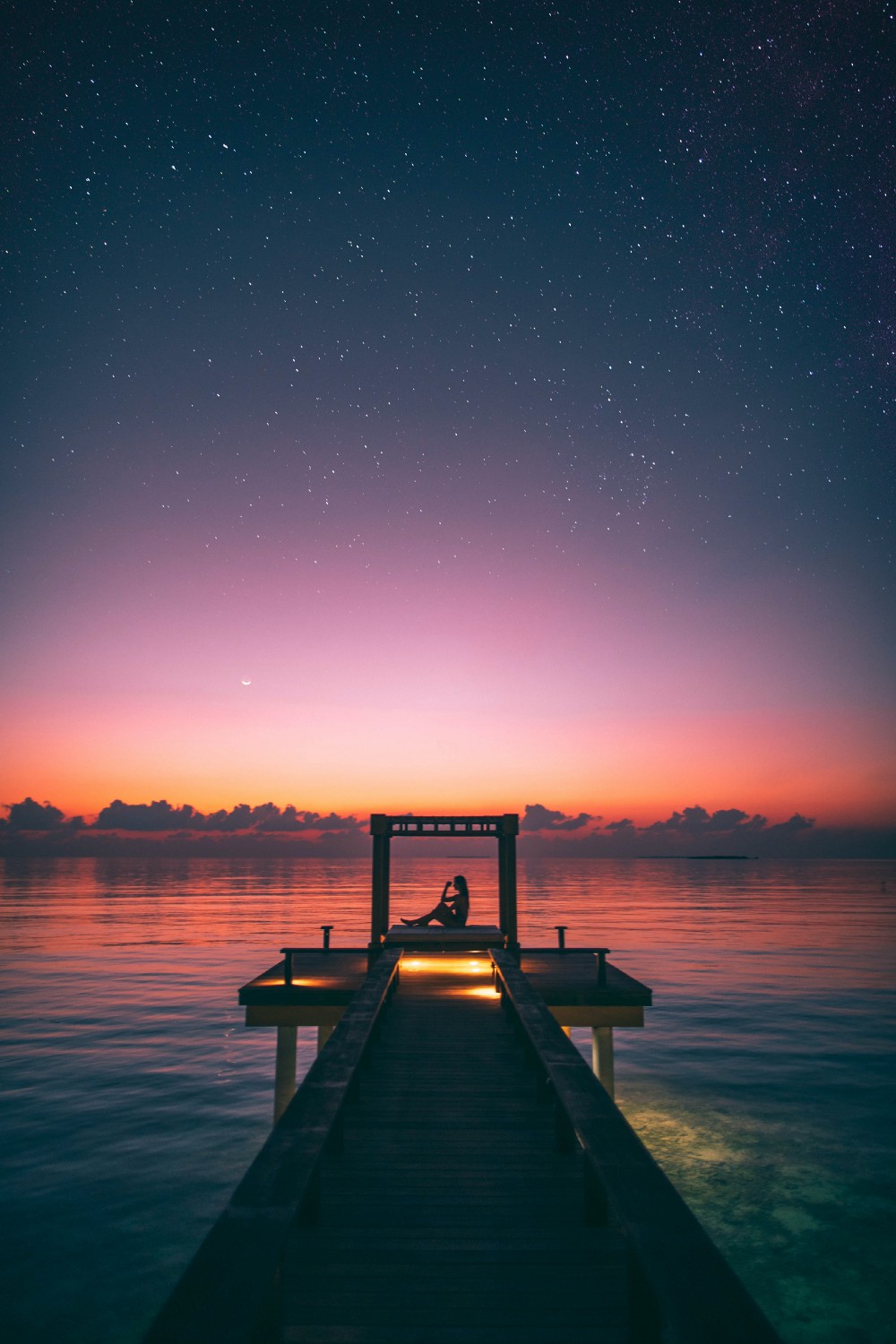
I have always gazed at the stars, longing with the beating of my heart for some greater connection to our cosmos. My childhood was filled with science fiction, astronomy, and glow in the dark stickers of constellations on my bedroom ceiling that I spent hours arranging. Even as an adult, I yearn to see our planet from above.
Space is potential and possibility, a garden of infinity. It is a great treasure of wonder and knowledge. The Universe is mostly space, and yet at our scale, it appears to be so crammed with life, and stuff, and objects that we can often feel claustrophobic, especially in our cities. Everywhere you go, there you are, bumping into things and people. Then, you scale up, and even the distances from here to the next nearest star system, are vast and unimaginable. And what’s in that space between the Stars?
Nothing?
No, not nothing. Potential.
In the last several years, I’ve been asking myself. Why do I desire the stars so desperately? Is it my curiosity of the unknown? Am I hungry to see with my own eyes, the grandeur shown to us by instruments like the Hubble telescope? Maybe it’s just too many hours consuming Star Trek, Star Wars, Stargate, the Expanse and countless other favorite sci-if films, shows, and books.
Is it that final frontier I crave? Is it an escape from the present and difficult state of humanity? Am I running away? Am I a coward?
What is it?
And then, I remember this quote from one of my favorite books, The Tao Te Ching,
“Do you want to improve the world?
I don’t think it can be done.
The world is sacred.
It can’t be improved.
If you tamper with it, you’ll ruin it.
If you treat it like an object, you’ll lose it.”
I always pushed back against that quote, especially during my time as an activist, but what I have come to understand is that quote is about space. It is about potential and possibility, about the desperate need to turn inward and consider the space between thoughts and emotions. We run around trying to fix things in our lives for the wrong reasons. Our rush to change things, is a kind of running away, a distraction from what we really need.
Many of us run our lives ragged. This culture, this American drive for more, tells us that if we work hard, that if we grind and grind and grind, somehow we will come out on top. But it’s not true. Most people will stay in the same position they are born in and in fact, according to the research of American Economist Raj Chetty, social mobility is far more limited in this country than we think.
It is so easy to get lost in the hustle, the desire to improve our space in this place. We are gig workers chasing a way to eek out a living on top of our full time jobs. Though we may do everything right, we still fail. It feels, overwhelming and sometimes pointless. We drown in our desire, filled to the brim with a hunger that can never be satisfied.
Why can’t we just breathe and be?
Why do we chase the American dream? Why do we idolize those who have so much? Why do so many of us play the lottery and fantasize about what we would do with all that money? How do millions of people get sucked into Multi-Level Marketing schemes? Why do books like The Secret or Think and Grow Rich sell so well to those dispossessed in this capitalist system?
The answer is, that what we really crave is freedom and potential.
We feel that if we had the economic resources, the space, and time, we could become our best selves. But we don’t have to go anywhere to be our best selves. If we want to change the world, the best place to begin is within. We only become our best selves by making space in our minds and hearts, by contemplation and learning from our mistakes.
What comes from working on ourselves, from engaging in that final frontier within? If we look at history, at the great periods of science and learning, we see that diversity, contemplation, exploring our humanity, and questioning everything, lead to the illumination of the human experience. We made progress when we were allowed to play with knowledge and people who were different than us.
When I read about the International Space Station, and the cooperation between many countries that it requires, all in the name of something bigger, I feel hope for our species. Here, in space, is another place for great human questions and the power of diverse thinking. Space within, and space out there, are both necessary for humanity to grow beyond the shackles of materialism and empty promises in ad campaigns.
What I really want from this world most is the opportunity to explore beyond the bounds of greed and the lust for more. Space to me, represents everything wonderful about what it means to be human. Exploration, discovery, research and the pursuit of knowledge are, in my mind, the greatest of goals.
On our planet, and in particular in the United States, there is so little space for poetry, sculpture, theater, and other wondrous explorations of our inner lives. If it cannot easily be commodified and turn a tidy profit, it’s considered to have little importance. We see the demoralization of artists, writers, poets, and scientists. People who dedicate their lives to trying to understand the big questions, rather than the pursuit of a stock portfolio, are dismissed as idealists at best, and unproductive leaches on society at worst. We have become the dispossessed of our humanity. What happened to the pursuit of knowledge for knowledge’s sake?
Yet, what did you consume during quarantine? What treasures did you find in isolation? All were the spark of space and being, the talent of so many creators and the fruit of the research of scientists.
We, as a civilization have lost ourselves in the pursuit of the temporary high, the cult of happiness, instant gratification, gifted to us by the propaganda on endless commercial breaks and targeted algorithmic ads. Where do we have space to be human? I believe it’s out in the Stars but also within. After all, we are made of star stuff. We are a mirror to the wider universe, a fractal of knowing.
We need room for our imaginations and wonder in order to grow again. We need to value those who help us create the space for curiosity and creativity. There is so much space in the nature of our own existence, so much to the nature of our own magnificent mind. Space is everywhere.
I don’t know if sending more people into space will solve these issues, but I do know that exploration drives human ingenuity. We must however be careful of the mistakes of the past, and remember the horrors and wrongs we committed when exploring our own world, and the endless suffering that we caused to indigenous people. If we let greed be our guide again, we will continue the cycle among the stars.
I believe we can do better. We are worlds, within worlds, within worlds. Not only is our planet full of life, death, growth, and change, so too are our bodies, our minds, our hearts and even our perception. We ourselves are an epic tale of triumph and failure. I believe that we are at a turning point in our species. We can choose to continue down the path of greed and selfishness, or we can turn in, recognize the meaningless that we have created though our missteps, shift our goals, and then explore the final frontier within and without.
Recently I sat down with the very wonderful Joanna Penn on her podcast, The Creative Penn. Her podcast has more than 500 episodes on just about everything you can think of when it comes to writing and she’s also a very well published author. Definitely check out her podcast and her books.





 Loridian's Laboratory